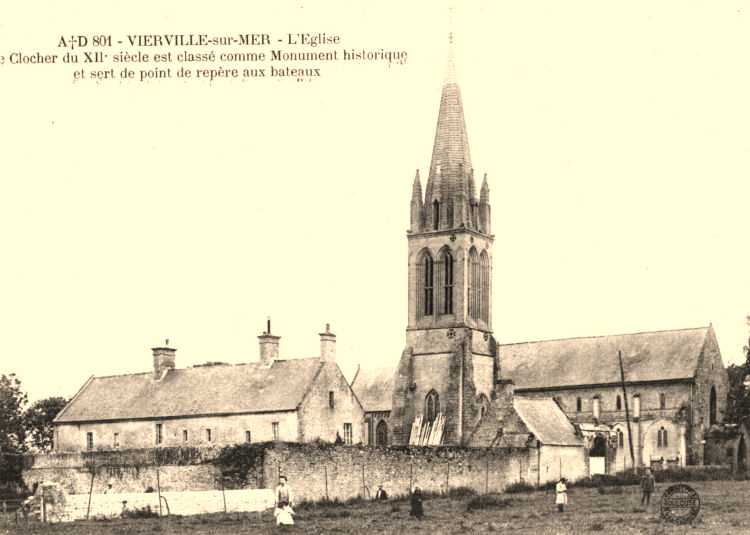
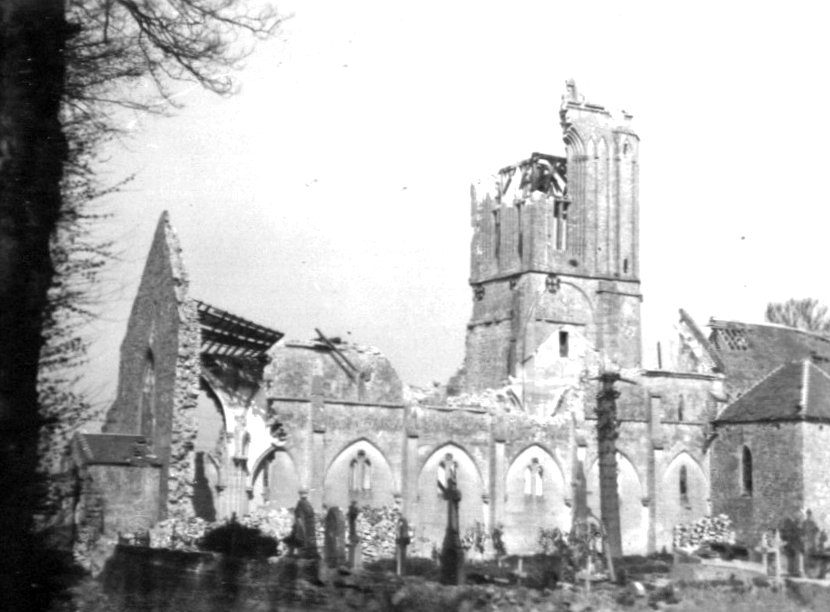
(details)To the left the presbytery, which was destroyed with the church.

(details) The church destroyed. The stairs leading up to the bells were still usable.
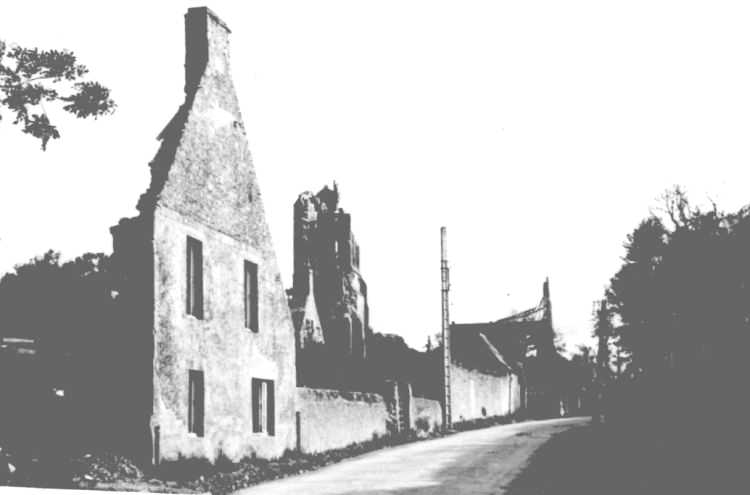
(details) The small house belonging to the Collières, 100m north of the church, destroyed at the same time, too
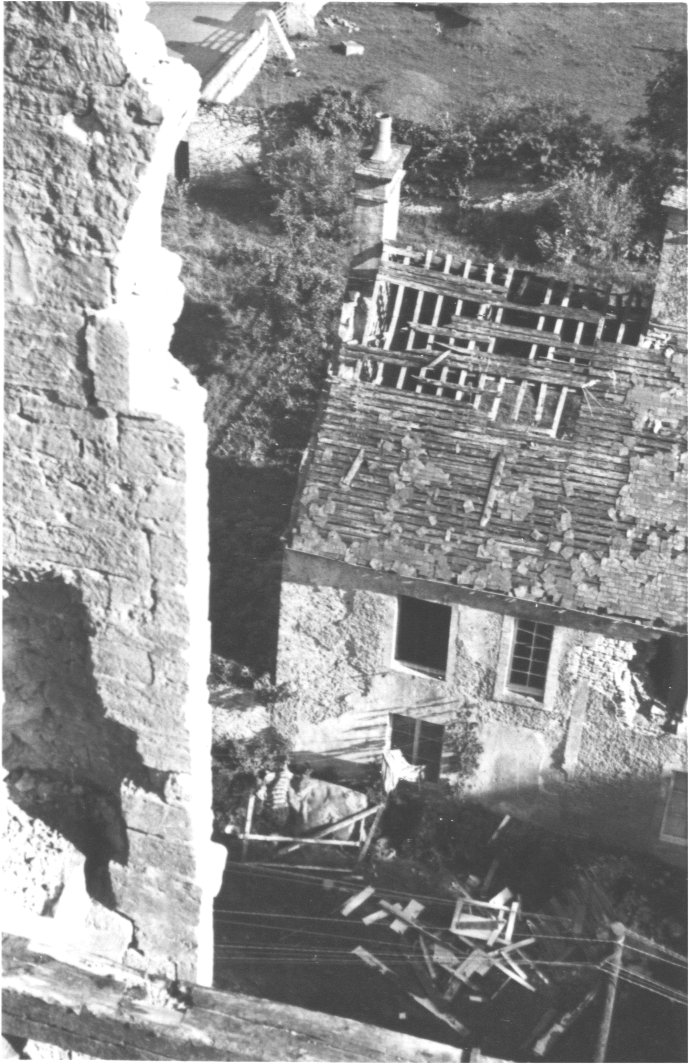
the presbytery with its flat roof, seen from the church bell tower
411
The destruction of the bell tower of Vierville, 6 June at 2:15 p.m.
At the beginning of the afternoon in Vierville, Colonel Canham's isolation was complete. His only radio in condition was that of the liaison officer of the 743rd tank battalion, which he could not even reach on the beach. Canham was well aided by the navy - but not so useful -
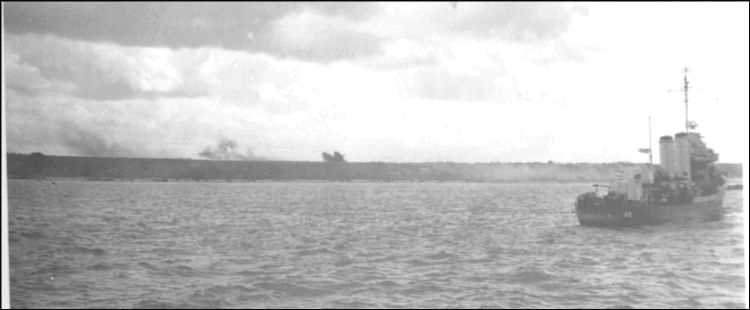
At 1:50 p.m., an LCI 538 helmsman, then off Omaha Beach, sent an optical message to the destroyer "Harding": "According to information from shore observation teams, believe that the bell tower is an artillery observatory. Can you destroy it?"
Answer of the "Harding": "What church is it?"
"Vierville" replied the LCI
"Don't you want to talk about Colleville?"
"Colonel Houston (??) says no"
The Harding insisted: "Where did you get this information from?"
Answer: "From Colonel Houston"
The "Harding" reported on the request to the Advanced Observer Command of Force O. He replied 5 minutes later, granting permission to shoot the church for 1 minute, indicating that the church had already been shot and that no more than 1 minute of ammunition had to be dedicated to it.
The operational report of the "Harding" notes, "At 14:13, opened fire at 3200 yards (2900m) and demolished the church completely, used 40 shots (of 127mm), all at the goal."
Although a Major Reed (unknown among the US troops of Vierville) of the Rangers would later have told the "Harding" that 4 German machine guns were in the bell tower, it seems that the information was completely false. It was obviously impossible to install 4 machine guns in the bell tower and at this time, the Americans controlled the centre of Vierville, and certainly did not demand its destruction.
(Souvenirs by Jeanne Colibeuf, reported by Michel Hardelay)
"Johnne heard the ringing of the bells when they fell with the arrow of the bell tower and said to her husband, "You will not have to ring the Angelus and probably those to come for a long time."
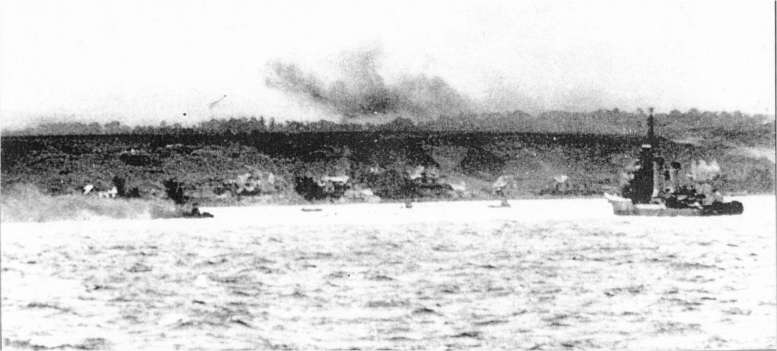


Timonier 3d Class Albert J Berard, LCT 538.
"The coastal batteries fired at us with great precision until our skipper joined me and ordered me to use the lamp to warn the USS Harding destroyer to ask him to destroy the church bell tower of the village of Vierville (13h50). We suspected that the Germans were using this bell tower as an observation post. After receiving the approval of the high authorities, the Harding came so close that we thought he was going to hit the ground. We could see the guns turning in the direction and the bombardment of the bell tower began (14:15). After everyone could see the result. The guns bombed without any precision."
The incident is characteristic of D-Day (and even subsequent fighting in France) in several aspects. Every time the Americans received shells, they were convinced that the Germans were using nearby bell towers as observatories, and they were trying to shoot them down. Sometimes they were right, but often they were wrong. In any case, many bell towers in Normandy were thus destroyed.
In the case of Vierville, the village was owned by the Americans (but neither the "LCI 538", nor the Advanced Observer Command, nor the "USS Harding" knew) and none of the Americans who were there thought that the bell tower was home to an observatory.
The answer to the question whether all the shots have been at the end can be easily discussed. It is certain that the church received numerous shells (it was almost entirely destroyed), that the nearby presbytery received several shells in its roof, and that the house of the Collières, 100m forward was also destroyed.
The shells that killed civilians in the village (at the bakery) were fired at 0600 hours with artillery preparation before the landing.
The G.I.A. also suffered some casualties in the village due to the firing of the ships, including a salve of naval cannons killed a Ranger and injured 2 men from Command Group 116, which was just south of the church. It is likely that this happened at the time of the bombing of the church.
Contradictions of testimony, even direct and eyewitnesses, are common in the case of the June 6 fighting in Vierville. These testimonies are distorted by the circumstances: - groups unaware of what is happening next - absence of radio - isolated groups - stress of combat, etc.