42
Infantry and Rangers in Vierville in the afternoon of June 6
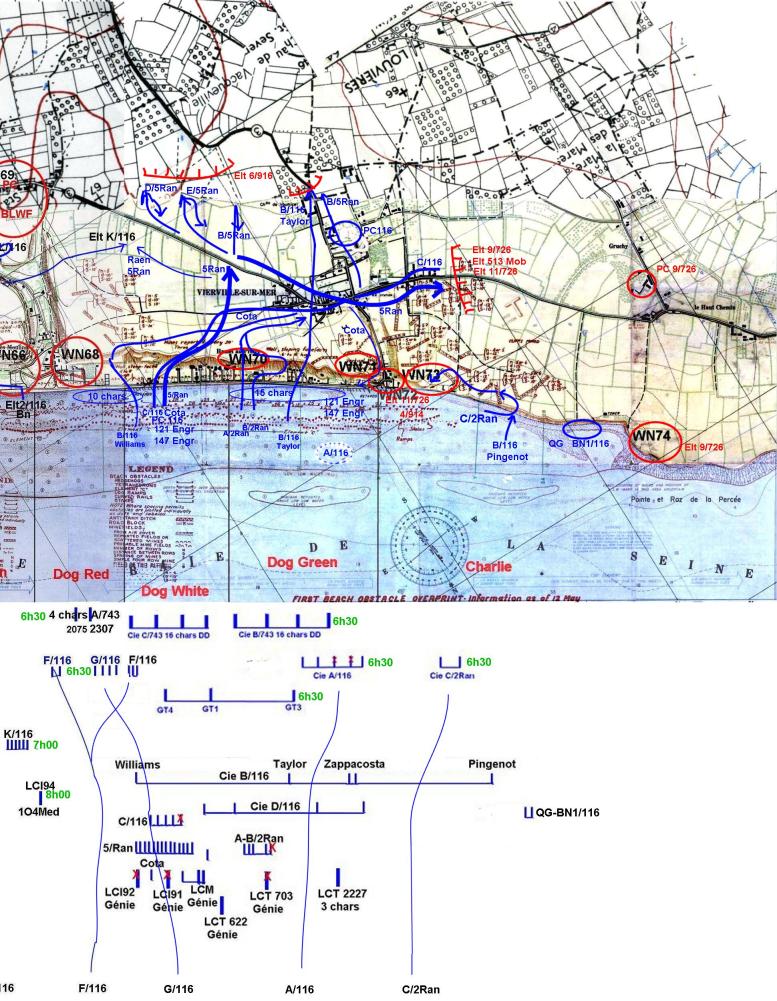
(details) diagram of the various penetrations of the cliffs towards Vierville
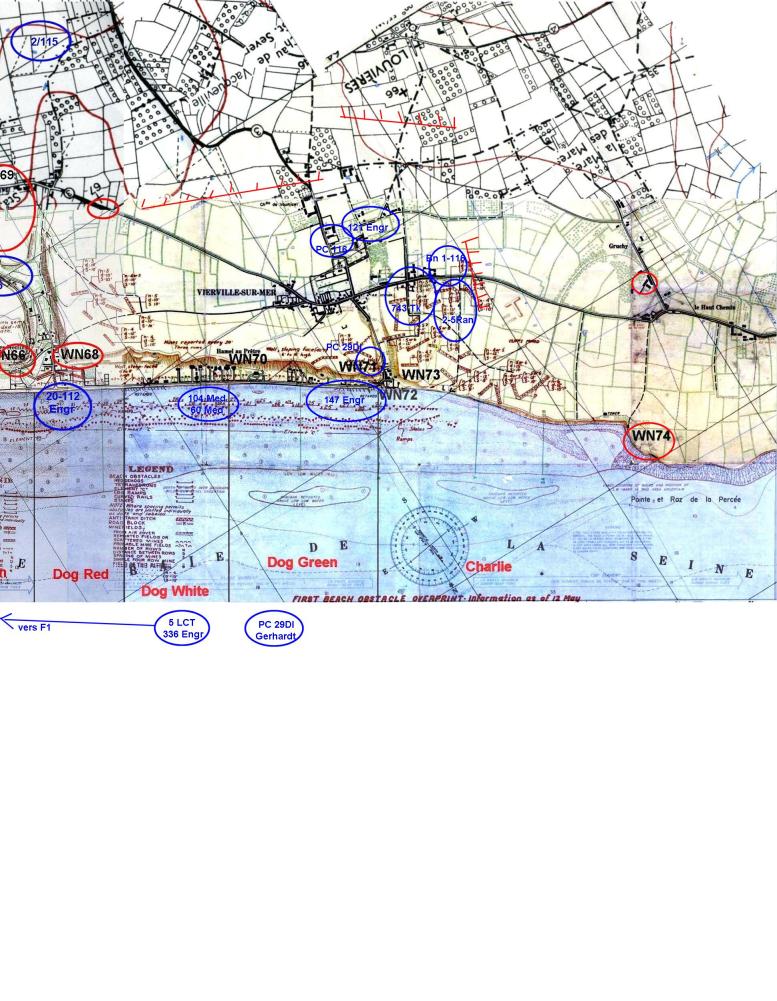
(details) Afternoon and evening


Testimony of Private Rocco Russo, Cie 7/116: "General Cota set us up with Private Simmons and me in the cemetery next to the church, where we dug a hole for two. With our bazooka, we were stationed to protect our unit from a possible attack by German tanks. We didn't think to spot the surroundings until night. When it fell, the shadows around us started to move, we were worried, fearing that some Germans would crawl towards us, we tried to sleep, but our exhaustion was not enough to overcome our freckles. In the morning, we realized that the shadows were those of two trees in the cemetery. So we learned a good lesson that night. When you bury yourself before night, see the shape of the neighborhood."
These were essentially the 8 Cies of Rangers A to F/5Ran and A and B/2Ran, Cie C/116, and scattered elements of Cies B, D, F, G, H, K/116, which were completed at the end of the day by the survivors of Cies A/116 and C/2Rgr returning from the beach and the Gambier house.
Apart from the 5th Rangers and Cie C/116, all units suffered heavy losses (40 to 80% of their staff).
The connections were difficult, if not non-existent, due to lack of radios.
There were no tanks (the tanks remaining from the 743rd Bat. were blocked on the beach until around 21:00), nor support artillery (no radio link with the ships, nor with the little artillery landed at the Ruquet).
The command, at the 116th C.P., isolated in the Isles neighborhood, could not really control them, except by running on foot.
The orders were for the Rangers and the 1st Battalion to push west, Pointe du Hoc. The Germans of the 9/726th Company (those of Gruchy, of the Percaea) had installed an effective defense screen west of Vierville in the morning. Neither the 2nd Rangers and the C/116 attacking from 12:00, nor the 5th Rangers arriving at 5:00 p.m. could cross it due to heavy weapons.
.
See in this regard the Memories of the Mayor of Englesqueville, left by bicycle from Englesqueville and crossed the German and American lines to meet again in the afternoon in Vierville before returning to Englesqueville via Louvières.
No infantry reinforcements were available, especially as the reinforcement regiment, the 115th Reg. had landed at the Ruquet at about 11:00 a.m. and was employed around St-Laurent still held by the Germans.
Colonel Canham then decided not to continue his efforts on the coastal road to Pointe du Hoc, as the 5th Ranger was his main force in defending Vierville against a counter-attack from the south.
In the evening, after the opening of the road coming from the sea, 23 tanks surviving from the 743rd Battalion passed through the crossroads and came to place themselves in positions in Vierville and in particular behind the CieC/116 near the Normanville farm. The firing of these tanks repeatedly replicated the bullet hails coming from the German positions in front of Cie C/116.
One of the big problems for the Americans had been to keep the pace of their movements. The natural and inevitable propensity of the men (exhausted, having lived hell on the beach and found themselves in relative calm on the plateau) was to think that they had earned a little rest, and that they had finished their job of the day.
Finally, men arriving in a inhabited area often had cider at their immediate disposal, or sometimes even calvados.
The lack of radio, the lack of cohesion of units, the nature of the terrain and isolation contributed to the loss of pace. Everyone thought their group was the only one in the area, and that was sometimes the case.
These weaknesses and an easy-to-defense terrain have benefited the Germans. Still, the growing groups on the plateau fell on nests of resistance in prepared positions, usually established around nests of machine guns buried along hedges and with good ranges of fire. The location of these positions was difficult because of the confusion created by the snipers and it took a long time to wipe out these resistances with the weak weapons available. By-pass manoeuvres often led to the scattering of assault groups and the gradual loss of links.
These difficulties in fighting in a country crippled by hedges were not easy to solve under any circumstances, much less for those whose first experience it was. Although the Germans were never concentrated in large groups, they were able to stop the American advance very quickly. Assault units fought in a disorderly manner and especially separately.
Testimony of infantrymen of 1/116:
"From noon until the end of D-Day," says Private Harry Parley of the 116th Reg., "I am unable to remember chronologically what happened to me. The rest of the day is full of memories, races, battles, hiding places.
We were like a band of outlaws, usually not knowing where we were, often meeting other groups like ours, joining us or separating ourselves according to the circumstances, and always asking for news of our company or battalion."
Parley also tells of an incident this early afternoon. He was moving on a road when he heard the characteristic noise of the caterpillars, then the start of a German cannon. "Terrified, I turned around, ran like a madman and plunged into the ditch of the road. There was already an old hard-to-cook sergeant lying on the side like a couch. I yelled at him, "It's a tank - what are we gonna do now?"
The sergeant, a veteran from North Africa and Sicily, calmly looked at Parley for a few seconds, like poker, and said to him, "Smooth, old man, maybe he's going to leave." Of course, he's gone.
And in fact, half a dozen "Marder" track assault guns from the 352nd Panzer Abteilung (Armoured Squadron of the 352nd Division) made an attempt around noon south of Vierville. Remarked by the aircraft, attacked by the "Texas", and insufficiently accompanied by infantry, they turned back, probably also recalled to support the German defense of Bayeux, very threatened by the British breakthrough.
In the afternoon, Lieutenant Jay Mehaffey of 5/Ran was on the western boundary of Vierville. He had lost a man passing by the opening of a hedge, because of a sniper. At that time, another Ranger arrived on the road with 8 prisoners. Mehaffey made them align in the open hedge, with his hands on their helmet, and he was able to cross the passage through his men behind the prisoners.
"We didn't have time to take care of the prisoners," he said. So, when he was safely installed, he signaled to the disarmed German prisoners to continue to the bottom of the cliff where they would find someone to surrender.
Captain Raen of the 5th Ranger Command Coy Good:
"After organizing our defense and placing sentries, I ordered the men to bury themselves. It was at this point that I realized my biggest mistake of the day. I left my trench shovel on board the HMS "Prince Baudouin". Two men offered to dig me a hole, but no, I didn't want to hear about it. I tried with my helmet, but a compact clay, centuries old, wouldn't let it begin. The night fell, something had to be done. I noticed a millstone in the middle of the farm yard. A haystack, it must be hot, the weather seemed to be pretty cool, the hay would dampen the projectiles, so why not? I got a little hay off, I went to bed, I got some hay over it. It was hot. But I was a cityman, not a countryman who knew the difference between a pile of hay and a pile of manure. I learned it in a second. All kinds of French stinging insects were on me, hundreds. I jumped like a spring."