All photos below are probably from June 7th

(details) LCVP spades

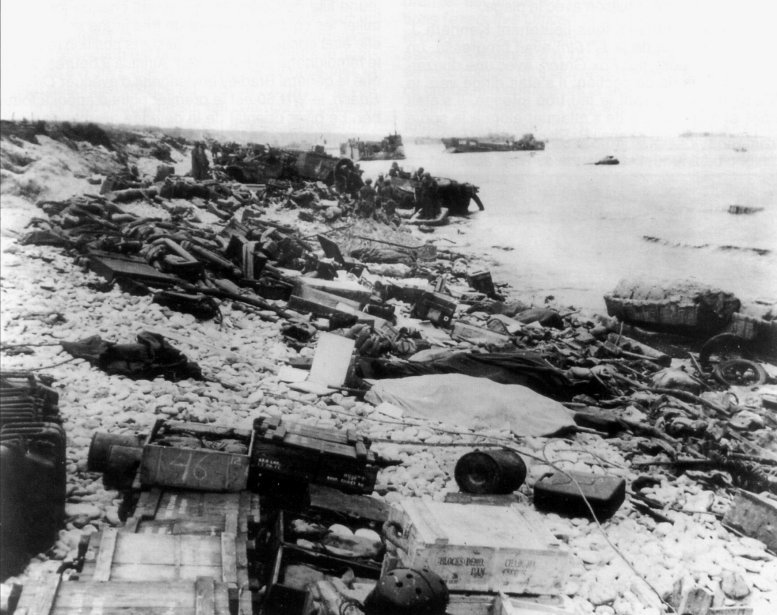
(details) At the bottom of LCT wrecks


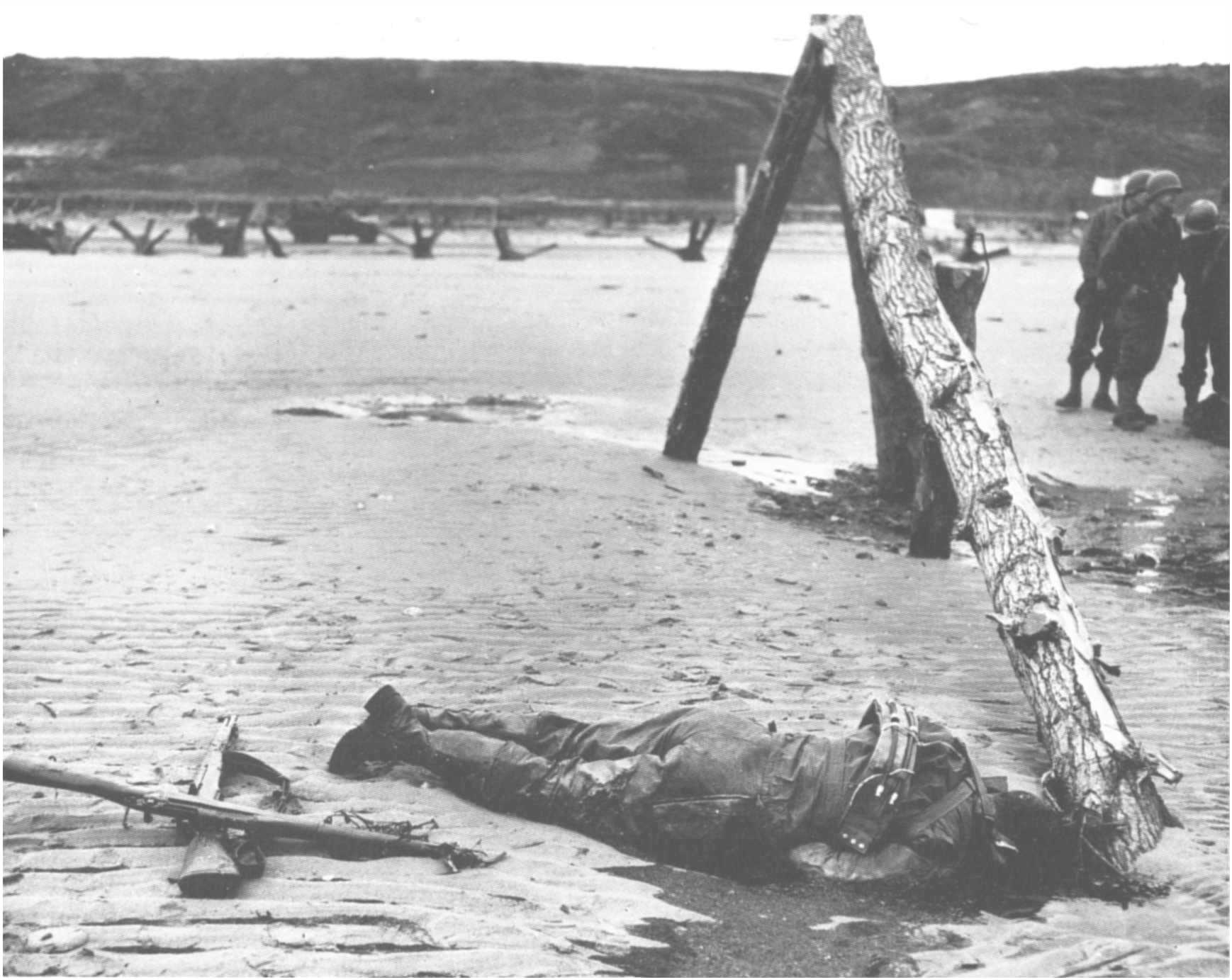
(details) A dead GI in front of a "rape" obstacle. Down the hedgehogs and a half track.

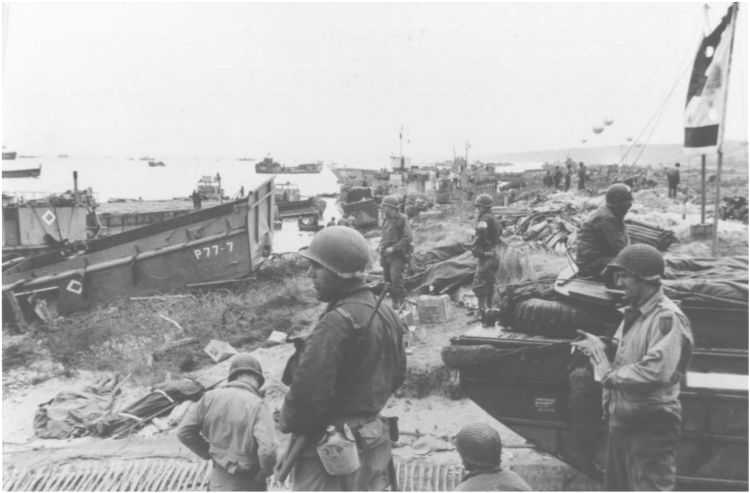
(details) A GMC truck in front of the wreck of a LCVP.


(details)Two wrecks of LCT in front of Les Moulins, at the bottom left we see the wreck of LCI 92.

(details) In the midst of a mess of landing craft and vehicles destroyed, among debris of all kinds, dead people wrapped in blankets are loaded on a funeral "canard" to be directed to the first cemetery, on Dog White Beach


(details) On June 7, one of the B/116 ACLs was wrecked, and the day before it was severely tested. To the right, a drowned Sherman tank. On the left, two typical "C" obstacles emerge. Off wet transport as close as possible to the beach.

43
engineers on the beach and in Vierville in the afternoon of June 6
On the beach, the 147th Battalion of the Beach Engineers was able to make serious progress in its essential task of cleaning and organizing the beach for future landings and movements inward. Its units opened passages in the gale slope, cleaned minefields and participated in the clearing of the exit from Vierville. Increasingly, battalion units and equipment continued to arrive on land, but often to the east, delaying operations.
As the tide fell in the afternoon, the survivors of the SETF demolition teams (146th Engineer Battalion) began working on the obstacles discovered again, despite the harassment of shooters posted on the cliff. They have finished opening breaches, and have opened new ones. In the evening, most of the planned breaches were fully open and staked, and an estimate gave 35% of the clean beach obstacles.
On the evening of D-Day, the survivors of the 146th and 147th Engineer's Battalion settled at the foot of the cliff for the night.
The 121st Engineer Battalion opened the road from the ascent to Vierville to the vehicles, after the destruction of the wall. The road was declared open at 6:00 p.m.
In fact it was hardly used immediately, as it was still under the sporadic fire of the 352nd German Division's field artillery, which now lacked a lot of ammunition, and had to limit its fire to blind harassment on the descent of Vierville.
In addition, there were no major units to climb through Vierville except the tanks of the 743rd Battalion (they came up at the end of the evening) and the 121st Engineers that accompanied the 1/116. There were only a few Americans on the beach, other than medical stations and Beach Engineers working to clean up the land, obstacles and mines.
At nightfall only, traffic began to climb towards the village. The survivors of the 121st engineers Cies B and C and the battalion headquarters moved to Vierville and beyond at the Ormel, for their first cantonment. The 121st Battalion had lost 10 officers (including all company commanders) and 51 men, killed, wounded and disappeared.
Testimony of Colonel Ploger, Cdr 121 Engr Good: "After blowing up the anti-tank wall (in the afternoon), Sergeant Hickman and I went on the road to beyond the Ormel. There were abandoned trenches on the south side of the building, some of our sappers had already settled there. I then went back into the downhill and reported to General Gerhardt at the division's PC, in the career. Later, as it was beginning to get dark, I was in a clear field near the Ormel, where I met a senior officer of the Vth Corps Engineering. He got two bottles of Calvados, which he recommended me try. It was terrible. We talked for half an hour. It was dark now and I didn't want to sleep."
No significant reinforcements had been landed on Dog Beach since 9:00 a.m. The reinforcements initially intended for these beaches had all disembarked from mid-morning at the Ruquet, notably the 115th Reg. and the remains of the 58th Armoured Artillery Battalion (which was originally destined for Dog White and had lost half of its cannons while attempting to approach it). The 111th Field Artillery Battalion, destined for Saint-Laurent, had lost 11 of its 12 guns, sunk by the bad sea and lack of fuel in the DUKW.
Finally, the 336th Engineer Battalion planned to work on Fox Beach (the exit beyond Colleville, directed towards Ste-Honorine) was mistakenly landed in Vierville, 4,000 meters too west. At about 3 p.m., this unit began a difficult walk through the beach, eastward, under the harassment of German artillery, to reach its objective. The 336th reached the F1 exit at 5 p.m., losing six men. A trailer loaded with explosives and pulled by a tractor was able to make its journey intact. See William Marshall's memoirs on this subject.
Marion Wheeler, soldier, 121th Engineer Combat Battalion, Command Company:
"On D-Day night, we were scattered all over nature. I did not know what others thought, but I calculated that the situation was such, that it was everyone for himself until we received orders to do otherwise. Not only was I afraid but I was very tired and so I crawled over a hedge where I leaned against the sloped slope in a small field. With my rifle by my side and my head resting on my backpack, I fell asleep like a mass."
(see also Part 1, Part 3, and Part 4 Dube memories)
"After blowing up the wall, which was not my original mission, we found Lt. Pope had the 7th and 8th squads with him.
We crossed the wall and climbed up the valley to these 2 fields to the right of the crossroads. We did a quick examination and concluded that it was not mined, because there were about 4 cows and 3 horses in the one where our truck entered and parked next to a hedge. The driver, instead of putting a camouflage net on it, is mounted on his roof to sleep there.
That night, we placed guards (2 per corner) at the 4 corners (A,B,C,D) of the field. The 7th, 8th, and 9th squads and Lieutenant Pope with his staff were under cover along a hedge. There was a space of 50 cm to 1 m where we could crawl and shelter. I noticed and spoke with American Rangers who were going to settle across the hedge.
