


The Command Group of the 116th Regiment
in Vierville in the afternoon of 6 June
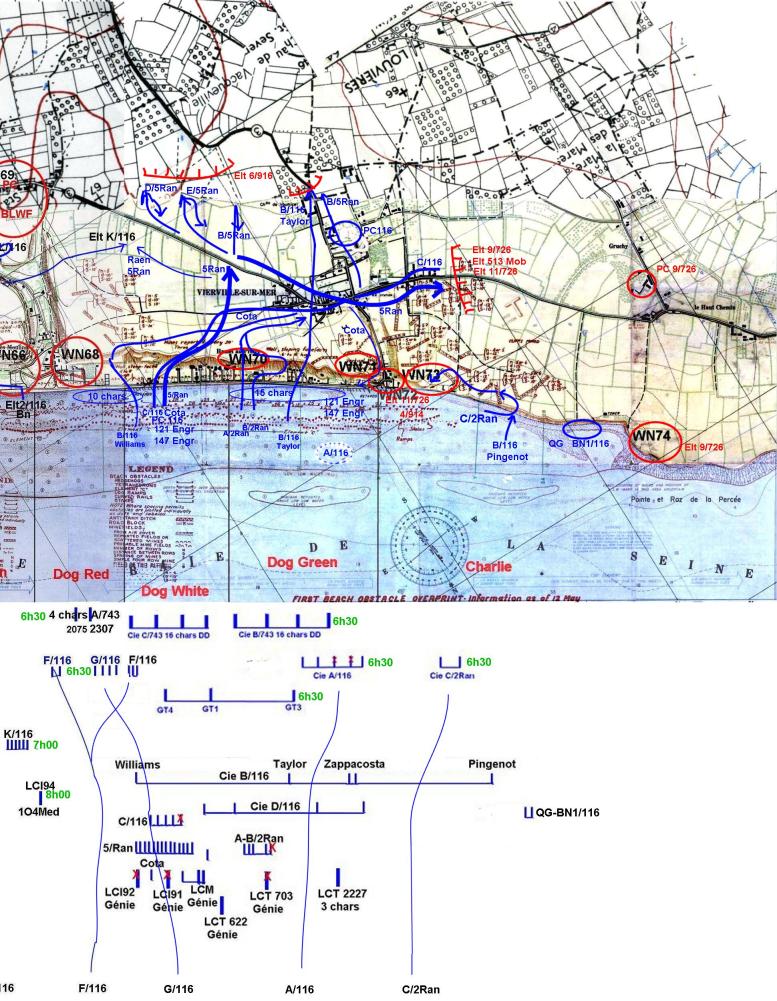
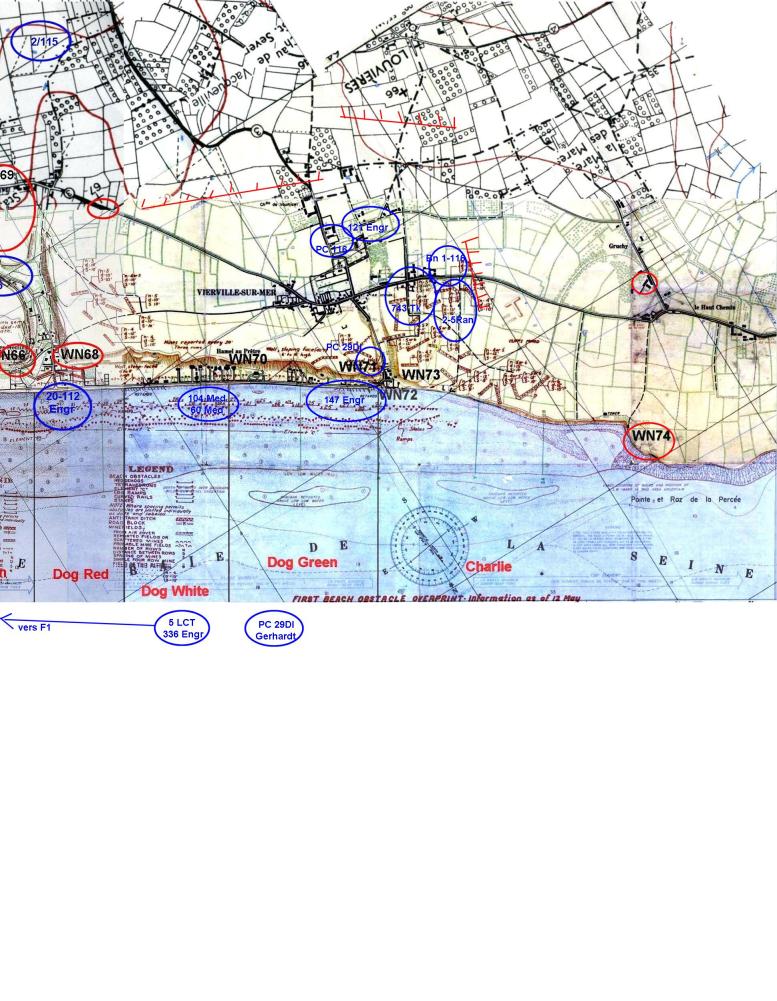
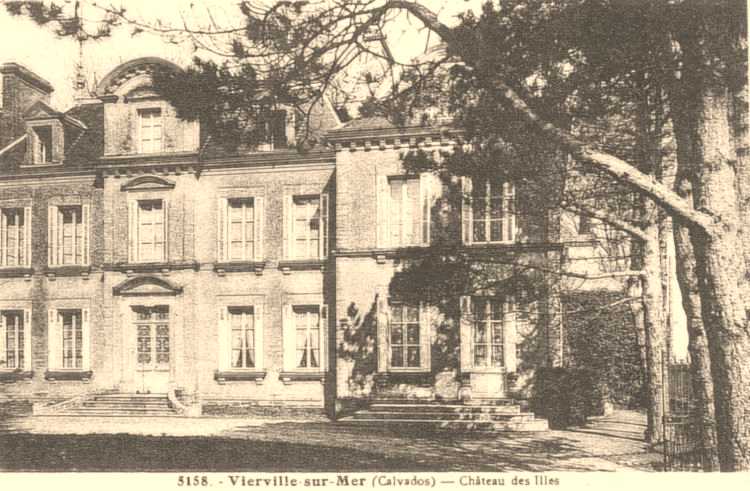
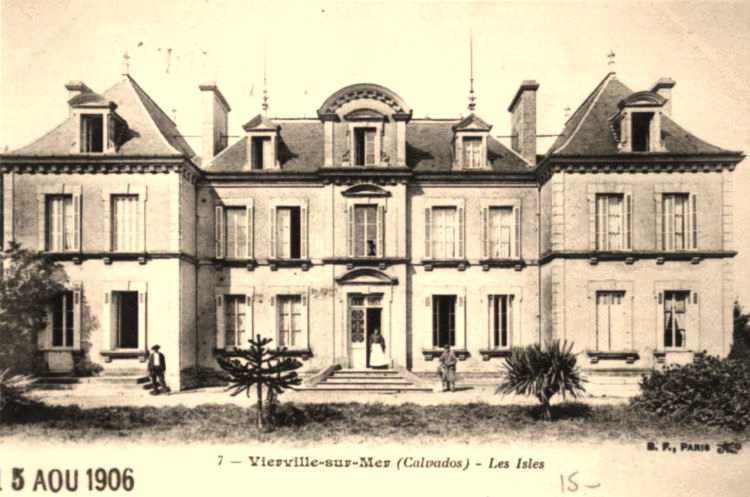
In Vierville, Colonel Canham's command group, after launching C/116 on the Grancamp road, had continued south, early in the afternoon, in deployed formation, encountering isolated snipers or machine guns, finally arriving at the planned site for the PC, (a house in the "Isles" quarter), south of Vierville.
The small staff group (3 or 4 officers and 2 soldiers) found themselves very quickly isolated behind a hedge.
The radio was still unable to contact the units.
Sergeant Moore of the Intelligence Section, was killed in an outpost.
A section of Company B/5Rgr passing by, en route to the West, was required by Colonel Canham to ensure the safety of the Command Group.
A Rangers patrol was then sent to Louvières to find the 2nd Battalion, which was the assembly point. (in fact 2/116 had landed, dispersed, beyond Saint-Laurent and was still on the plateau between Saint-Laurent and the Ruquet). Rangers' patrol came back and reported that there were no U.S. units south of Louvières and that the campaign was infested with Germans, 8 of whom were killed.
Vierville's bell tower was destroyed early afternoon by the Navy without Colonel Canham even being informed. It may be under this circumstance that a salve of naval guns killed a Ranger and wounded two Command Group men.
Finally, in a new effort to find the 2nd Battalion, Captain Rice and the Warrant Officer Holland were sent on patrol, still southward. Captain Rice came back and reported that there were no friendly units between the PC and 1km south of Louvières, and that in a skirmish Mr. Holland had been captured.
There were still some clashes near the P.C. in the afternoon and 15 Germans were killed in the immediate vicinity.
At 1830, the commander of the 1st Battalion presented himself to the PC, from Charlie Beach (between the Pointe de la Percée and Vierville), and Colonel Canham learned for the first time what had happened on the beach in front of Vierville and his valley.
Dispersed units of the 2nd and 3rd Battalions began to report on arriving at the PC (Lt. Hendricks, Nathan and Kukis). In particular, a K/116 Company group arrived at the end of the evening and was used for PC security.
Lt. Bradburry arrived with overnumbers in reinforcement of the 1st Battalion. These 24 infantrymen, landed in the afternoon, reconstituted, under Bradburry's command, Cie A/116, with the valid survivors of the morning on the beach in front of Vierville, Bradbury also took under his command the survivors of Cie B/116.
Finally at the end of the day, via the 743rd Tank Bat radio, Canham was able to contact his "communications group" (Lt. Sink) , which was near Saint-Laurent. Canham learned that the 2nd and 3rd Battalions, which were hard tested crossing the beach east of St-Laurent, were in defensive positions near the Moulins and the eastern districts of St-Laurent.
The only officer in this "communication group" who was able to join Canham's PC was Captain Mac Grath, who arrived very late in the evening. See his detailed account.
Captain Mac Grath says, "Some vehicles had settled for the night in the "Transit Area 1", to the right of the regiment's PC. Their safety was my immediate concern, because I knew that there were very few infantry on screen in front of them."
Private Carl Weast of the Rangers tells of a skirmish in the Isles and Ormel neighbourhood on the afternoon of June 6:
"A house was still occupied by Germans. A German cyclist arrived by road. The Rangers shot him down, and took a stand in front of the house. Weast was watching when a group of Germans came out of the buildings and formed a column around a two-wheeled cart carrying wounded people. The Germans were unaware of the Americans' presence, carrying their rifles in shoulder straps.
"They were pulling the cart, 2 pulling and 2 ensuring balance. We waited until they were really close, maybe 10m away, and we came up on the road, the weapons pointed, they went immediately."
"Now, in this kind of situation, what do we do with 25 prisoners? We put them in an orchard with a guard and tried to interrogate them.
Damn it! They were not Germans, they were all, Hungarians, Romanians, Russians, except Germans (at least they claimed it). There was a German, non-commissioned officer, middle-aged, looking like he wanted to do anything but war. He was only very happy to be a prisoner, though concerned about a German counter-attack, but still less than us."
"The situation became very delicate. Colonel Canham was to cover 1500m in front with 35 men, and expecting an armored attack. It's bad morale."
As the afternoon progressed, there was a discussion among the Rangers as to whether to kill the prisoners, but Weast pointed out that it was "not only immoral but stupid."
When evening fell, "we made them sleep very close to each other, with a BAR gun-mutter at one end, making them understand that in the night we would not see them but that we would hear them, and that if we could hear anything they would all receive a BAR gust. They slept there all night, and believe me, they were funnyly calm enemies."
In his situation, on the evening of 6 June, Colonel Canham found that instead of having 4000 men (including the Rangers) to continue his mission to Grandcamp and Isigny, he had only 1,000 fighters: 500 Rangers, 250 shotguns rescued from I/116, some 50 shotguns isolated from II and III/116, 150 sappers from 121st Engr Bn. No artillery, no radio liaison with the Navy for fire support. He did not know where battalions II and III/116 were.
As a result, he had to give up his attack, notably towards the point of the Hoc where 200 Rangers were isolated, and formed a defence line to the west and south of Vierville. From 21:00 around thirty tanks surviving the 743th Tk Bn were mounted by road coming from the beach.
Via the tank radio, Canham was able to have an affair with the Communication Group of his state-Major (Captain Sink), which was east of Saint-Laurent with battalions II/116 (or rather what remained with Lt-Colonel Bingham) and III/116 (which was in better shape, with Lt-Colonel Meeks).
Canham then decided to move his advanced PC to St-Laurent the next morning 6:00 a.m. to regroup all of his Headquarters, and regain complete control over his regiment dispersed by the fighting of June 6.