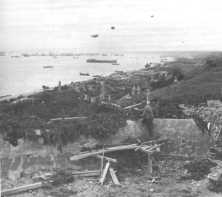
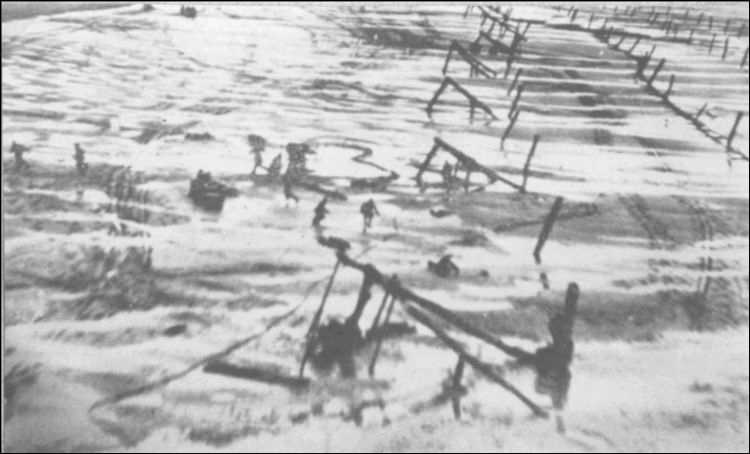
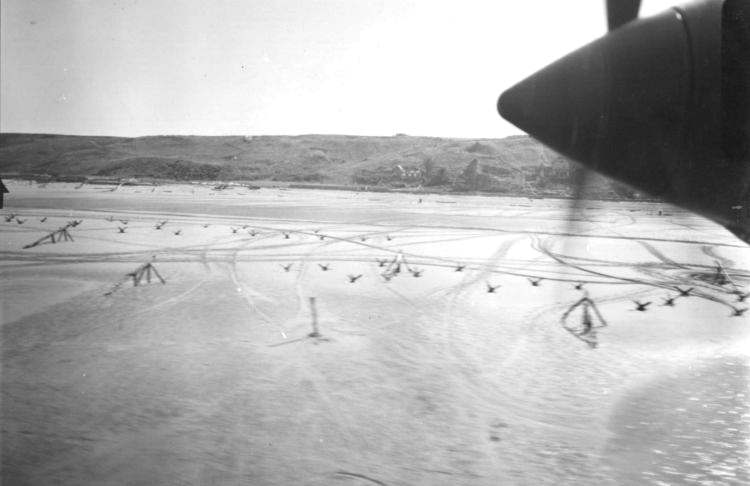
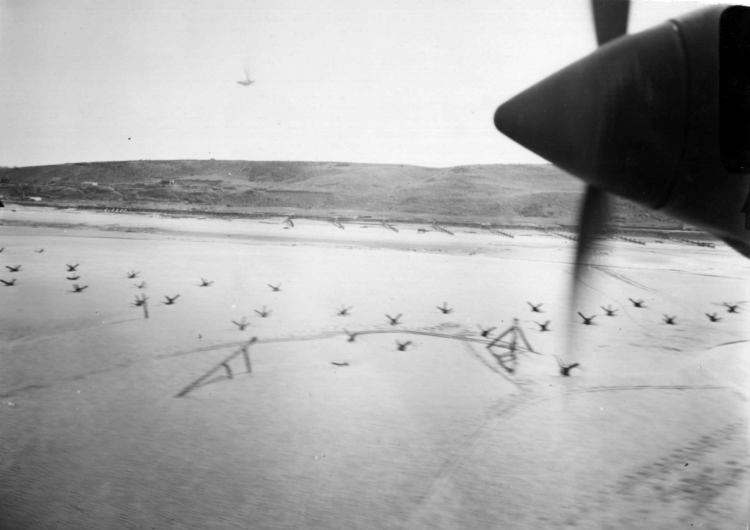
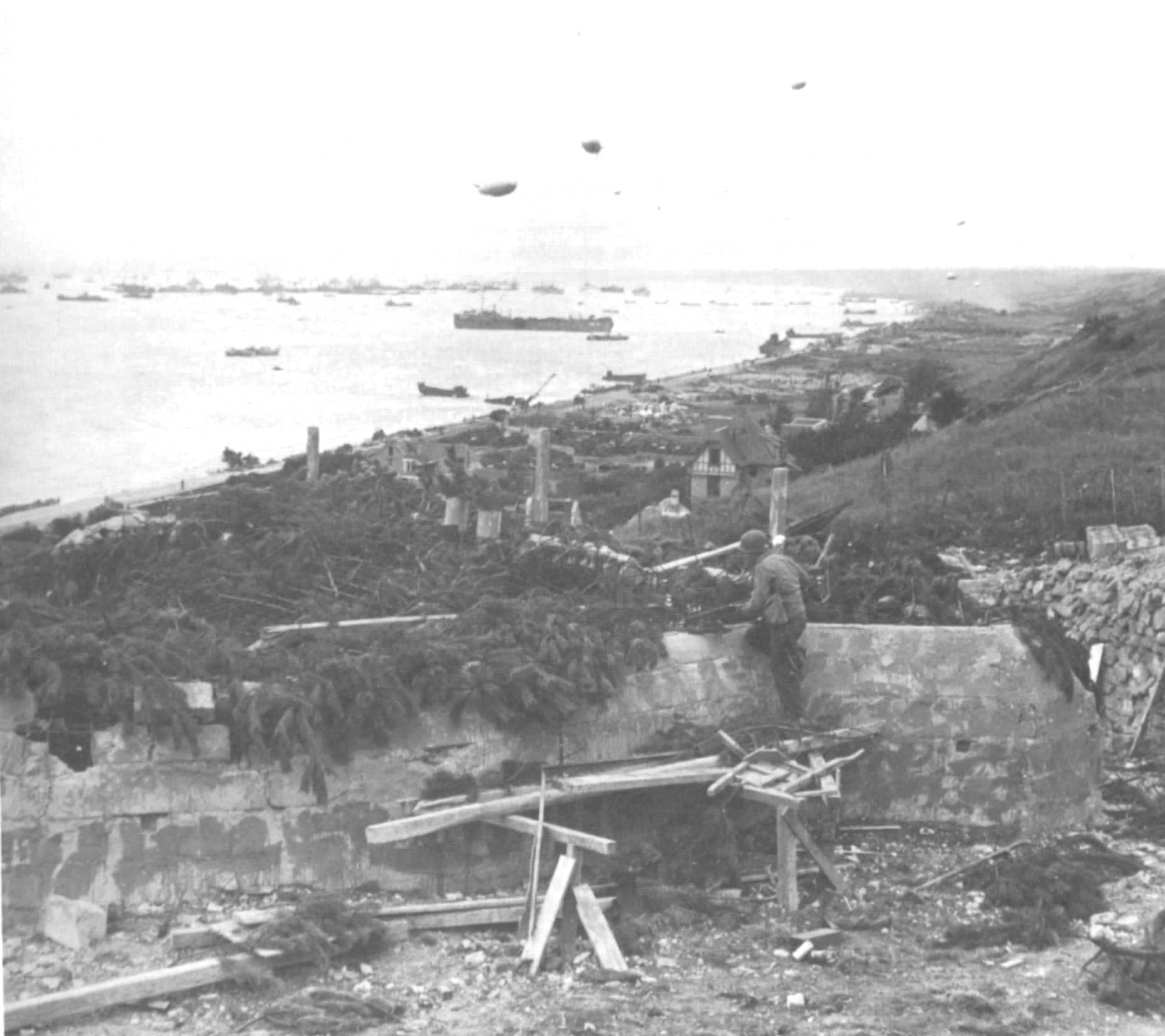
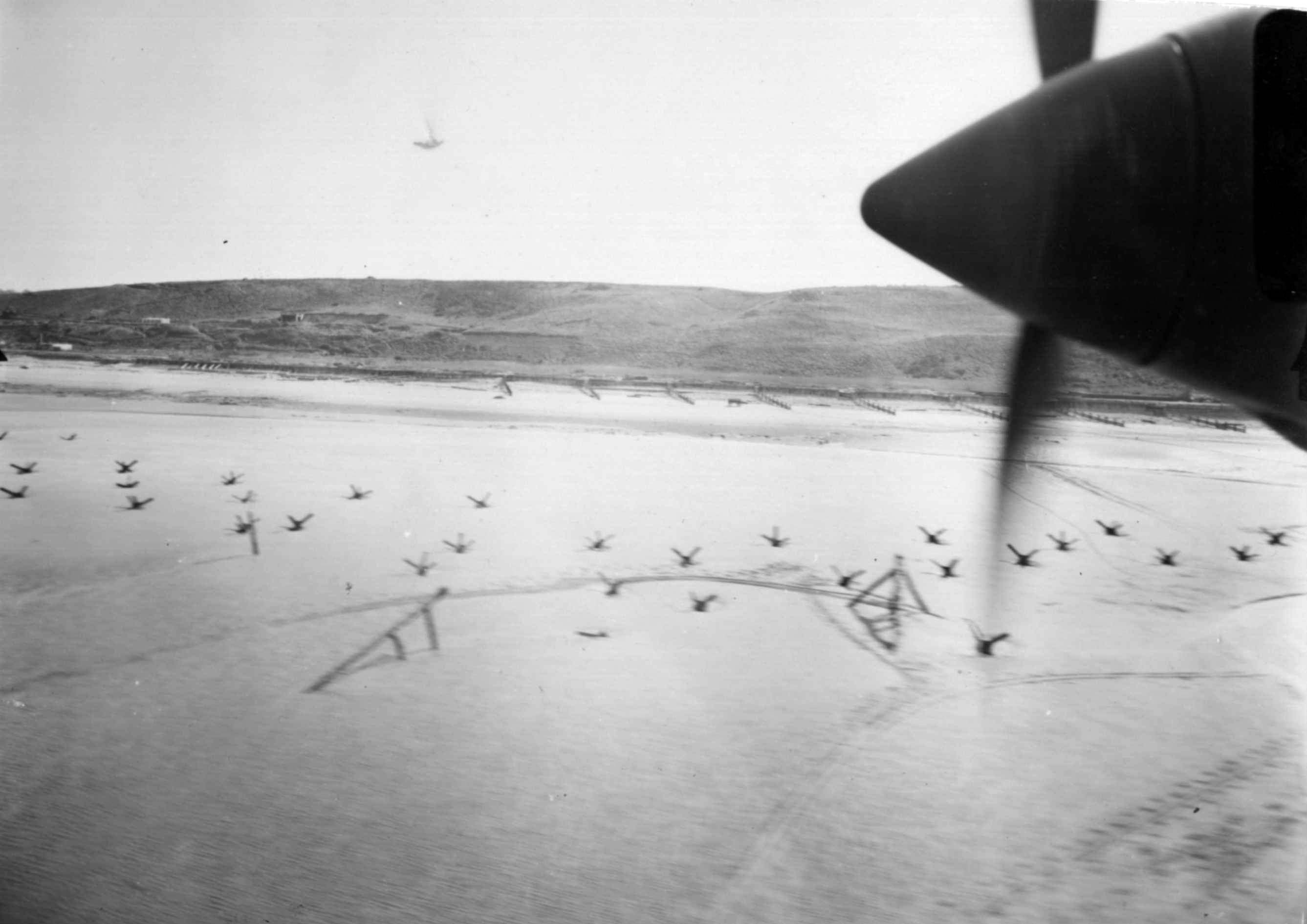
Seen from the WN 70 above the Hardelay villa. We see the ruins of the German Mathy villa at work surprised by a plane (around May 19th) — Yves Cordelle Collection, reference 201.
drawing up on the basis of indications by Michel Hardelay
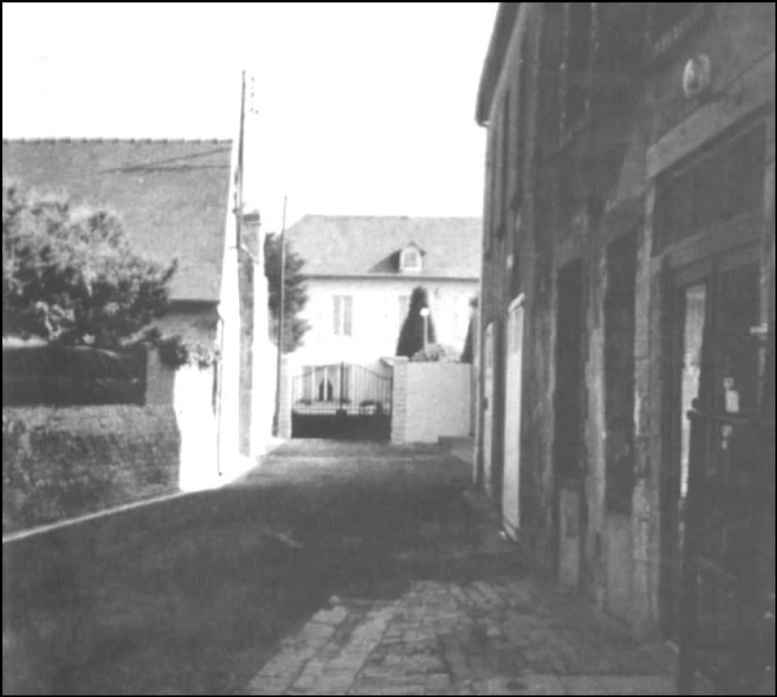
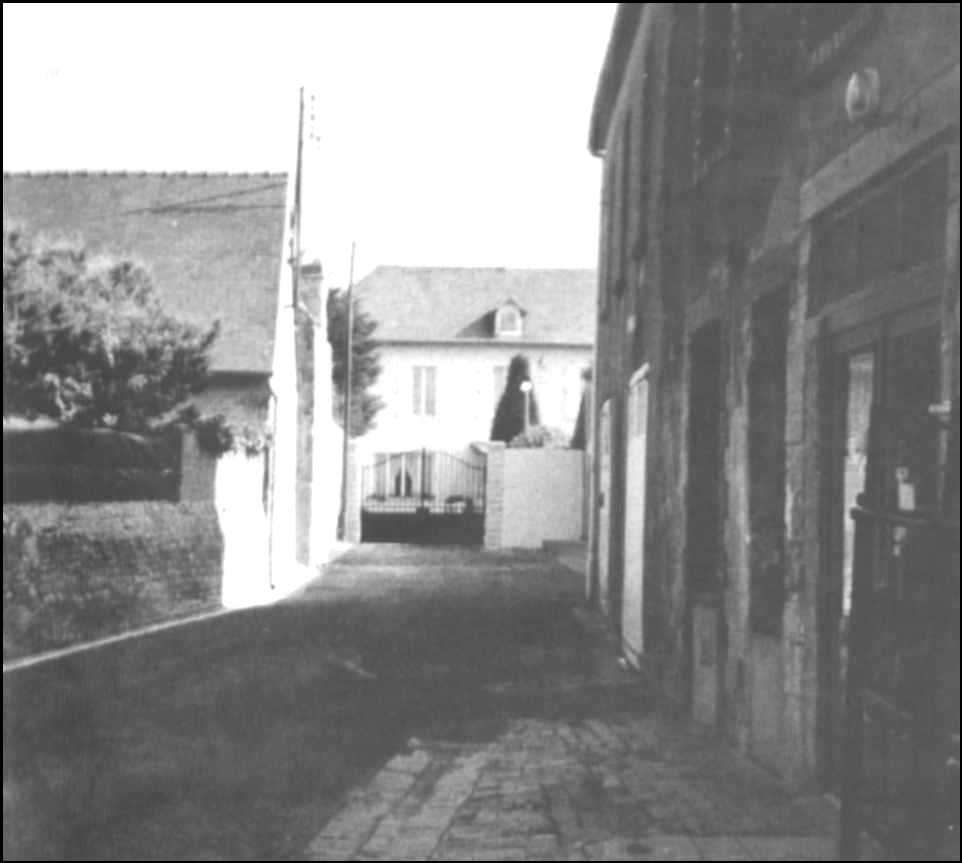
(details) The house where Michel Hardelay lived on June 6, at the bottom of a north-facing impasse
(Sunday, 4 June)
"On Sunday, June 4, 1944, the first communions of the parish of Vierville took place. On this occasion Raymonde (Hue, future Mrs Watel, was 12 years old) had received a rare gift at that time, a beautiful blue bicycle which I will talk about later, and Huguette, who was staying at a household living in our impasse, had obtained permission for her parents to come to the forbidden area for three days for the ceremony. They were due to leave the following Tuesday and stayed almost four months.
At that time the first communions, baptisms and marriages were the occasion to make exceptional meals with white bread and sweets sought after. On Monday we finished the leftovers and on Tuesday we were trying to get back to work.
As for me, not having the opportunity to make up and although having some plans of houses demolished to put on the net for the town hall in view of future compensations, I decided to take advantage of this beautiful day to start the construction of a shelter in our small garden, project already repeatedly handed over.
I was not afraid of a bombing by sea, but rather of a systematic watering of the coasts shortly before the landing to weaken the defences while leaving the Germans little indication of the point of landing.
In addition, I was following the advice of the English radio. There was only one small lawn, I had no choice. I had planned a trench of 1m25. deep with 6 steps cut into the ground at each end, the grass clots removed and stacked on the shoulders to provide a slope of 55cm high on the sides, and maintain excavated debris.
After an hour of work I saw my neighbour (it was Mr Leterrier, the mayor) intrigued questioning me over the wall that separated us from the impasse
- "Mr. Michel, what are you doing here?" "You see, I'm starting a shelter for the three of us, now if you want to help me, I can do it for five by extending the trench by one metre." He ricana and shook his shoulders and said, "Don't land here" and he went home.
(Forty hours later, at the first explosion, he came with his wife to see if they could be welcomed, but he had to go clearly, my mother and I occupied all the space available. They went with a large part of the inhabitants of eastern Vierville to find a refuge in the ditches of the fields bordering the road going to St-Laurent where they spent the night to return the next day with the first U.S. units.)
In the end of the afternoon, I had cleared my six steps and finished 80 cm. Two metres in a row being dug on 45 cm; I must not have the possibility to continue this work, which, however, must have been very useful to us.
After dinner it was the usual work of watering vegetables from the vegetable garden with a small water barrel filled at our pump (at the time there was no running water, each property had its well and arm pump) and weeding of the flats, weed removal and passage to the henhouse to harvest the eggs of the day.
(Monday, 5 June) The night was quiet (Sunday 4 to Monday 5), but Monday was to happen abnormal facts. The mayor received every day from the Kommandantur requisition orders for the next day, chores, transport of all kinds by horses with carters or general instructions for the population. These orders were drawn up by the town secretary and carried by the field guard to each person or posted if it concerned all the inhabitants. But if on Saturday it had been designated the demolition team of the beach houses and the eight men for the guard of the railway on 11, 12 and 13 June, and I was one of them, the field guard had been able to enjoy his Sunday because no planton had brought an order to the town hall, which had not happened for more than two years.
(details) Seen from the WN 70 above the Hardelay villa. We see the ruins of the villa Mathy
(details) Germans at work surprised by air (circa 19 May 44)
(details) On May 19, 44, a US P38 aircraft photographed the beach of Vierville (details)
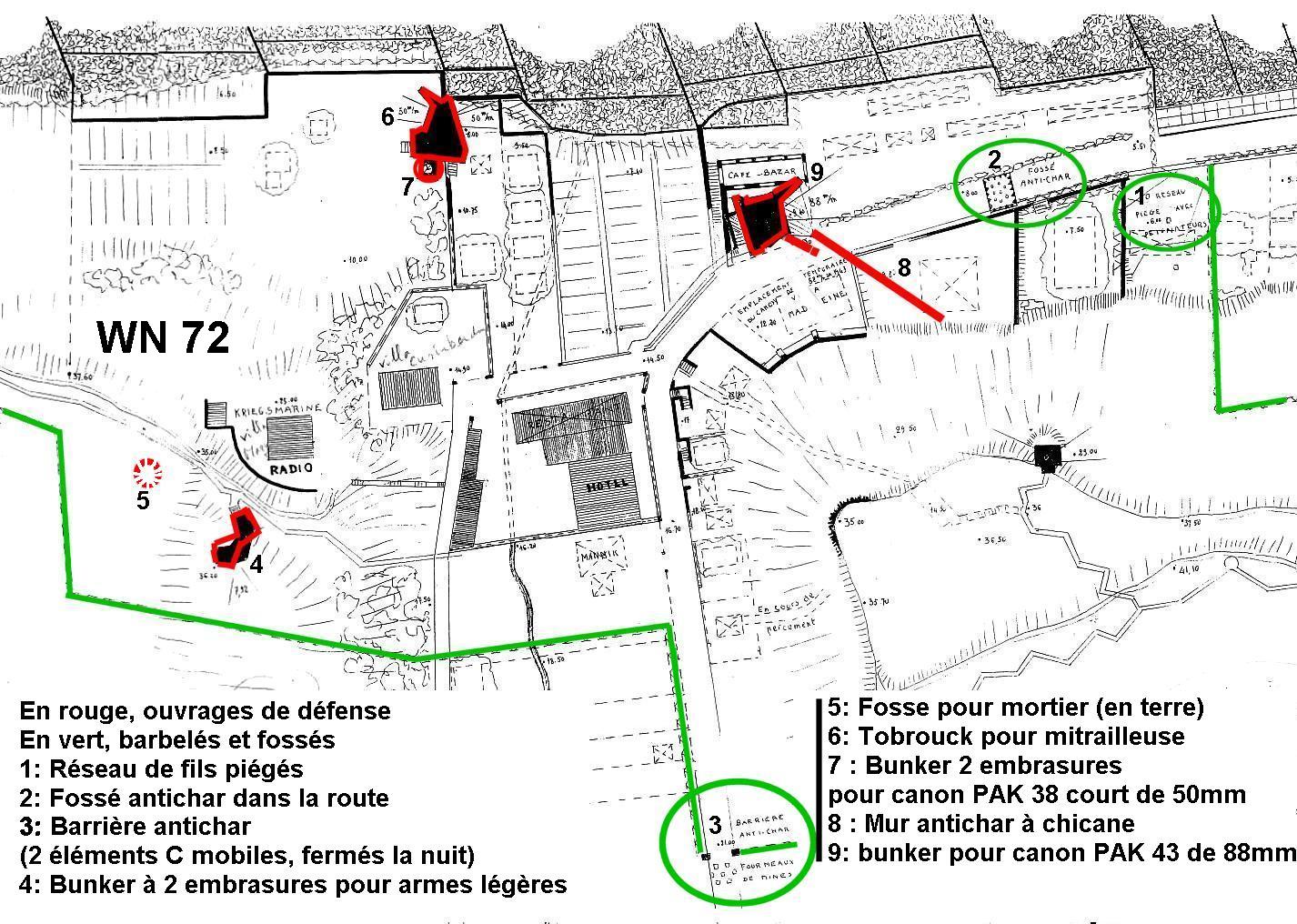
Details Sketch of the WN72 , on a cadastral plane background and indications of Mr Hardelay
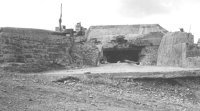
(details) 88mm anti-tank gun bunker on left anti-tank wall starter Currently Monument of the National Guard of the USA
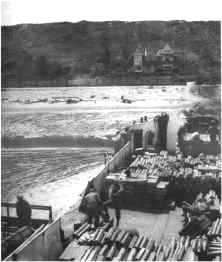
(details) A TCL loaded with ammunition in front of the Hardelay villa, photo taken at the end of June 44
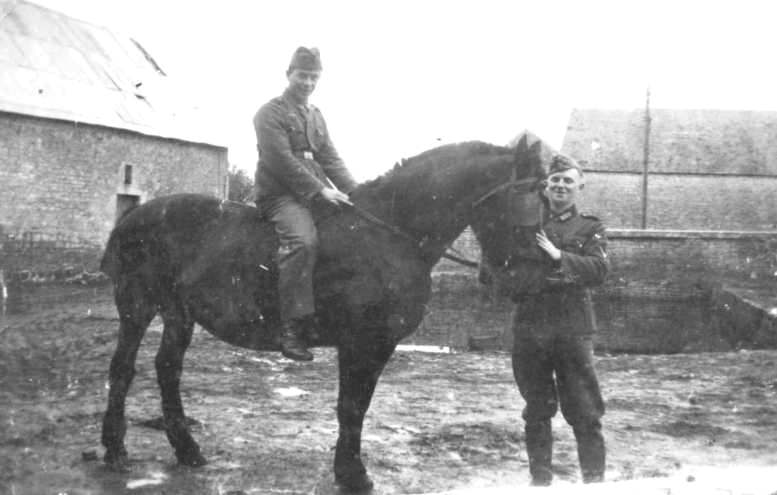
(details) the Houyvet donkey car, requisitioned every Thursday by the Germans
The officer who was staying at the mayor's house had given his laundry to his usual washing machine. She saw him arrive on Monday and asked him to hand him over immediately while the linen was to be soaked. He took it all out of water and left the commune shortly afterwards.
Finally, I promised Schlecht, the German who was monitoring the demolition team at the beach and who was not as bad as his name might suggest ("Schlecht" means bad in German), to go down with a rope in order to move two heavy iron beams. I had been part of the previous week's team that was responsible for demolishing... My own house. But as a wing had been built shortly before and was made up of beams and a large concrete slab in its lower part I knew that the Germans did not have the necessary equipment to overcome these structures, and I did not want to cause irreparable damage by a drop of heavy elements on the slab on the ground floor. The German had been ordered, for his part, to clear the intact beams. So he agreed to take them down with a rope.
I had witnessed a rather nasty incident the previous week, which proved that the Germans had a blue terror of allied aviation. Thus we were all four, monitored by Schlecht, to extract the chevrons from the frame while Germans on the beach shoved some trunks of trees to complete their device - they did so with the help of requisitioned fire pumps - when we heard a noise of aircraft engines, they were light British bombers coming to attack the battery of Englesqueville. They passed in a shave-mott on the beach at 150 m. of us. In the team of Germans on the sand it was panic: four lay under their horses, two under the pump trailer, two hidden behind the trees, the rest ran towards the boulevard; as for Schlecht we found him at the bottom of the basement. But the British had not machine-gunned this easy prey. Monday, June 5, early in the afternoon, I took a big rope and a package to drop at the post office by the way. This package, which contained a roast of veal and was intended for our cousins at Clamart, we learned later, despite the events, that it had been well received by them - bravo la Poste which was doing a remarkable job at that time. I feared I would be pushed back to the guard station still present at the anti-tank wall and have to turn around.
To my great surprise, for almost four years this passage was monitored day and night, there was no German to keep the chicane of the wall, nor the cannon of 88. The barbed wire barriers were open to the passage of the networks delineating the two zones and I entered the sidewalk of the dike in a superb weather, the warm sun compensating a small sea breeze that made it rather agitated. (This sun contrasts with all the other accounts of bad weather that day, perhaps it was a variable time of showers?) I was watching the ridge of the cliff fearing receiving from a sentry the order to turn back, but there was also no soldier there. Schlecht was very surprised to see me arriving unaccompanied.
I gave him the rope and took the same path in the opposite direction by ironing the barbed wire network in front of the boulevard door, the top wire had been removed for the team's passage and it was enough not to move the small smooth alert wire placed in the centre and to span the other four barbed wires stretched 60cm from the ground at their lowest point.
I went home without meeting a soul who lived and undertook to finish the plans requested by the town hall that had supplied me with butter paper, (sulphurized paper) the layered paper being unobtainable.
Almost the whole evening BBC show was devoted to personal messages. The number of these had increased during the previous week; by the end of the week if Melpomène had abandoned his "green grass" instead Verlaine had made his appearance with "the long violins of autumn", and on Monday evening he was completed with his rhyme, repeated three times. Of course this increase was ready for reflection but since I did not know the meaning of it I could not deduce any information from it except that large operations were close.
I promise myself that they will complete my shelter as soon as possible, the next day if possible.