91
The explosion of an ammunition depot in Asnières in October 1945
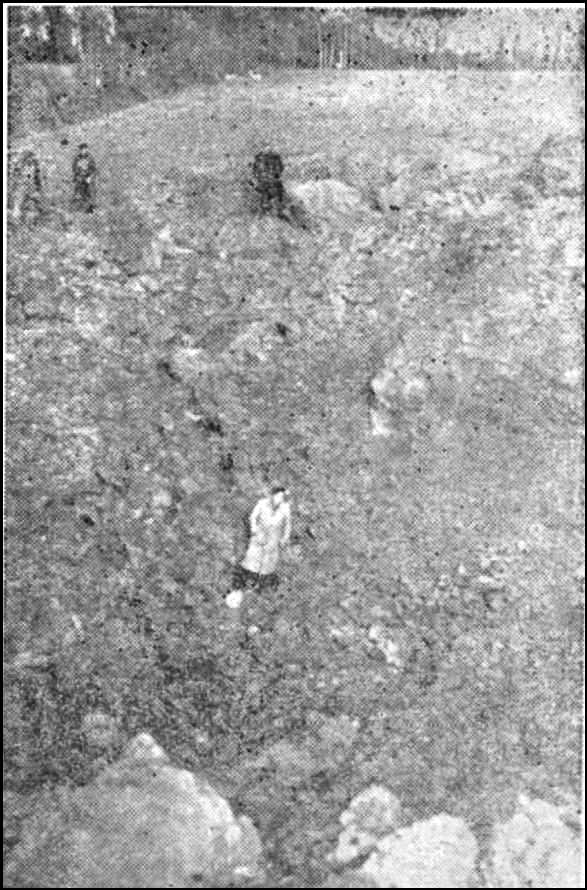
one of the 3 huge craters, the character at the bottom of the hole gives an idea of its dimension
Acknowledgements The Mayor, the Municipal Council and the Inhabitants of Asnières-en-Bessin express their heartfelt gratitude for the help and the expressions of sympathy they received from the French authorities and allied on the occasion of the sinister mourning of their commune, they also thank all the people in the surrounding area who helped them in any way. They give special thanks to the Entr'Aide.
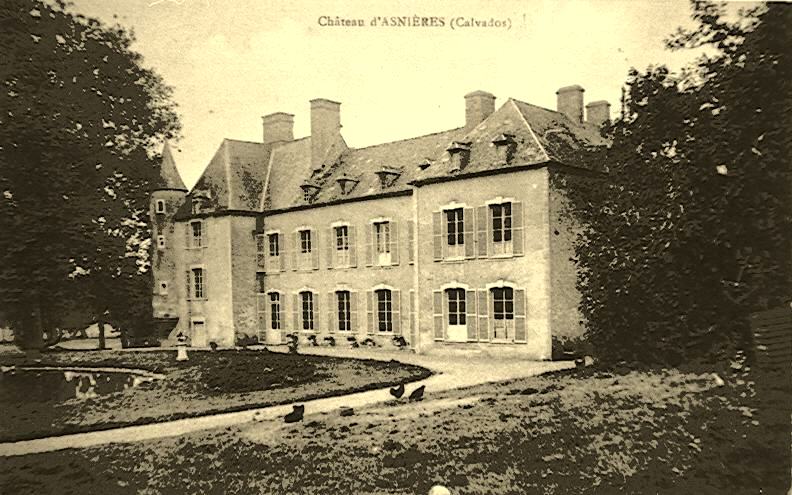
Asnières Castle, owned by Mr. de Brunville, Mayor of the Commune
The Mayor of Asnières-en-Bessin thanks on behalf of all the inhabitants of the commune, the Burnel and Surbin families who have in the generous thought to offer the victims the amount of the quest made at the wedding of October 25 at the town hall of Saint-Pierre-du-Mont.
(cf. "The Renaissance of Bessin" of Saturday, 27 October 1945)
The village of ASNIERES
destroyed by the explosion of an explosive depot
41 deaths
4 civilians, 7 Americans and 30 Germans
On Thursday, around 2.30 p.m., a violent explosion was felt throughout the region. A dump of explosives in jumping had just destroyed the village of Asnières-en-Bessin while the neighbouring communes of Louvières and Vierville suffered greatly as a result of the violence of the explosion.
About 500m. German prisoners loaded six U.S. trucks with black drivers.
For an undetermined cause, the depot jumped, volatilizing trucks and men and leaving three huge craters. A woman from the country, Mrs. Le Gara and her two infants who were picking grass for rabbits were killed instantly by the explosion.
A large number of more or less serious injuries were removed from the rubble of houses damaged by the explosion. There are 110 homeless people. There were 20 serious injuries, 3 civilians, 7 American soldiers (the 6 drivers and the group leader) and 30 German prisoners killed.
The wounded were transported to Bayeux Hospital where they received the necessary care.
The 8-year-old Janine Gouyer died Thursday night at the Hospital.
As soon as they became aware of this disaster, Mr. Triboulet, sub-prefect, and gendarmerie lieutenant Lepère went to the scene.
As soon as we became aware of the sinister destruction of the town of Asnières, we went to the places where we were received by Mr. of Brunville, mayor.
"Asnières en Bessin was ravaged as if by a bombardment: blown roofs, collapsed walls, doors and windows torn. The church of the 12th century had lost its roof and its bell tower hung dangerously. The town hall and the school (empty because it was Thursday) collapsed.
In the castle where he resides we have already noticed the terrible effects of the explosion: doors and windows were torn away; furniture was moved; an indescribable disorder reigned in all rooms. The night had come and the country was plunged into total darkness. Mr. of Brunville, met with Mr. Triboulet, sub-prefect, in the presence of the delegates of the Entr'Aide Française de Bayeux, Miss de Bernard, social worker and several of his more or less contusions.
We noticed with what intelligence Mr. the Mayor had organized the first aid, the transport of the wounded, evacuation of the old men and children and now he was talking about housing of the victims with our very active sub-prefect before undertaking with the Entr'Aide Française, a distribution of emergency relief: blankets, food and utensils of first necessity.
In the village we were able to talk to a few inhabitants still under the blow. All were devastated but dared not leave their homes fearing looting, and all stayed on that long night, in the dark, while the fall quagmire was raging, making the slates steal again and moaning the broken frames, the gloomy night on which death was hovering.
It was Friday morning that we were able to see the true extent of the disaster that had the day before, ruined this peaceful village: all the roofs fell on the houses that have more or less resisted; all are uninhabitable, in large part they have collapsed and will have to be rebuilt; the church has not escaped a common fate: the bell tower is deeply lizarded, the roof pantelante. Near the confessional, under a sheet, rests the horrificly mutilated body of a black soldier: the only one of whom something has been found.
Here the home of Madame Le Gara who found her death with her two infants in the neighbouring field; opposite, the dwelling of the Thomas brothers, one of whom is at the Hospital, seriously wounded; the one to whom we speak was slightly wounded; he is overwhelmed in front of his house in ruins, his furniture crushed. He was a prisoner for five years!...
Here, at the end of a little road, is the house of the Gouhier family whose child, little Jeanine, died at the Bayeux Hospital; her mother is still in treatment...
The closer we get to the blast site, the more impressive the damage is. Here we go, it's about 200 meters from the town.
A field of battle show is offered to our eyes: mounds of land, shredded trees, transported, ploughed grounds, dotted with engine debris, shreds of tires or scrap informs, electric pylons crushed on the ground.
Three huge craters mark the scene of the explosion. The deepest is 10 meters deep over thirty in diameter. In the fields surrounding the soldiers are looking for the remains of the victims. A field of beet is just a hundred meters away. On the way back we meet Mr. the sub-prefect, accompanied by the gendarmerie chief of Trevières and delegates of the Entr'Aide de Caen. We still see U.S. Colonel Khurie and several officers; the black MP sets up the guard and provides order service in the village that the inhabitants are now evacuating in full carts.
General Laffitte, commander of the subdivision group in Caen, representing the General Commander of the 3rd Region, visited the places where he greeted the body of a victim at the Church of Asnières and offered his condolences to the American authorities. In Bayeux, he visited the wounded in the hospital.
Who will ever tell us the reasons for this disaster? The most varied reasons are accepted; as we have said, they were explosives: dynamite and cheddite, not ammunition. It is possible to assume malice as the malice of a German prisoner or anything else; all assumptions are allowed, but it is certain that the light will never be shed on this tragedy.
May a repetition of surveillance and serious precautions avoid the recurrence of similar disasters.