soldier in WN62, June 6, 1944
6 June 1944: "THEY ARRIVENT"
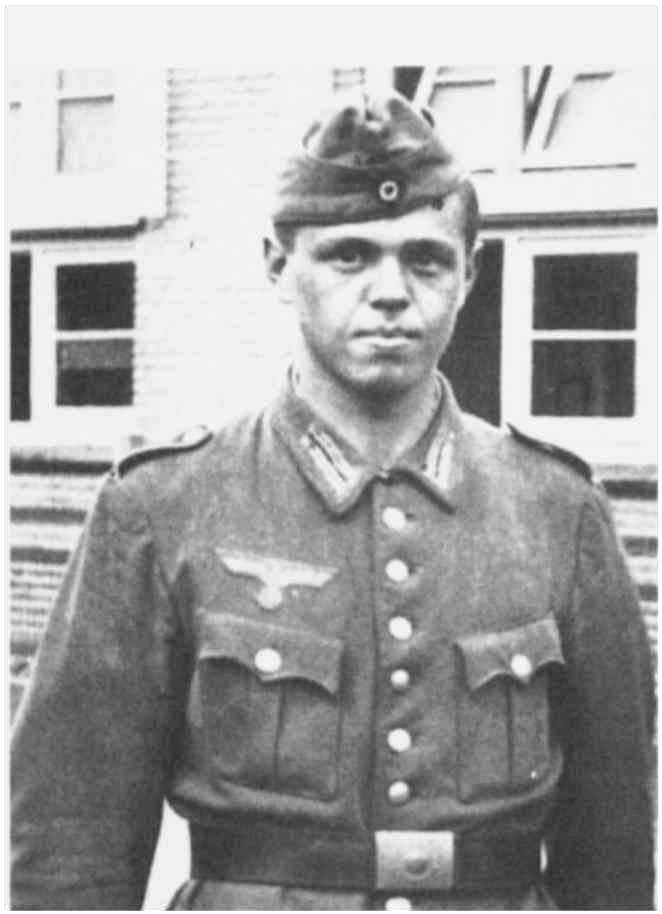
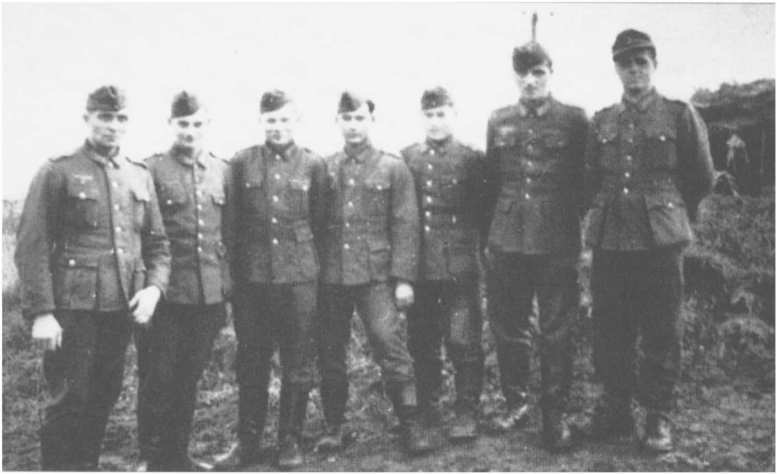

"The cry of "Alert!" cast inside the shelter, drew us from a deep sleep at about one o'clock in the morning. A comrade stood at the entrance and yelled again, so that there would be no doubt "the highest degree of alert!" and urged us to hurry. But in the past few days, we were so often taken out, that now we didn't care. The hardest to cook turned into their bed with a few swears looking to go back to sleep. While the comrade was still standing in the entrance, NCO Förster appeared behind him and this time, with the phrase "The guys, now it's getting serious, they're coming!" immediately put us up. All of them took their rifles, headed at the pace of a race towards heavy weapons. All fatigue was forgotten. The machine guns, guns and mortars were loaded. Ready to fire, we were standing by the weapons. It was a night like many others. But soon the first messages came from the company's command post (PC). At Sainte-Mère-Église, in the air corridor about 35 km west of Colleville-sur-Mer, in the Cotentin peninsula between Carentan and Cherbourg, landing troops were parachuted. An armada of boats had left the ports of southern England and approached Normandy.
"Nothing was yet visible in our coastal area. Everything remained calm. Was it a false alarm again? Time passed slowly. Should this really become serious? Dressed in a light lattice, we were trembling in cold with our weapons. The cook distributed hot wine. Our survival instincts immediately prevailed. Having carried out earthworks, we had kept during the night the lattice -our work clothes - because it was planned to dig further trenches the next day. We cursed that damn alarm and waited until we could get back to our shelter. The calm weighed heavily on us. The inner tension was growing. Soon there was a noise in the air, which led to the guessing of the sights of approaching bombers. And again, as so frequently in recent times, our coast was overflew. But the calm did not go on. With the dawn of new formations of bombers arrived. Dark shadows became visible on the horizon. First of all, we believe that they were German coastal patrols. The shadows, however, grew and became so numerous that we could no longer believe in them. The silhouettes of small and large boats were becoming ever more numerous. New formations of bombers approached the coast. In Port-en-Bessin, just a few kilometres east, the first bombs fell.
"Bombers came near the coast again. I was standing in my buried bunker. In front of me there was the heavy machine gun on his rotating watch. Three shooting openings were facing the sea. I checked the cartridge tapes again. I tried to focus on my weapon to avoid thinking. Now the bombers were above us and it was too late to risk jumping into the individual hole, which was to offer us shelter in case of an air attack. It was too late for that. So I was very small under the base of the machine gun. The bombs sank into the sandy and rocky ground, screaming and whistling. We were immersed in mud and smoke. The ground trembled, the eyes and nose were full of dust. The sand screamed under the teeth. All hope for help was lost: our planes were slow to come. There were no DCA guns in this part of the coast. The bombers could release their deadly load with impunity. Meanwhile, heavy artillery shells from Marine exploded. From a trench, I had the opportunity to observe, how heavy bombers dropped their deadly charges on a nearby strongpoint. Bombs and shells of naval artillery were sinking into the ground, projecting in the air muds of earth, barbed wire, and concrete blocks. But that was not all: The landing fleet that was approaching in the morning grey was preparing even more frightening things for the points of support. For us we started a fight without a way out. Perhaps it was precisely this despair that contributed to what we defended so bitterly. We wanted to survive.
"A fleet was lying in front of our coast as far as we could see. Large warships seemed to be standing in front of us, like a parade. The show, for the few survivors of the naval bombardment, was a unique but frightening adventure.
"Salve after salve, naval artillery was shelling on our strongpoint. The boats were only about 20 km away. This distance was gradually shrinking. With the naked eye, we could better and better distinguish the details of this fleet that was coming. The shell hail that fell on our strongpoint was becoming ever more violent. More and more sheaves of earth went up in the air to collapse again. The mined belt on the beach had been torn by the shells. The mine dams and the Rommel asparagus were scattered in the water.
"Everything in the landing fleet was evidence of a deployment of prodigious equipment, to which we could only oppose a weak resistance that was going down. Our heavy weapons were planned to fire closely. Therefore, it was for us to wait and wait. The enemy was to advance in the immediate vicinity of the coast. Until then, we had relied only on a landing at high tide, since at low tide, the boats would have stranded on the sand. Yet it was low tide. The water was about 300 metres from the shore.
"Bombs and, above all, shells had upset our strongpoint. But we had not yet suffered large losses in men. In the middle of this shell hail, we used every second possible, to establish a connection with the neighbour. About 15 meters in front of me there was an anti-tank gun of 50 whose servant was alone because his sniper was wounded. 40 meters to my left, there was an isolated fighter - like me - with a heavy Polish machine gun.
"During this cannonade, the landing fleet had approached enough so that all the details were clearly identifiable. Alongside various types of warships, there were troop carriers, landing boats and assault boats ready to land the invasion army on the shore. Suddenly, at about 6:00 a.m., the fire suddenly ceased. The result is a disturbing calm. But it didn't last. The warships started firing again. The shells screamed again. It was then that an artillery barrage broke out on the obstacles of the beach. Part of the tree trunks were shredded. Some were burning. Slowly, meter after meter, the fire roll went forward. A monstrous roll of fog and smoke turned around with deafening cracks, screaming, whistles and screams, cutting everything down and moving towards us. The fire roller took its time. He knew we couldn't escape him. Without any help, I was lying under the base of my machine gun. The first shells of this roll of fire fell between our machine guns and our bunkers. Others passed through the shooting slots of my machine gun post. The firing facilities of two flame-throwers were sprayed. Under this heap of shells, I sought to overcome my fear with spontaneous short prayers spoken aloud.
"In the paternal house, during the bombings, in addition to the prayer of the rosary, we called the mother of God, Saint Joseph and our Saints Patrons, asking for protection and help. Now, in this hour I remembered these prayers and kept repeating them. As an isolated fighter near my machine gun, I had no one to talk to in this hell unleashed by naval artillery.
"On top and next to us there were like drum bearings and crepitations. The shrapnel flew, whistling and screaming. They were slamming against wood or concrete or sinking into themselves with a deaf noise. Then the silence returned.
"Once again there were whistles and screams. We were six comrades to be distributed in the lower part of the strongpoint over an area of about 80 meters. Only one of us had been slightly injured so far.
"Comrade Siegfried Kusta, the servant of the anti-tank cannon of 50 came crawling in my bunker and shouted: "Warning, Franz! They're coming!"
"Then the surface of the sea came to life. Assault boats and special landing boats approached the beach. The first full landing troops standing tight on the boats rushed outside. The water went to their knees, sometimes to their chest. A race started on the wide unprotected beach to the pebbly slope, which offered the first shelter. Now we were working on the points of support. So far we have not used any defensive weapons. It would have been foolish and useless to want to retaliate to the aerial and naval bombardments. We all thought about saving our lives in bunkers and earth holes, as long as possible. The first machine guns fired at us called for weapons. The occupants of the first assault and landing vessels collapsed dead or injured after a few metres. Some of the first assault boats were unmanned on the surface of the water. It didn't last long. The shooting of the low-draught vessels, which had approached very close to the beach, continued. They were mainly armed with fast-fired guns and heavy machine guns, which were now opening fire against our positions and the locations of scattered guns. Heavy naval artillery took under its fire the hinterland.
"With my heavy machine gun I had fired a few gusts on the landing vessels, when it stopped as a result of the shelling of the rounds of cartridges during the bombardment. Quickly, the ammunition was extracted, shaken and again introduced. At that very moment, my machine gun was sifted with bullets in my hands. Even today I can't understand how I got away without the slightest injury.
"We were surprised that with so few remaining defenders we stopped the invasion of our coastline.
"We thought of the many victims of bombing and destruction in Germany. Here we were in front of the same opponent. But unlike the many civilians there, who were defenceless against the bombings, we could defend ourselves. And we wanted to survive!
"A comrade fired shells at shells with his 75 gun. But at this fire, the landing vessels that were approaching responded quickly. The shooting openings were masked by the fog and smoke of the shells that exploded. A few shells that penetrated through these openings put the gun out of use. The gun servant managed to get safe while only slightly injured.
"Just 20 meters away, next to the 75 gun pointing towards the sea, there was a "Tobrouk" with an MG 42 machine gun. This new rapid-fire machine gun had recently proved itself against the assault of the Russian infantry masses. I also found the two comrades of this post in 1964 at the military cemetery in La Cambe.
"About 40 meters behind me, in the house which contained our PC and the kitchen and which had already been destroyed at the beginning of the bombing by naval artillery, countless shells were still exploding and pieces of wood and remains of wall were constantly thrown into the air.
"At about 15 meters in front of me, in the direction of the beach, there was in a hollow built the anti-tank gun of 50 served by Siegfried Kusta. This cannon location was not visible from the sea. With that cannon. Siegfried defended the beach from WN 62 to WN 61. Several tanks and boats in flames after being hit, proved that this soldier had prevented the crossing of the pebble slope of the beach thanks to his experience on the eastern front. Emest Hemingway mentioned these tanks and burning boats on the beach.
"In the meantime, the second wave of landing boats arrived. A new race took place towards the beach. Again the occupants of the strongpoints defended themselves. But the resistance was weaker. More and more comrades were dead or injured. The sea was rising slowly. The water was approaching the edge. The short course was no longer as long for the landing troops. Landing boats with tanks opened their slashing doors and tanks rolled quickly to the beach by firing. For a few hours the fight was going and coming. The beach was covered with dead, wounded and soldiers looking for shelter. The tide was coming. Water was rising ever more. All those who could run or crawl, sought to reach the savior slope. Again, many were victims of our defence.
"But on our side there were also significant losses. The light wounded were bandaged and sent away. The serious wounded were bandaged and lying in a protected area. The dead comrades remained lying. No one had time to take care of the dead.
"Many of the landing troops were now reaching the pebbly slope that provided them with protection. There, they thought they were safe. But only for a short moment. Our mortars had waited for this moment to open their dam fire on the pebble lift. Buoys with percussion ignition exploded on the pebbles. The shrapnel of shells, the rolling gravels and the pieces of stone again caused serious losses to the disembarked units.
"The rising tide brought to shore the dead and wounded soldiers of landing troops along with ship debris and shipwrecks. It was a scandalous vision, to see new troops constantly sent to death. Peter Busemann, a student from Michigan to the USA, found in schoolbooks this report: "The US soldiers were advancing like automatons through the fire of defense towards German positions". At his idea, this reality of "hurling into death like automatons" was not imaginable. We were within reach of them.
"By noon, the rising tide had reached the pebbly slope. Landing boats and low-draught barges were stranded in front of us just 100 metres away. We seized our rifles and sought to prevent further landings.
"The first troops had reached the areas west and east of our point of support and had conquered other fortified points that had suffered heavy losses as a result of the air attacks and the cannonade of naval artillery and from there they entered the hinterland further. We now had to defend ourselves against attacks from the back. He didn't come from backup. Michael Schnichels was sent as an emissary to the company, to seek reinforcement, but he did not return. In Colleville, fierce fighting was already taking place. There was no more backup.
"As Michael described to me after the war, he was in Colleville hidden behind a dead horse. He was then hit by a shell, and thus covered him completely with the slats of his body by sprinkled with his blood. He himself had only slight wounds due to shrapnel. For the Americans who were assaulting, Michael found lying in the body of the horse in shreds, had to be a horrible spectacle. A "Friend" immediately put a cigarette in his mouth.
"The adversary was disembarking ever more troops, and our resistance was going down. Around noon, at high tide, two small landing boats passed in front of the WN 62 on mines fixed on sea-covered obstacles. Strong explosions broke the boats. All that left was wrecks.
"At about 11 o'clock, after a pause of fire, a large troop carrier (Landing Craft Infantry LCI) came straight in front of our positions, a few meters from the beach. Sidewalks were filled with soldiers against each other. There was another shot at our lower strongpoint. Then Siegfried Kuska approached me by crawling, the gun in his hand. His anti-tank gun was only installed to fire parallel to the coast. The fire then moved to the soft sloped terrain of the strongpoint. We could breathe. There was no problem with ammunition. A few boxes of ammunition for my machine gun were laid next to us.
"The LCI, a big target, was barely 120 meters in front of us. Around my buried bunker, destroyed by fire, we looked for places offering maximum security. After a heavy fire with our rifles on the sidewalks and on the command bridge, there was soon a great confusion on board the boat. Saccaded loud-speaker commands resonated with us.
"When the boat, ten to fifteen minutes later - an infinite time for us - returned, we breathed with relief. We looked happy. This time again we had come out unharmed.
"As we had not eaten anything in eighteen hours, I wanted, after consultation, to seek some sustenance from the staff shelter.
" I reached this shelter east of our resistance nest, into the land, first through trenches, then through burning grass and a mass of junipers. In the trench in front of the shelter, I met two comrades, Helmut Kieserling and Paul Hâming, carrying a light machine gun and a rifle. Bullets were whistling over us, not just from the sea, but also from the west side. Both of them listed the names of several dead or wounded comrades.
"On the WN 61 and WN 60 located further east, we saw landing troops heading in Indian line towards the interior of the country. Two hours after the landing, the 88 gun of WN 61, which was under the command of Chief Warrant Officer Schnüll, was silent. I also found Chief Warrant Officer Schnüll at the German military cemetery in 1964.
"We decided, that I would jump into the shelter under the protection of the arms of the two comrades to look for war bread, sausage and milk cans. As usual, I went to a peasant in Colleville to pick up milk the day before.
"By 6 June, our work plan had planned earthworks: the extension of trenches in the lower part of the strongpoint. As a result, I wore my lattice, which was the working dress. My identification plate was suspended from my bed. My military booklet was still in the tunic of my uniform. The rosary that my mother gave me to take away was also in a pocket of my tunic. I still had a little case with a Lourdes medal from my father. He had worn it all the time during the years 1916-18. In great haste I gathered papers and medals.
"By the way, I saw Heinrich Kriftewirth's tooth, swimming in his glass of water. Initially declared dead - the identification plate was broken - but being only slightly injured, Heinrich had woken up in his protective casemate, coming out of a deep unconsciousness, and with the help of another light wounded, had gone to Colleville in haste. What did the discoverer think of this tooth?
"Fuses, machine guns and boxes of ammunition with us, we appeased hunger and thirst with bites swallowed hastily and large sips of cold milk caught in the pot. I hadn't thought about the fact that the cold milk swallowed fast with an empty stomach, is laxative. After having briefly heard me with the two comrades I jumped out of the ditch over a slope sheltering me in relation to the sea. To avoid doing it in my pants, I removed it so strongly that its seam was torn. The belt supported by two belts, the cartridge, not to mention the pockets filled with grenades and straps, obligatory in the Wehrmacht, did not allow me to do otherwise.
"Before returning to the lower part of our strongpoint, I saw 50 meters further, against the slope, an anti-tank gun installed in a field. He wasn't there two days ago. That cannon was pointed at the WN 61. Two older soldiers saw me coming with my torn pants. They immediately understood my embarrassment and said to me without procrastination: "Search in our pants if there is one that suits you. We no longer need replacement uniforms, and you can't reach your position. A Friend is already sitting there."
"We exchanged what we knew about this defensive fight. We were unanimous in finding that we didn't know yet, how we were going to get out of this mess. During this conversation, our Chief Warrant Officer and the strongpoint commander came crawling out of the direct line of fire, as the Chief Warrant Officer was seriously injured in the back. To our left, to the west, we found that WN 64 had been invaded and that American infantrymen had already entered the perimeter of this resistance nest.
"As a young soldier just eighteen years old, some old soldiers made some recommendations to me before I went back to the staff shelter with which my comrades were standing. On a length of 50 meters I was not afraid of being at the foot of the slope. The body against this slope, I climbed a few meters to its upper part, in order to gain in a few quick leaps the protective ditch where my two comrades were. The left hand had reached the top of the slope and I was slowly re-adjusting to the slope. When my head was on the hand, I suddenly felt a brutal blow to my left hand. I let myself fall back to the bottom of the slope and saw when three fingers of this hand were held only by the tendons.
"My rifle had remained halfway up the slope, and without it I didn't feel safe, so I climbed up again crawling. And with the gun, I rushed to the comrades at the location of the anti-tank gun. As soon as I arrived, one of them was already holding tapes. I begged him to take precautions because I wanted to keep my fingers. As a consolation, he said to me on the way back to Colleville: "It's a good shot to go home. Be happy you can always run. We still don't know how we're going to get out of this fireworks." An American veteran who is now a friend told me, "It was a shot that was worth a million dollars to you."
"I also found my comrades Heimut Kieserling and Paul Hâming in 1964 in the German military cemetery in Cambe.

the afternoon of 6 June
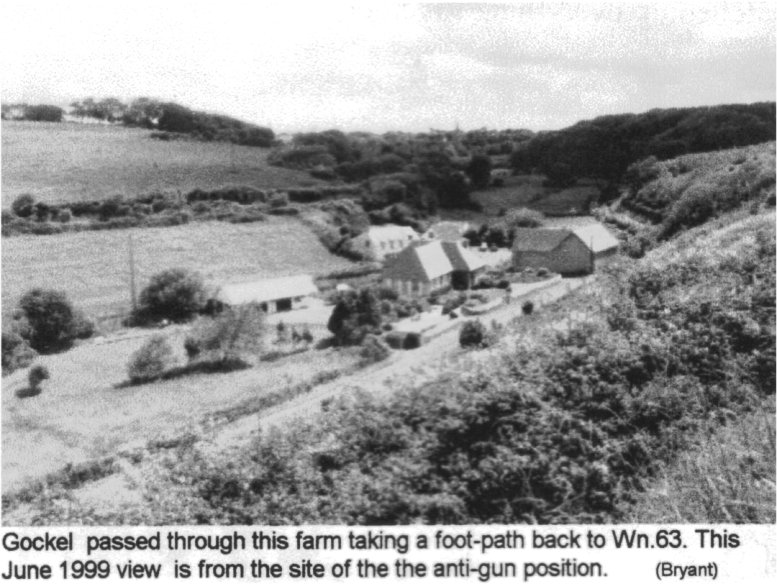
Franz's flight route
Gockel
"On the way to Colleville, I remembered my mother's letters. Each letter ended with the wish: "God protect you."
"Ramping and running, the gun firmly stuck under the arm, I was rushing to Colleville-sur-Mer, between high hedges. I heard the fighting that was also raging in the village. Shots of rifles and machine guns were resounding. At the entrance of the village, I met again some comrades from my strongpoint, wounded.
"The opponent had already entered Colleville-sur-Mer for a few hours. Between Colleville and St Laurent-sur-Mer, the landing troops quickly reached the mainland and entered the interior. The company commander and several comrades had already fallen in front of the church during unexpected attacks from the interior.
"Near the entrance of the company's bunker in Colleville, corpses of German soldiers were laid out, covered with tent sheets, the boots or shoelaces being only visible.
"I let myself fall on the concrete floor of the half dark bunker. So only, thinking I was out of the dangerous area, I felt violent pain in my hand.
"I recognized Chief Warrant Officer Pie in his voice and heard him describe the battle on the coast. He said, "I am the last of the WN 62, there must be no one alive." He was then astonished, when he learned that I had seen him crawling under the barbed wires while he was seriously wounded. It was an hour later that I got hit in my hand.
"We were described by the church as fighting. The names of several comrades, who had fallen between the company's PC and the church, who were only 60 metres away, were recalled. Before the Americans who had invested the church and the bell tower could be repelled, our company commander Lieutenant Bauch, another officer, four non-commissioned officers and ten comrades had fallen.
"Our canteen in the nearby farm had already been emptied and sacked. Comrades of my knowledge were looking for protection behind the front walls. A comrade trained at the same time as me in Holland, Franz Wilden, handed me a dry sausage from the bottom of the truck. I also found him at the Cambe cemetery after the war. A few wounded were again raised on this truck. Several deaths had been removed from the road and placed in shallow ditches.
"With us, there was a "Friend" and a French civilian.
"The road from Colleville to Ste Honorine-des-Pertes, without hedges or trees, made it possible to see the sea. It was swarming with vessels of various sizes. Large landing boats were surmounted by dam balloons against the aircraft, but they served as reference points for our artillery back. Very quickly, the batteries lacked ammunition. The houses at the entrance to the village of Ste Honorine were destroyed by fire. After the war, Yvonne told me that one of his uncles and cousin had been killed in the bombing of naval artillery. Crossing the village with the truck was not possible. Soldiers who had sought refuge in the ditches on either side of the road at the entrance to the village had also been victims of naval artillery. We who were only slightly wounded, took the direction of Bayeux to join the military hospital of our division, where I had been treated for an infection for three weeks in November 1943.
"Three serious wounded remained lying in the truck. The driver wanted to go back to Colleville, find another road to Bayeux. But we wounded them lightly, we did not want to drive again on this road visible from the sea, in the truck discovered.
"We walked the way to the neighbouring village, Etreham. At the entrance to this village, a battery of artillery was on the roadside, well camouflaged by a grove; it had not yet been discovered by the fighter aircraft. This battery was used to defend the beach of Colleville-sur-Mer. There were only a few shells left and day supplies should not be considered. Ally fighter aircraft had air control. All day long, I hadn't seen a single German plane. The battery conductor tried to inquire with our prisoner. From the location of the battery, we couldn't see the coast. There was no longer any liaison with the artillery observation post and a link with the landing coast by another observation station had not yet been established.
"In the village of Etreham, Kurt Wamecke, the corporal of an artillery observation post, was standing by the roadside. Sucked flatly on the ground in WN 62, a bullet had crossed both buttocks. Eventually, with great luck, he had been able to reach a ditch that had saved him. Here two charitable French men changed his blood-covered band. Kurt Warnecke, from the neighbourhood of Magdeburg, quickly recovered from his wounds in two weeks. He returned to Normandy, in his artillery unit, after being recognized as fit for service. He fell a few days later. I also found him at the German military cemetery in Cambe.
"In the meantime, my Chief Warrant Officer felt so much pain that he said: "We absolutely need a horse car. I can't stand these pains anymore. We need to get to the hospital as soon as possible."
We stopped at the next farm. The frightened peasant and his wife immediately brought us milk and cider, hoping that we would immediately return. When our Chief Warrant Officer ordered the peasant to drive us to Bayeux with a horse car, the man and the woman collapsed, the children being fearfully back. The farmer clung to her husband crying. The children also threw themselves on their father with large sobs. Explaining to the wife that her husband would immediately be able to return from Bayeux, did not calm her. As an alternative, she begged us not to take her. The peasant saw above all the danger posed by the planes that made the skies difficult. Especially in the morning, they had shot at everything that was moving, and now it was the roads and the back roads that were more monitored. In front of Etreham, we had seen countless cows in the fields, victims of aircraft flying at low altitude.
During this discussion, our Chief Warrant Officer - I stood with him with another comrade - placed his pistol on the kitchen table, without a word, and then called a horse and a car, speaking to the peasant, while looking at the woman and the children: "I understand the fear of your wife, I also have a family waiting for me. Give us a horse and a car. We have a Frenchman with us, he's the one who will drive and bring them back to you both. " We were then given a cart to carry the animals, with high riddles on each side, and a horse. I think it was the oldest rosse in Normandy, who, on this farm, lived his retirement. After a bumpy journey, during which the horse had to be pressed, we reached Bayeux by narrow paths, between high hedges, and always with the fear of flying low. Chief Warrant Officer Pie fell a few months later in Holland.
When we arrived at the hospital, we were instantly surrounded by French men and women who wanted to know: "Is this the landing you were talking about so often?" The American prisoner was observed with interest.
We were terrified that the German services of the hospital had been evacuated. "What was going to happen now?" So only we saw that the driver of our team, a Frenchman about 30 years old, had disappeared. At the company's PC, we were told: "This man is part of the Resistance, he opened the church to the Americans. Tell him to the next Feld-Gendarmerie."
We were no longer interested in this. We wanted to continue our journey to the nearest German hospital. So the question was, "Where is the nearest hospital and how do we get there?"
Yes! We were lucky. Ambulances arrived to look for more wounded people from the hospital that had been moved. It was a chance for us to be able to leave with a truck carrying the Red Cross. However, the drivers warned us: "Don't make too many illusions! " On the road from Bayeux to Balleroy, several columns of vehicles, including ambulance cars, were machine-gunned and burned. We'll wait till dusk to try the trip." We left without lights. Several times we crossed piles of destroyed vehicles. In the meantime, the night had fallen and the dreaded Jabos (bomb-hunters) had stopped their action on everything that was moving on earth.
This long journey ended in front of the city of Vire, which was very damaged and was still burning in many places. Almost the entire city had been the target of violent air attacks. The ambulance couldn't go any further. We stayed in a farm near the city. The inhabitants had left the house in haste at the beginning of the bombing: the meal was still on the table. We comforted ourselves with the provisions of the house. There was plenty of bread, milk, butter and eggs. A barrel of calvados was discovered and a few bottles were filled that were blocked and taken away.