
The movements of 7 June and 8 June (below) (29th Division)

(details)
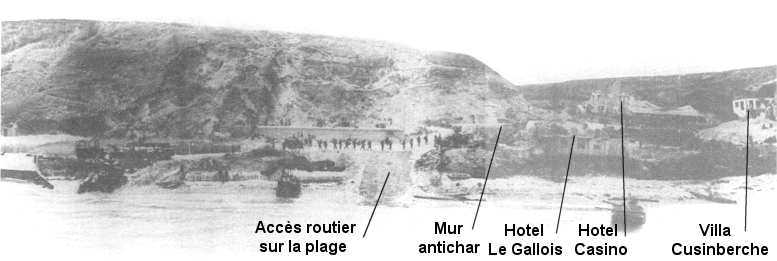
(details)
Soldiers cross the destroyed anti-tank wall at the bottom of Vierville in the Indian line. Access to the road from the beach was built in front of the main casemate. We can see the ruins of the Casino and the Cusinberche villa (all right)

(film extract) La digue de Vierville circa June 7

(details) stranded landing barges, supply piles and killed soldiers awaiting evacuation or burial. A USS Thurston LCVP (APA-77) is located in the foreground to the left, while the British LCT-555, LCT-638 and LCT(A)(5)-2421 are located on the beach. In the midst of a mess of Landing Craft and vehicles destroyed, among all kinds of debris, dead people wrapped in blankets are loaded on a funeral "canad" to be directed to the first cemetery, on Dog White Beach

(details) Overview of Omaha Beach on June 7th in the afternoon. The transports left their offshore anchorage to get as close as possible to the coast. Vierville is on the far left (details)
It was therefore necessary to achieve the objectives set from the beginning for D-Day, that is Grandcamp, the approaches of Isigny, and Trévières.
General Gerhardt, commander of the 29th Division, had landed on D-Day evening in Vierville and had established his command post in the quarry overlooking the lower valley. He was to take over command of the units of the 29th on 7 June. This was in fact insured since the beginning of operations by the 1st Division for all Omaha Beach.
On the night of 6 June and at the dawn of 7 June, his deputy, General Cota, made several trips between Vierville and Le Ruquet, where the PCs of the 1st Division (General Huebner) and V°Corps (General Gerow) were located. I don't know from when he was able to have a jeep for these trips, perhaps as early as the evening of June 6, returning from his first passage to the Ruquet.
The situation was still uncertain around Vierville and St-Laurent, with continuing difficulties in the connections. When Colonel Canham (116° Reg.) came from Vierville to the Ruquet at 9 a.m. to meet General Cota there and find his 2° and 3° Battalions, St-Laurent was still occupied by the Germans and he went through the beach.
The St-Laurent exit (D3) was still not open. The WN 66 on the cliff east of the Moulins still held. Small groups of shooters, with occasional support of machine guns and mortars, reappeared at certain points along the cliff to harass the beach.
The 116°Regiment was harshly tested and most of its units were still scattered. His battalions still had none of their vehicles and had to carry heavy weapons with them. Battalion I/116 began the day with only 250 men in Vierville, but at least he had recovered his staff. Battalions II/116 and III/116 were in front of Saint-Laurent and on the plateau. The Rangers were about 500 (5/Ran and half of 2/Ran). There were also the 23 tanks of the 743rd TankBon, and what remained of the 121st engineers. A total of a thousand men, while the force under Canham's command should have numbered 4000 men in Vierville.
The reinforcement regiment, the 115th, also without vehicles, had bivouaqué south-east of St-Laurent.
The 3rd regiment of the division, the 175th, was still on board the transports, which were to begin landing in principle at 10:30 am on Dog White.
The Germans were still near Vierville in the South, because early at 5:30 am on June 7, a attack forced Company B of 121°Bat. engineers to leave Ormel, leaving prisoners , (see continuation of Dube's account) and back to the village. This counter-attack was entrusted the day before to the small battalion of the Engineers of the 352nd Div. (the 352 Pioneere Abteilung). Attached to Regiment 916 (PC at Trevières), he was to attack from Louvières at 2:00 in the morning. It is likely that the attack was slow to launch and that the German sappers could not afford to push very far, especially for lack of heavy weapons, armor and artillery (the latter had had to retreat into the night and was really in action only in the evening).
This Ormel affair and the infiltrations into Vierville all day long have caused great concern to the Americans, still concerned about a possible Panzers attack.
At Pointe du Hoc, the other half of the 2/Ran was still isolated, weakened by heavy losses and lack of ammunition.
The following decisions were therefore taken for the morning of 7 June:
1/ Battalions II/116 and III/116 (currently ahead of Saint-Laurent) were to be clean the remnants of enemy resistance along the cliffs between Vierville and St-Laurent.
2/ Battalion III/115 was to be take the village of St-Laurent, clean it completely, and then continue on Vierville for any other similar work if necessary.
3/ The rest of 115° Reg. (Battles I/115 and II/115), had to pushing towards Longueville, going largely south of Vierville, by Louvières, through fields.
4/ The Battalion 1/116, the 5th Rangers Battalion and the A, B and C Companies of the 2nd Rangers Battalion, supported by tanks of the 743th Bat, were ordered to heading west on the road to Pointe du Hoc.
However, the German counter-attack in the morning led to the urgent recall of 4 of the 9 Rangers companies with a few tanks to defend Vierville.
5/ The third regiment of the 29th Division, the 175th Infantry Regiment was to land as soon as possible in the late morning and be sent directly to Gruchy by crossing Vierville. In fact, he only landed in the afternoon and in Saint-Laurent instead of Vierville. After stopping in Gruchy, he was then set on his way to La Cambe and Isigny at night.
6/ Armoured reinforcements were disembarked in the 29th DI sector, including:
The CieD/743, equipped with 16 light tanks M5 Stuart.
The 747th Tank Battalion (48 Sherman tanks and 16 Stuart tanks).
Half of the 635th battalion of Tank-Destroyer M10 (the other half being assigned to the 1st DI) to provide anti-tank support (90mm guns) to medium Sherman tanks (equipped with only 75mm).
7/ On June 7, 1944, at 6:00 a.m., Colonel Canham decided to bring his Command Group back to Saint-Laurent. The Command Group returned by the descent of Vierville and the beach towards the Moulins, and resumed contact with Captain Sink's "Communications" group who had landed there.
Villagers (see souvenirs Michel Hardelay, page 511)They began to realize their Liberation, to count their deaths and destructions, to marvel at all these new things, and they were worried like the Americans about a possible return of the Germans.
Views of the beach of Vierville on 7 June after the battle
Story of Ernie Pyle, war correspondent

(details) On June 7, one of the B/116 ACLs was wrecked, and the day before it was severely tested. On the right, a drowned Shermann tank. On the left, two typical "C" obstacles emerge. Off wet transport as close as possible to the beach.
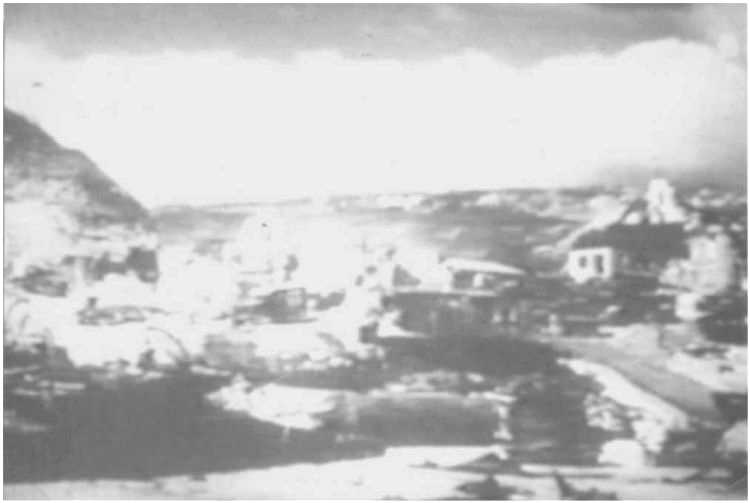
(film extract) The descent of Vierville around June 7th

(details) Two wrecks of LCT in front of Les Moulins,
at the bottom to the left you see
the wreckage of LCI 92.

(details) LCVP spades
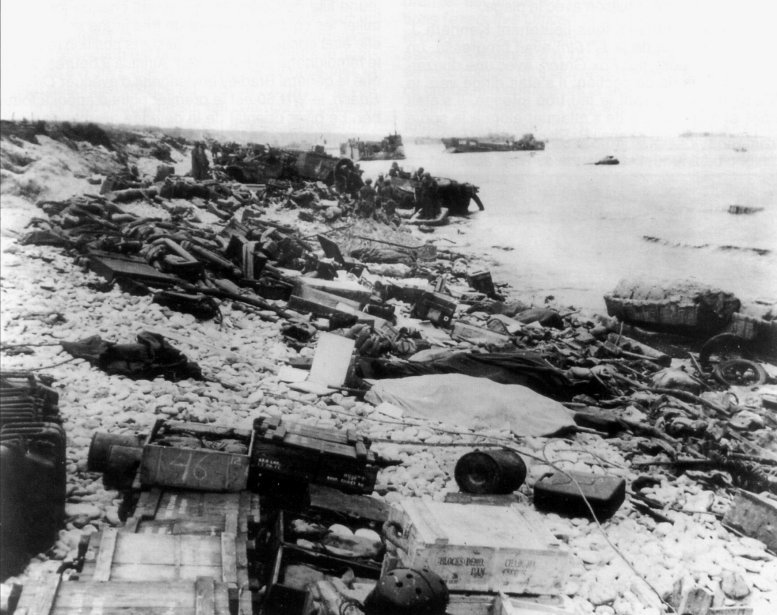
(details) At the bottom of LCT wrecks
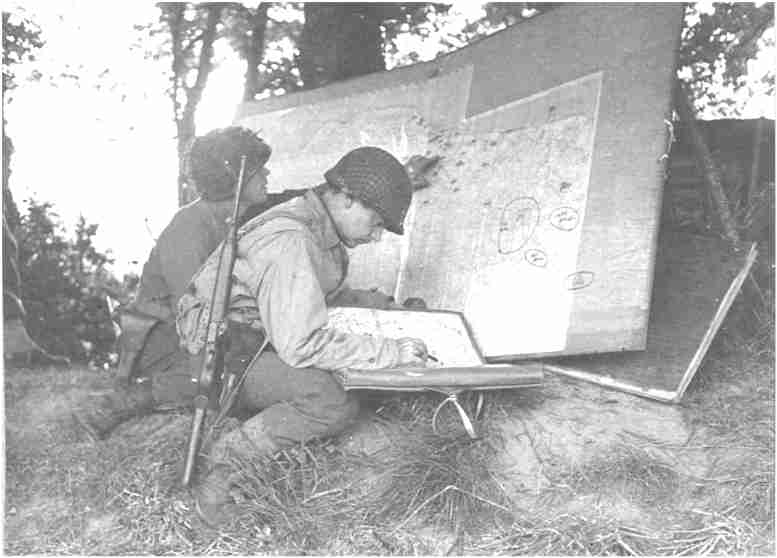
(details) A campaign PC
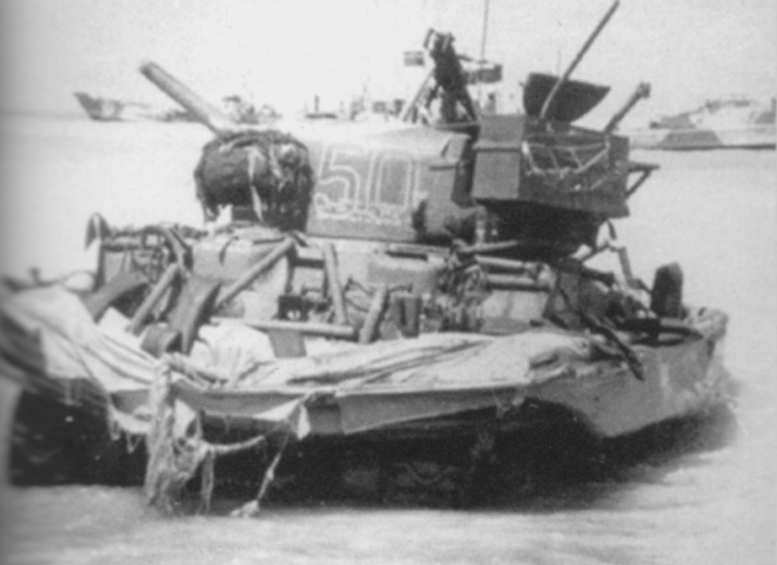
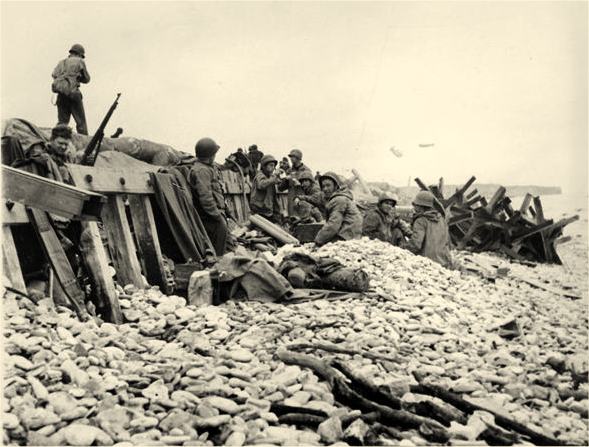

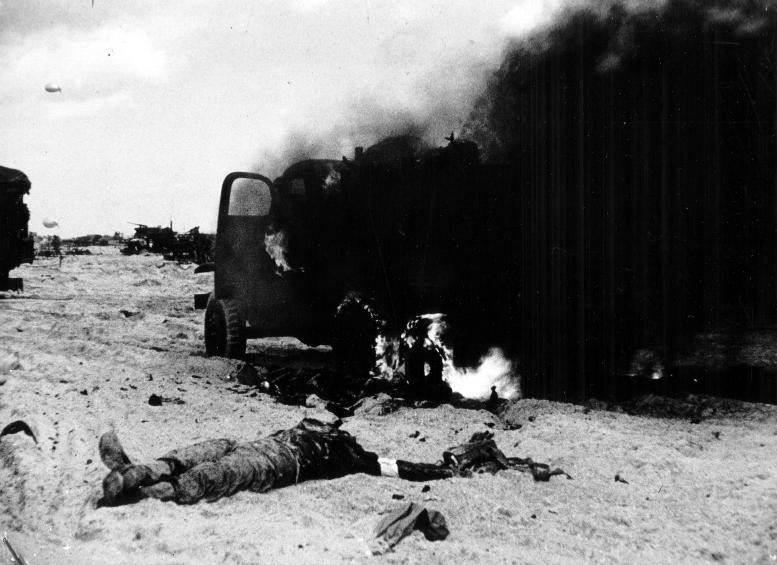
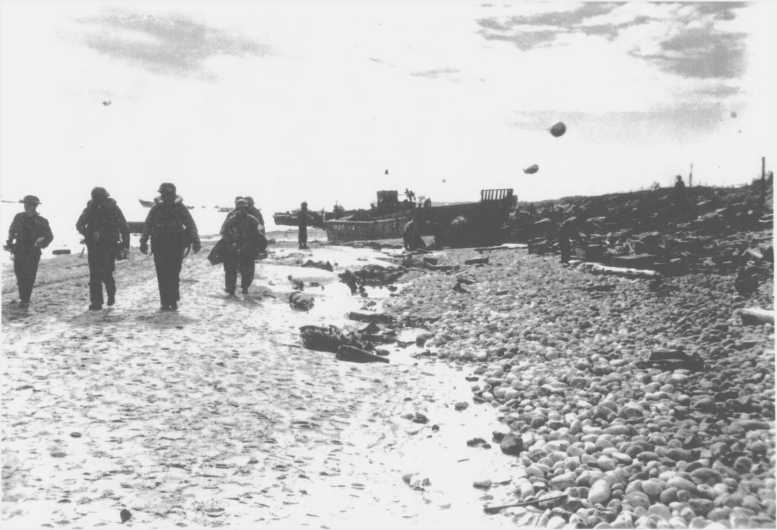
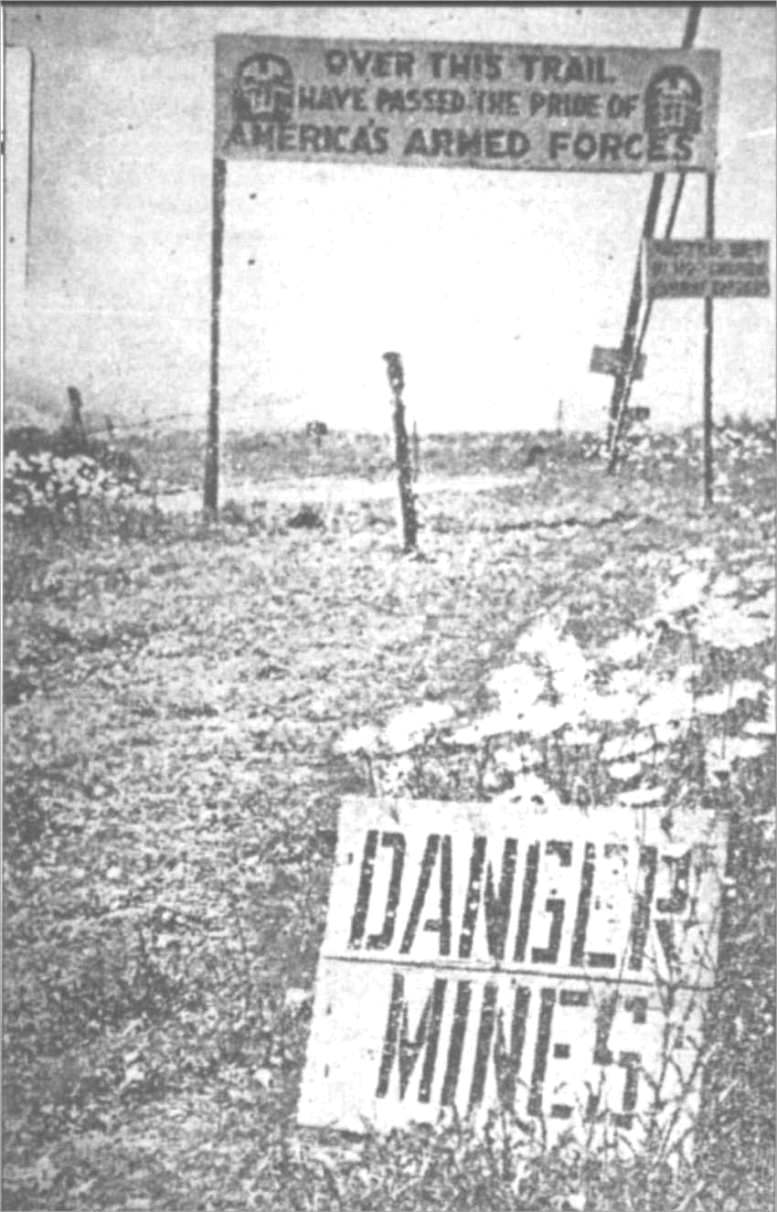


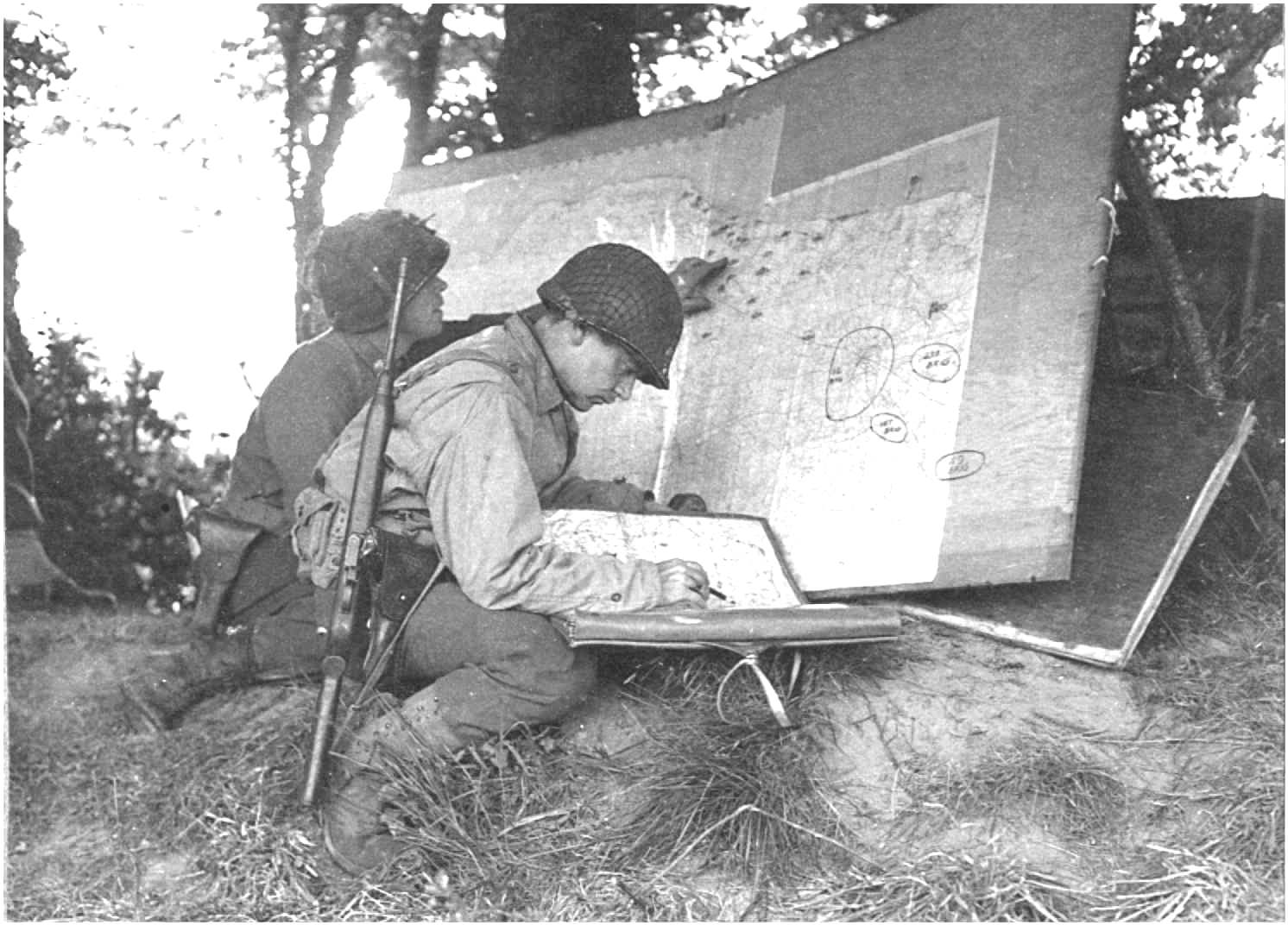


(details) Left of the Villa Parmentier (destroyed)


(details) A dead GIs in front of an obstacle

"rampe". At the bottom of hedgehogs
And a half track.
Testimony of Private Ugo Giannini of the 29th Military Police Section, June 7: "I walked in the midst of wrecks destroyed in Vierville sur Mer, slowly, despite myself, forced to breathe the smell of death. I was alone, looking for my comrades, 37 men thrown on that beach yesterday morning (or was it years ago?)"

(details) A GMC truck in front of the wreckage of a LCVP
.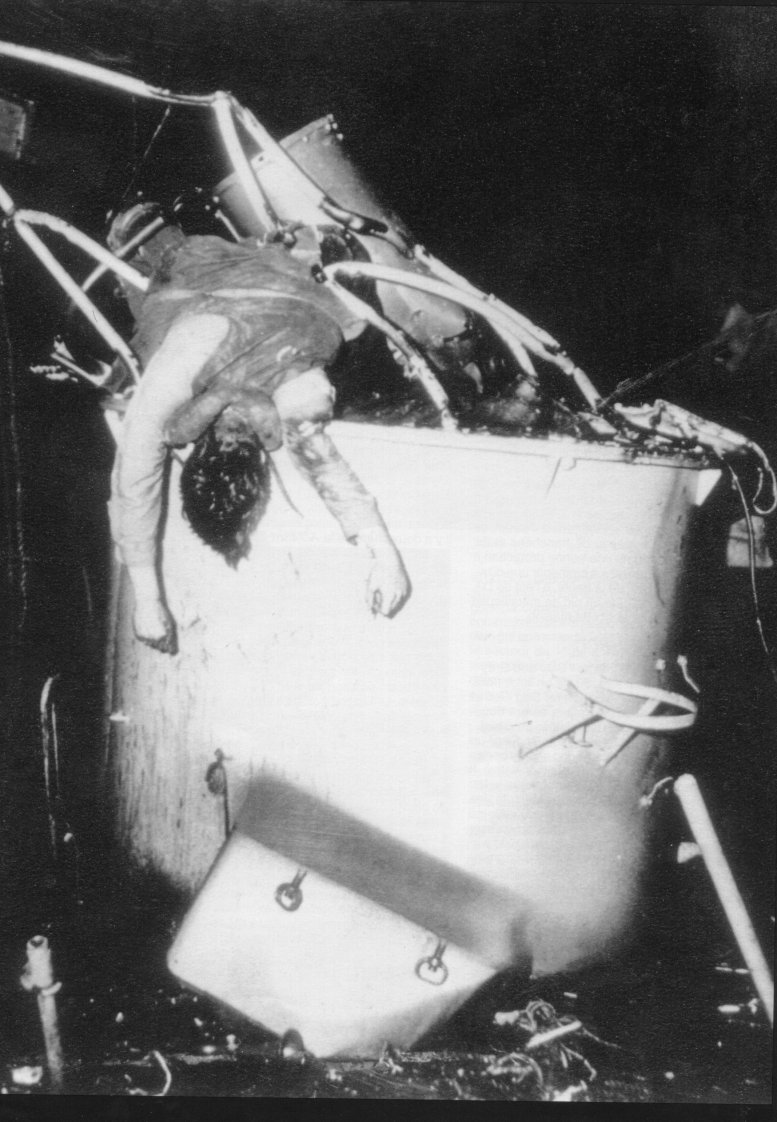
(details)A dead sailor on his boat.

(details) Summary meals on the beach
(details)


