
The movements of 7 June

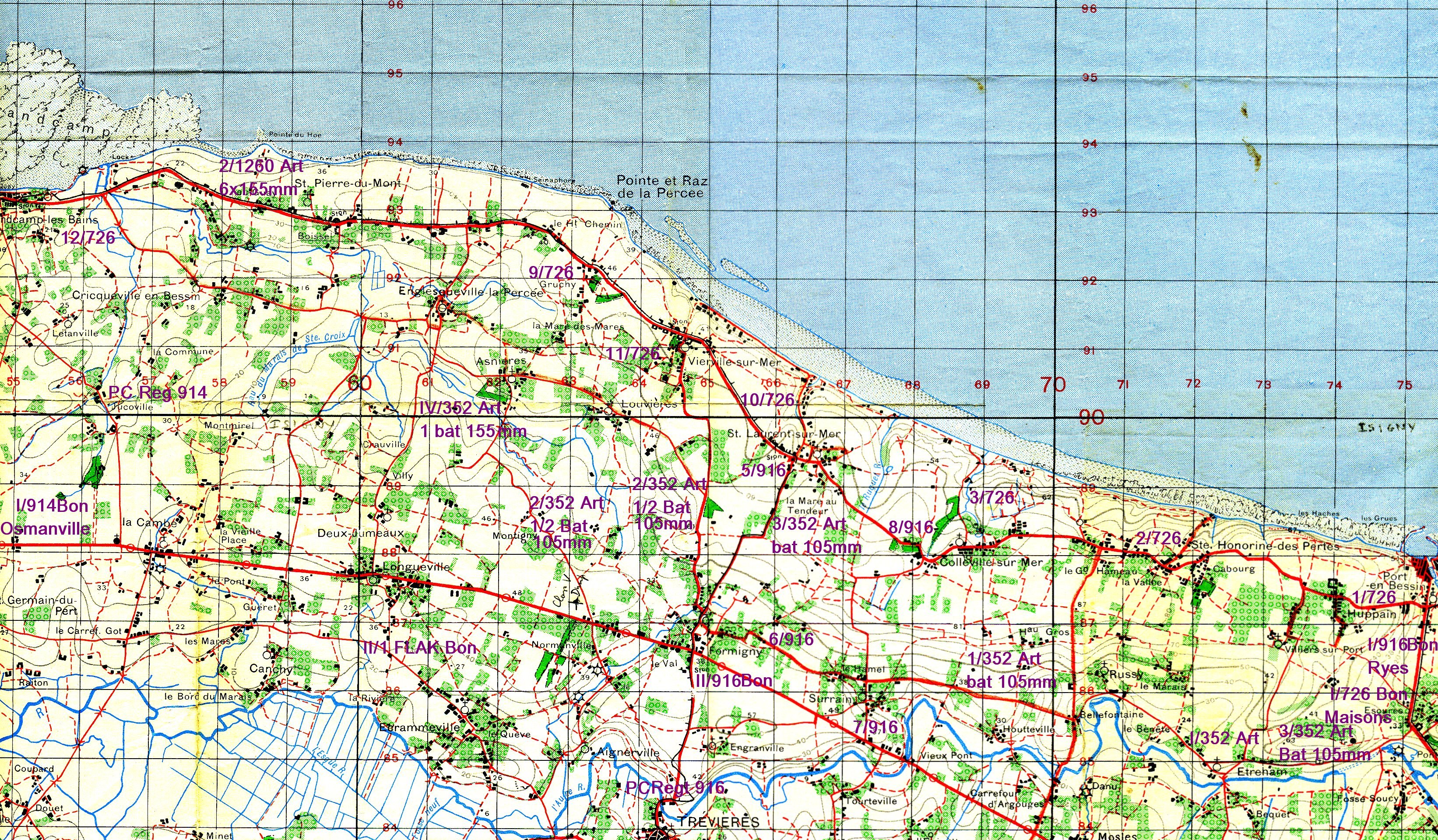


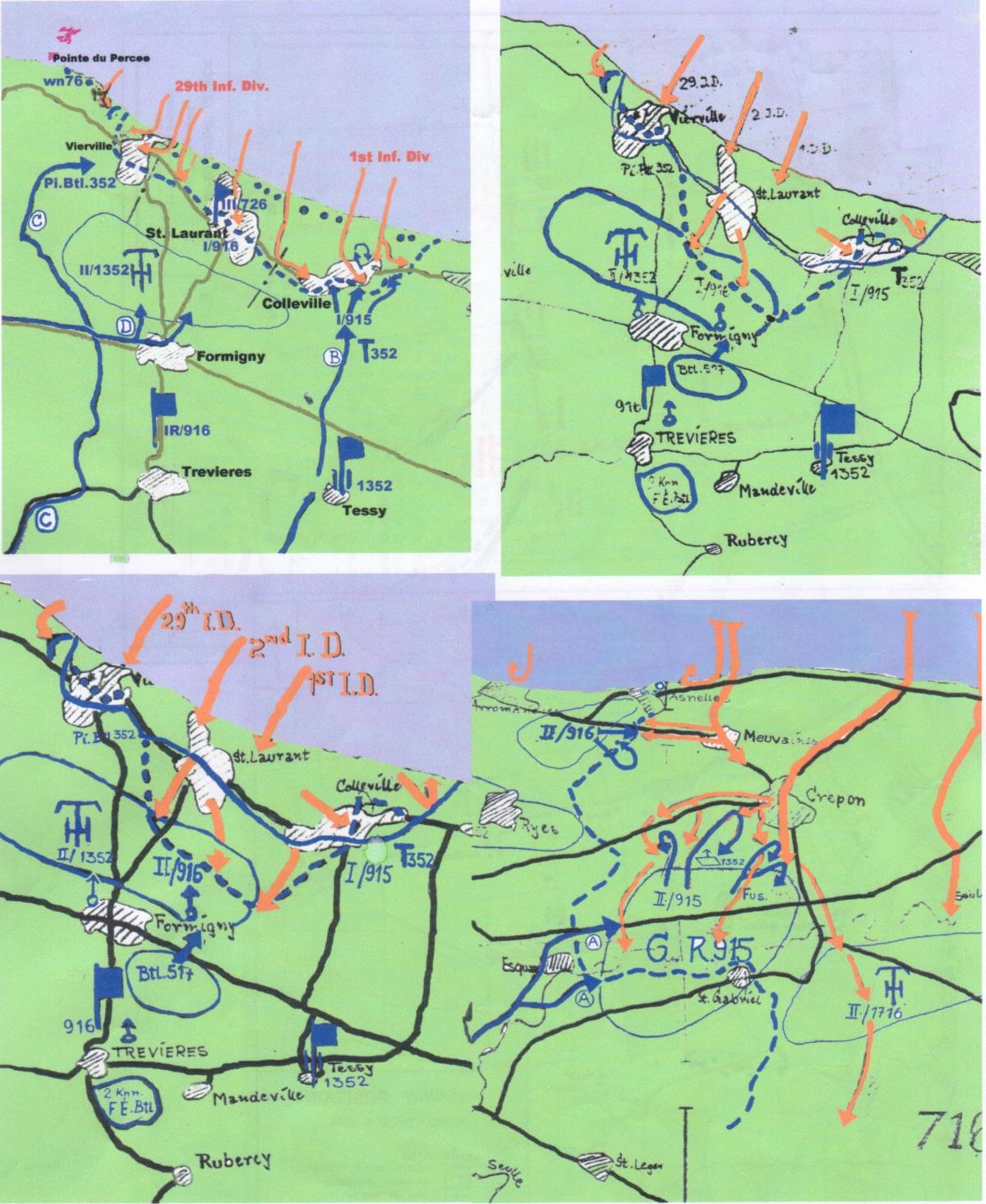
excerpts from the memories of a German senior officer of the 352nd Division (Colonel Goth ??, Cdr 916th Regiment of Grenadiers PC in Trevières) (received by Stewart B)
"The last reserves (Pionniers' Battalion 352) were therefore subordinated to the 916th Infantry Regiment (PC to Trevières) to regroup, then reduce the bridgehead and then remove it by a thrust from the West to the East. The division's intentions to also use the Replacement and Training Battalion were not viable, as its Companies were being rebuilt and not yet available on the evening of June 6.
On 7 June, after regrouping forces in the night, the 916th Regiment was ordered to launch a counter-attack on St-Laurent via Vierville. The Battalion of Pioneers 352 (at St-Martin de Blagny) moved to Louvières via Aignerville, was put under the command of the 916th Regiment. In addition, the Regiment was to coordinate with 2 FLAK Squadrons (one heavy - 88mm - and one light - 20mm -) of Regiment No.1 of Flak, employed against shore targets, which had been regrouped north of Formigny.
At around 9:00 a.m., the 916th Grenadier Regiment (Central Sector) reported that the attack on Vierville was progressing. It had been possible to repel the enemy to the far north of Vierville (??, seen from the American side, it was rather the loss of the Ormel at that time, hence the southern end of Vierville). Our attack from Vierville to St-Laurent had begun with elements of the 352nd/Pioneers (nothing was reported in this sense on the American side). The losses in Vierville were described as considerable on both sides (on the US side the significant losses of prisoners (several dozen sappers) were recorded in the 121st Engineer Battalion).
A telephone conversation with the Commander of the WN Fortified Point of the Percaea confirmed the report of the 916th Regiment and informed that the enemy had continued its landings, including tanks and artillery, all night and until now, practically without hindrance. (in fact, it does not appear that the Americans landed night troops, except at the beginning of the night in Colleville, the 26th Regiment, of the 1st Division)
How the 116th PC saw this counterattack (Captain Mac Grath's story)
Some vehicles had settled for the night in the "Transit Area 1", to the right of the regiment's PC (in Isles). Their safety was my immediate concern, because I knew that there were very few infantry on screen in front of them.
At 4:30 a.m., these infantry groups began to retreat in front of the little castle where I was. I asked them where they were going, and they said, "We are leaving, the Germans are coming behind us." There was now with me Lieutenant Garing, my sergeants, a Ranger officer and 7 his men. Knowing the tactical situation, it was obvious that the "Transit Area 1" would be uncovered after this withdrawal, so we set up a small aggressive force and attacked through the hedges while shooting continuously. We met some enemy snipers who had already occupied the ground left empty by the infantry, but as our shots ended up reaching their positions, they escaped back. I believe that we have succeeded because each of us has fired with the maximum of his means. We continued to advance to the main road (which is the road to Formigny ??) and then returned to the "Transit Area 1".
These movements took place between 6:00 a.m. and 9:00 a.m. We thought that this small counterattack, very brief, had eliminated any immediate danger, and by reaching Transit Area 1, we resumed our various activities.
In the central sector of the 916th Regiment, it was possible to attack the sides of the bridgehead. But the 916th reinforced Regiment suffered considerable losses and it was so physically and morally weakened because of the enemy's superiority in men and equipment (it was the bulk of the Vth US Corps), that on 8 June, the counter-attacks could not be continued. Rommel's tactics of annihilating or repelling the enemy on the beach could no longer be used in the 352nd Division area.
At approximately 00:00 (June 8), the Division's HQ took note of a detailed plan of the Allied objectives, which had been seized in Vierville, and which could inform us about the situation of the Americans. In my opinion, this very extensive order of operations far exceeded the resources of the Vth U.S. Corps. I recognized with my Division Commander that we did not have time to study it in detail. But as far as I can remember, this order covered all the details of D to J+17 days, and contained a lot of information about organization, armaments, assignments, tactical intentions, radio networks, etc."