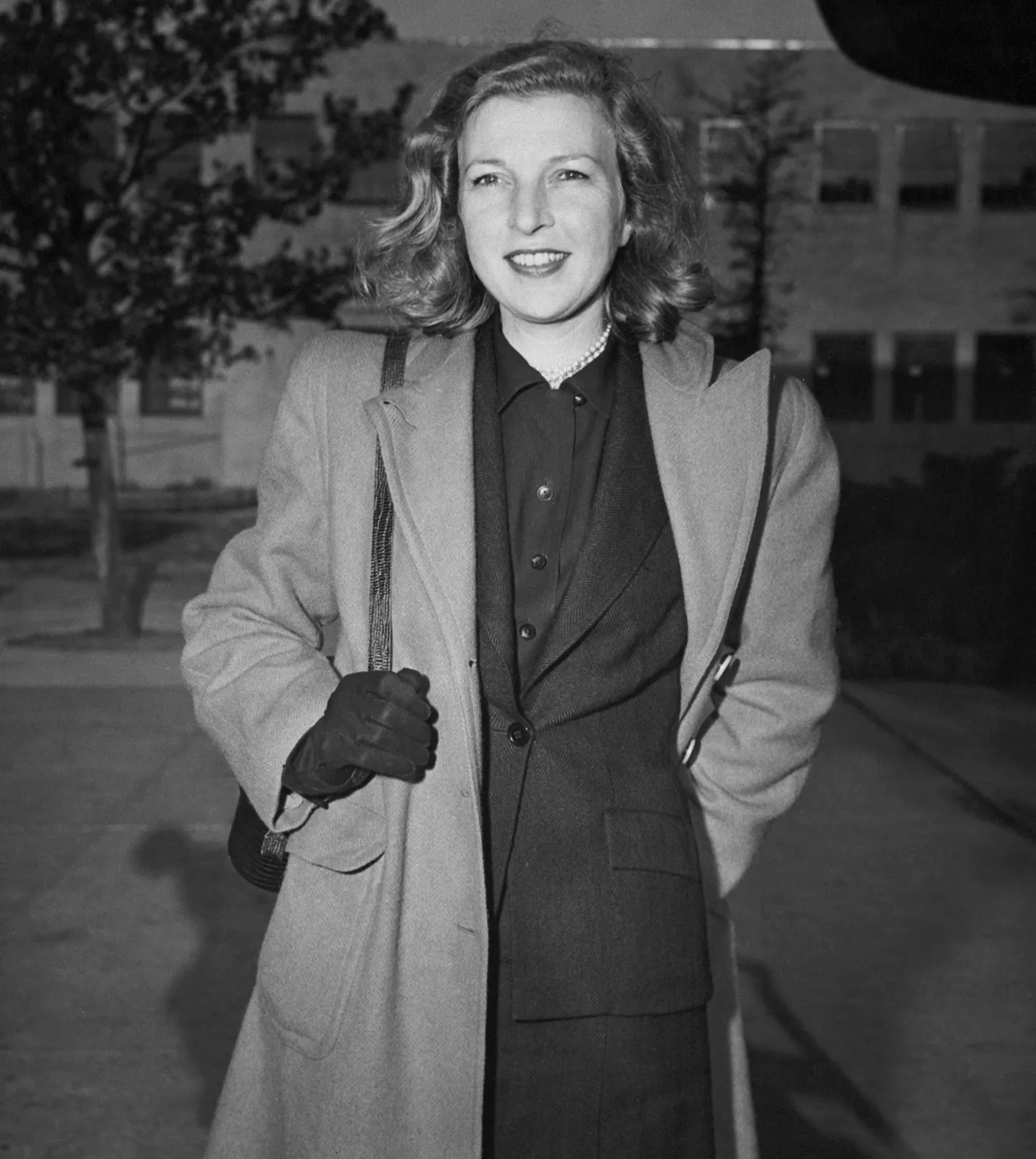
© FPG / Archive Photos / Getty Images.
Martha Gellhorn (1908–1998) was an American journalist and war correspondent attentive to the lives of civilians and soldiers. Published in Collier’s on 5 August 1944, this report describes the evacuation of wounded men from Normandy aboard a hospital ship.
The Wounded Come Home
By Martha Gellhorn — radioed from London
The Wounded Come Home
Collier’s correspondent goes on a great white ship to help bring back the boys who “got it” in the great invasion battles.
There was nothing to do now but wait. The big ship felt empty and strange. There were 422 beds covered with new blankets; and a bright, clean, well-equipped operating room, never before used; great cans marked “Whole Blood” stood on the decks; plasma bottles and supplies of drugs and bales of bandages were stored in handy places. Everything was ready, and any moment we would be leaving for France.
The ship itself was painfully white. The endless varied ships in this invasion port were gray or camouflaged and they seemed to have the right idea. We, on the other hand, were all fixed up like a sitting pigeon. Our ship was snowy white with a green line running along the sides below the deck rail, and with many bright new red crosses painted on the hull and painted flat on the boat deck. We were to travel alone. There was not so much as a pistol on board in the way of armament, and neither the English crew and ship’s officers nor the American medical personnel had any notion of what happened to large, conspicuous white ships when they appeared at a war, though everyone knew the Geneva agreement concerning such ships, and everyone hoped the Germans would take the said agreement seriously.
There were six nurses aboard, and they were fine girls. They came from Texas and Michigan and California and Wisconsin, and three weeks ago they were in the U.S.A. completing their training for this overseas assignment. They had been prepared to work on a hospital train, which would mean caring for wounded in sensible, steady railway carriages. Instead, they found themselves on a ship, and they were about to move across the dark water of the Channel.
This sudden switch in plans was simply part of the day’s work, and each one, in her own excellent way, got through the grim business of waiting for the unknown to start, as elegantly as she could. It was very elegant, indeed, especially if you remembered that no one aboard had ever been on a hospital ship before, and so the helpful voice of experience was lacking.
The nurses had worked day and night for two weeks to get this ship ready to receive wounded. They had scrubbed floors and walls, made beds, prepared supplies, and now their work was finished. They went on working, inventing odd jobs to keep busy during these final empty hours before the real work began.
But two tired, brave, tough girls sat on a bench inside the hall of the ship, and painted their fingernails with bright red varnish and talked about wanting their mail and worried about their missing foot lockers, their valuable foot lockers which had in them the vital comfortable shoes and the unvital, probably never-to-be-worn evening dresses.
One of the British ship’s officers, who had been in the Merchant Marine since the beginning of the war, but had never yet set forth in a white ship, came to talk with the girls. He looked tired, too, and he was vastly amused by their nail polish.
“It would be nice,” he said, “if we could take that nail polish up to London tonight, instead of where we’re going.”
The tall pretty nurse held her hands out to see whether the job was well done.
“No,” she said. She was from Texas and spoke in a soft, slow voice. “No. I’m glad to be going where I’m going. Don’t you know how happy those little old boys are going to be when they see us coming?”
Pulling out of the harbor that night we passed a Liberty ship, going the same way. The ship was gray against the gray water and the gray sky, and standing on her decks, packed solidly together, khaki, silent and unmoving, were American troops. No one waved and no one called. The crowded gray ship and the empty white ship sailed slowly out of the harbor toward France.
We crossed by daylight, and the morning seemed longer than other mornings. The captain never left the bridge and, all alone and beautifully white, we made our way through the mine-swept channel. Everyone silently hoped that this would be a lucky number; and we waited very hard.
Then we saw the coast of France and, as we closed in, there was one LCT near us, with washing hung up on a line, and between the loud explosions of mines being detonated on the beach, one could hear dance music coming from its radio. There were barrage balloons, always looking like comic toy elephants, bouncing in the high wind above the massed ships, and you could hear invisible planes flying behind the gray ceiling of cloud. Troops were unloading from big ships to heavy barges or to light craft, and on the shore, moving up brown roads that scarred the hillside, our tanks clanked slowly and steadily forward.
Then we stopped noticing the invasion, the ships, the ominous beach, because the first wounded had arrived.
An LCT drew alongside our ship, pitching in the waves. A boy in a steel helmet shouted up to the crew at the aft rail, and a wooden box looking like a lidless coffin was lowered on a pulley, and with the greatest difficulty, bracing themselves against the movement of their boat, the men on the LCT laid a stretcher inside the box. The box was raised to our deck, and out of it was lifted a man who was closer to being a child than a man, dead-white and seemingly dying. The first wounded man to be brought to that ship for safety and care was a German prisoner.
Everything happened at once. We had six water ambulances—light motor launches which swung down from the ship’s side and could be raised the same way when full of wounded. They carried six litter cases apiece, or as many walking wounded as could be crowded into them. Now they were being lowered, with shouted orders:
“That beach over there where they’ve got streamers up.”
“Watch Out for Mines!”
“Take her in slow… Those double round things that look like flat spools are mines… You won’t clear any submerged tanks, so look sharp… Ready?… Lower her!”
The captain came down from the bridge to watch this. He was feeling very jolly, as well he might, and he now remarked,
“I got us in all right, but Heaven only knows how we’ll ever get out.”
He gestured toward the ships that were as thick around us as cars in a parking lot.
“Worry about that some other time,” he said brightly.
The stretcher-bearers, who were part of the American medical personnel, now started on their long backbreaking job. By the end of that trip, their hands were padded with blisters and they were practically hospital cases themselves. For the wounded had to be got from the shore into our own water ambulances or into other craft, raised over the side, and then transported down the winding stairs of this converted pleasure ship to the wards. The ship’s crew became volunteer stretcher-bearers, instantly.
Wounded were pouring in now, hauled up in the lidless coffin, or swung aboard in the motor ambulances, and finally an LST tied alongside and made itself into a sort of landing jetty, higher than the light craft that ran the wounded to us, but not as high as our deck. So the wounded were lifted by men standing on the LST, who raised the stretchers high above their heads and handed them up to men on our deck, who caught hold of the stretcher handles. It was a fast, terrifying bucket-brigade system, but it worked.
Belowstairs, for three decks the inside of the ship was a vast ward with double tiers of bunks. The routine of the ship ran marvelously, though four doctors, six nurses and about fourteen medical orderlies had to be great people to care for four hundred wounded men. From two o’clock one afternoon, until the ship docked in England again the next evening at seven, none of the medical personnel stopped work. And besides plasma and blood transfusions, re-dressing of wounds, examinations, administering of sedatives or opiates or oxygen and all the rest, operations were performed all night long. Only one soldier died on that ship and he had come aboard as a hopeless case.
No Time for Interviews
It will be hard to tell you of the wounded, there were so many of them. There was no time to talk; there was too much else to do. They had to be fed, as most of them had not eaten for two days; their shoes had to be cut off; they needed help to get out of their jackets; they wanted water; the nurses and orderlies, working like demons, had to be found and called quickly to a bunk where a man suddenly and desperately needed attention; plasma bottles must be watched; cigarettes had to be lighted and held for those who could not use their hands; it seemed to take hours to pour hot coffee, from the spout of a teapot, into a mouth that just showed through bandages.
But the wounded talked among themselves, and as time went on you got to know them, by their faces and their wounds, not by their names. They were a magnificent enduring bunch of men. Men smiled who were in such pain that all they really can have wanted to do was turn their heads away and cry, and men made jokes when they needed their strength just to survive. All of them looked after one another, saying, “Give that boy a drink of water,” or “Miss, see that Ranger over there; he’s in bad shape. Could you go to him?” All through the ship, men were asking after other men by name, anxiously, wondering if they were on board and how they were doing.
On A Deck, in a bunk by the wall, lay a very young lieutenant. He had a bad chest wound, his face was white, and he lay too still. Suddenly he raised himself on his elbow and looked straight ahead of him, as if he did not know where he was. He had a gentle oval face and wide blue eyes and his eyes were full of horror and he did not speak. He had been wounded the first day, had lain out in a field for two days and then crawled back to our lines, sniped at by the Germans. He realized now that a German, badly wounded also in the chest, shoulder and legs, lay in the bunk behind him. The gentle-faced boy said very softly, because it was hard to speak, “I’d kill him if I could move.” After that he did not speak for a long time; he was given oxygen and later operated on, so that he could breathe.
The man behind him was a nineteen-year-old Austrian. He had fought for a year in Russia and half a year in France; he had been home for six days during this time. I thought he would die when he first came on board but he got better. In the early morning hours he asked whether wounded prisoners were exchanged, would he ever get home again. I told him that I did not know about these arrangements, but that he had nothing to fear, as he could see. I was not trying to be kind, but only trying to be as decent as the nurses and doctors were. The Austrian said, “Yes, yes.” Then he added, “So many men, all wounded, want to get home. Why have we ever fought one another?”
Perhaps because…
Photograph captions in the supplied passage
- The medics carried the stretchers down the tortuous passageways of the converted liner for hours, until they were very nearly litter cases themselves.
- One at a time the wounded were placed, stretchers and all, in a rectangular box that looked like a lidless coffin, and hoisted over the rail of the hospital ship.
- Just a few hours after he had been trying to kill U.S. soldiers this wounded German is saved by blood plasma donated by some American citizen.
A central caption concerning the beach and a field hospital is too corrupted to transcribe reliably. Not all photograph credits can be recovered from the supplied transcription.
Martha Gellhorn: her career and the circumstances of the report
A career established before Normandy
Martha Gellhorn (1908–1998) was an American journalist and writer born in Missouri. Her career developed before her marriage to Ernest Hemingway. In the 1930s she investigated the effects of the Great Depression in the United States, then covered the Spanish Civil War in 1937, notably for Collier’s. Her writing focuses on people who were poor, displaced or caught in conflicts. It also expresses her commitments: her work needs to be understood in the circumstances and convictions of its author. English Heritage.
Obstacles to covering the landings
In 1944, military authorities refused female correspondents permission to follow the Allied landings. Gellhorn also faced a professional obstacle: Collier’s gave Hemingway the assignment she had hoped to carry out. These facts document unequal access to the field and editorial competition in which the writer’s fame played a part. Presenting Gellhorn primarily through her marriage pushes an already established journalistic career into the background. Smithsonian.
On 6 June she was still in London. She then went to Southampton and boarded the hospital ship Prague, saying she wanted to interview the nurses. She hid in a bathroom until the ship sailed. The Smithsonian places the ship off Omaha on 7 June and her return aboard after an evacuation mission in the night leading into 8 June; American Heritage dates her arrival on the beach to 8 June. The sources consulted therefore differ on this precise point. They place her on a medical evacuation mission after the first assault waves. Smithsonian, American Heritage.
Aboard ship, she observed the care given and helped with certain tasks, notably interpreting for the wounded. She accompanied a team that went ashore to collect patients. On returning to England, she was arrested by the military police for her unauthorized journey. Her report nevertheless appeared in the 5 August 1944 issue of Collier’s. The documented exclusion therefore concerned permissions, means of access and the editorial treatment of her work. American Heritage.
An account to read alongside others
Gellhorn continued reporting after Normandy. She entered Dachau after its liberation, attended the Nuremberg trials and later covered other conflicts, including the Vietnam War. Some of her war reporting was collected in The Face of War, published in 1959 and subsequently expanded. Her attention to civilians and the tangible effects of war runs through these different periods. English Heritage.
Her career highlights the importance of the conditions in which information is gathered: permissions, military supervision, freedom of movement and publication choices. Historical analysis establishes these conditions, distinguishes what a witness saw from what they recount, and compares the account with other sources. Gellhorn’s text thus provides the situated perspective of a correspondent among medical staff and wounded men, both American and German. It complements operational accounts with a description of people and care.
Yohann Cordelle
To continue exploring this subject: listen to the episode of Affaires sensibles on France Inter.