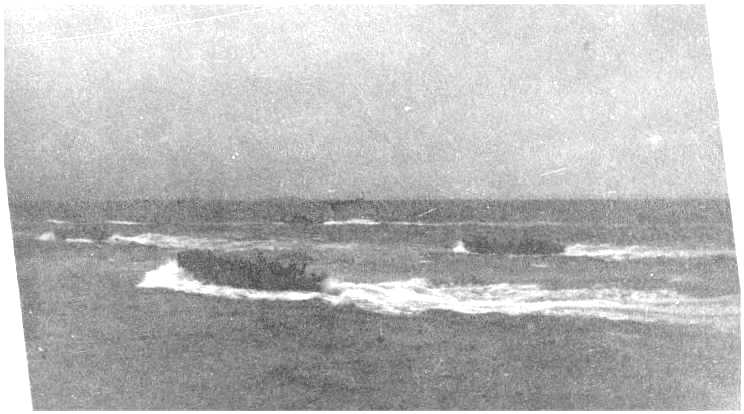
5 of Jimmy Green's LCA are approaching Vierville, carrying Cie A/116
It's 6:00 in the morning and it's still dark, the sun has just risen.
Here are the comments of Jimmy Green's son-in-law in this photo:
"Five LCAs approaching Vierville-sur-Mer at dawn on D-Day less than 1000 meters from the beach.
The first wave of infantry landing craft either side of the Vierville-sur-Mer draw were British LCAs (Landing Craft Assault) with Royal Navy crews from HMS Prince Charles and SS Empire Javelin. They were assigned to the Omaha sector under US Navy command.
Company C/2nd Rangers and Company A/116th Regiment/29th Infantry Division landed in 7 LCAs in the first wave.
My father-in-law, Jimmy Green, was the Royal Navy officer in charge of the first wave. Kevan"


Testimony of Lieutenant Green
Commander of the 551st LCA Flotilla
On 6 June, this flotilla carried A/116
Around 4am on 6 June 1944, the first 6 LCA of the 551st Flotilla of assault were launched by the transport "SS Empire Javelin", in a turbulent sea, with the men of Company A/116 already embarked.
The Ensign George "Jimmy" Green, a sailor in charge of leading them to Omaha Beach (Secteur Dog Green in front of Vierville) had already had experience (he had participated on board the destroyer HMS "Bulldog" in the capture of submarine U-110, on May 9, 1941, with his crew and equipment, including an encrypting machine "Enigma"! ).
"In early 1944, I joined the 551st Landing Assault Flotilla in Plymouth as a Divisional Officer (a function that is also called Executive Officer). We were waiting for the arrival of the SS Javelin Empire (our mother ship). After arriving in Plymouth, the SS Empire Javelin sailed for Scotland. We trained there, day and night, with the troops.
In early June, the Javelin Empire arrived in Portland, and we took on board the 1st Battalion of the 116th Infantry Regiment, along with other units, which were in support. There was a series of briefings at the Pavilion in Weymouth, and I attended a special briefing because of my particular role.
I was the leader of the first wave, and I had to land Company A of 116th Infantry Regiment in Vierville-sur-Mer at 6:30am on June 5. I had six boats of the 551th Flotilla under my command, plus two LCA of the HMS Prince Charles, which carried Company C of the 2nd Ranger Batallion. Captain Taylor Fellers told me, that in his case, it was the first time he and his Company had gone to combat, and he asked me for all my help. I assured him, if we could see Germans, we'd open fire with our Lewis Guns.
"My LCA 910 was on starboard on the lower deck with LCA 911 behind me. Captain Taylor Fellers and 31 men were waiting next to LCA 910. They were quickly on board to be released on a black and inamical sea. When LCA 910 was released, we were struck at the stern by LCA 911 and we started taking water in the engine chamber. After discussing it with the Webb "Stoker", we thought we could stay afloat if Webb used the hand pump to the maximum. After this little incident we found the American patrol boat that was to escort us some of the way to Vierville. We started in two columns of three, with LCA 910 at the head of the starboard column and SubLieutenant Tony Drew at the head of port column. There was no sign of the two LCAs at HMS Prince Charles and we left without them. It was difficult to get into this high sea and he was taking water over the bow. Nevertheless, we were on time. 8 kilometers from the coast, we dropped the American patrolman after a mutual exchange of respect signals. A few minutes later, we came across a group of LCTs that were moving twice as fast as we were. We left them in our wake and never saw them again. The day began to rise and the bombing of warships and cruisers had stopped. I could vaguely distinguish the French coasts through the darkness and notice clouds of smoke at the top of the cliffs. The moment was approaching to form a front line and to run on the shore. I turned around to see if the other boats could get there. At that time, I saw the bow of LCA 911 plunge into the sea and disappear under the waves. All the crew and the soldiers had their lifejackets and I could only hope they could stay in the water until I came back. It was against the principles of a sailor to abandon his comrades to the sea, but LCA 910 had no room and our orders were clear: "Leave the survivors to the sea, they would be recovered later". It was essential to land on time. A few minutes later, as we approached the shore, I spotted some bunkers and hoped they would be neutralized. A group of LCT(R) came behind us and they fired all their rockets. None arrived near the shore line. Now we were alone on the right beach and at the right time, in mind. We didn't see anyone on either side. Just yourself. And the French coast. An extraordinary adventure. 30 meters from the shore, we've been heeled."
Captain TayIor Fellers wanted to land to the right of the parade and the other three boats from the starboard column, to the left of the parade. Taylor Fellers came forward as soon as the ramp was lowered, before I could have wished him good luck. They were all deposited safe on the beach.
Jimmy remembers, the troops, sitting on 3 lines facing the beach, went out, left and right, decided, and as in training. They were deafened by their weapons and equipment, slowly exiting through the narrow opening of the LCA. It lasted a very long time and Jimmy "wanted to get out of here as soon as possible."
For good reasons, as the mortars had found the distance and the shells were falling more and more. As the last soldiers left on 910, Jimmy broke the radio silence and reported "Avons disembarked on time, against opposition." The German machine guns had not yet fired. "I didn't see Taylor Fellers' death," said Jimmy, "I saw him move forward, get on the sand, start organizing." At that time, there was a lull in German fire. The landing had taken enough time and I was burning up to return to the survivors of LCA 911, hoping they would still be floating at 1.6 kilometres shore. I looked on my left and saw Tony Drew on his LCA stern. I intended to see if I could help him when my pilot told me there were some of our young guys on the beach. I thought it was bad luck, but he was right. The two boats with the Rangers on board had landed just behind us, to the right. The crew of one of these boats was a frantic sign and wanted us to get them back. I was thinking of Toni Drew, the survivors of LCA 911, but I couldn't leave those who were still on the beach. One of them was injured and was supported by sailors. They told me that they had been hit by four mortar shells that had destroyed their LCA and killed many Rangers. We returned (following) to search for the survivors of LCA 911."
Jimmy left the Royal Navy in 1946, studied history and then returned to service in the army from where he retired as a Colonel. "A sailor always has the greatest respect for the troops he carries," he says.