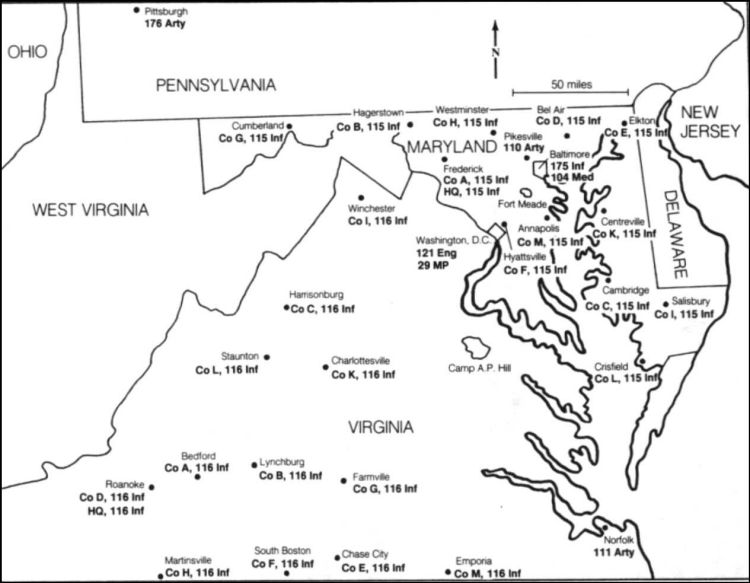
Geographical origin of the soldiers of the 29th Division: Maryland and Virginia, Company A/116 came from Bedford near Roanoke
24322
Detailed account of the landing of Company A/116
(Excerpts from the book of S.L.A. MARSHALL : "Battle at Best")
About 60% of the men in Cie A/116 came from the same city, Bedford, VirginiaFor Bedford, the first 15 minutes on Omaha Beach were an irremediable disaster. The G company that was to approach just east of the A, on Dog White, drifted by more than a kilometre, so the Germans defending the Vierville strongpoint came to rest on the A-Cie. It was a massacre. About 30 survivors, almost all injured. Here are some details about his agony.
Company A (Able Cy) of 116° Reg., boarded in 7 LCA, is still 4500m from the beach when it is caught for the first time under an artillery fire. The shells fall short. At 1000m, the ship N°5 is struck to death (in fact it probably sank as a result of damage suffered when it was launched, when it approached another LCA) and sinks. Six men drown before rescues arrive. Second Lieutenant Edward Gearing and twenty men paddling before being collected by a naval patrolman, thus missing the fight on the shore. It's their lucky day.
Private John Barnes of Cie A/116 was in this LCA. As he approached the front line with 11 other boats, someone shouted: "Look! You'll tell that to your grandchildren!"
And Barnes thought, "Yes, if we get out alive."
In front, he could see the bell tower of Vierville. Cie A was in exactly the right place. The LCA roared through the waves.
"All of a sudden a whirlwind of water wrapped my ankles and the bow of the boat plunged. The water quickly reaches my size and we called the other boats on either side. They made us a sign of farewell in response. The boat sank under my feet. I was pressing the gas cartridges in my life belt. The buckle jumped and she ran away. I was grabbing the man's back next to me, I was falling. I was climbing on his back, panicked. Heads floated on the water. We saw the other boats moving away to the shore."
A few men had fitted their weapons with life belts and swollen them. Barnes saw a floating rifle, then a flamethrower with 2 belts around.
"I was clinging to it, but I was still sinking. I couldn't keep my head out of the water. I was trying to drop the straps on my assault vest, but I couldn't move. Lieutenant Gearing grabbed my vest and cut the straps with his knife, which made me feel better. Now I could swim."
The group was 1 kilometer from the shore. Sergeant Laird wanted to go there swimming, but Lieutenant Gearing said, "No, we're going to wait and get caught by a boat that's going through here." But none wanted to stop; the pilots were ordered to continue and leave the rescue work to others.
After a while, "We heard a friendly call from an LCA. He stopped, his boat was empty. He helped us climb aboard. We recognized the pilot. He was from the Javelin Empire. He wasn't going back to the beach. We asked what became of the others. He says they landed them OK. We thus returned to the "Javelin Empire", which we had left at 4 a.m. How long have you been here? A few minutes, it seemed to me. When I thought about asking, it was 1:00."
Barnes and his ship section were lucky.
The other 6 LCAs continue their unharmed route up to 100m from shore, where a shell kills 2 men in boat #3. A dozen others drown as the boat sinks. There's five LCA left.
Lieutenant Edward Tidrick in Boat No. 2 screams:
"We just get to the right place, but look: no wall, no shell holes, no shelter, nothing!".
His men are on the sides of the boat trying to see their goal. They look but don't say anything. At 0636, exactly, the ramp is lowered in the axis of the boat and the men jump into the water that climbs them sometimes to the waist sometimes over the head. This is the signal the Germans expected on the cliff. Already hit by mortars, the area is immediately swept away by a crossfire of machine guns coming from both sides of the beach.
Each section of the boat had planned to go up to the sand in 3 rows per boat, the central line passing first, the lateral lines then stretching to the right and left. The first exiters try, but are torn by the bullets and separated before they have gone 5m. Even the light wounded drown, crushed by weight their equipment.
From ship number one, all jump in water that exceeds their heads. Most of them are trained at the bottom. About ten survivors remain around the boat, hanging on its shores to try to float.
The same thing happens to the section of the ship No. 4. Half is lost by fire or drowning before some arrive on the sand. Any organization disappeared from the A.C. before it fired a single shot.
From then on the sea becomes red. Even in some of the lightly injured who jump into shallow water, the blows are fatal. Suffered by a bullet in the arm or weakened by fear and shock, they are unable to rise and drown in the rising tide. Other injured people drag themselves to the sand and lie there completely exhausted, to be caught up by rising water and drowned. Some walk unharmed through the bullets sweeping the beach, see that they cannot stay there. They come back in the water to hide there. On the back, the nostrils out of the water, they crawl towards the shore with the tide. This is how most survivors will survive. Some seek shelter from obstacles planted on the beach and are shot down by machine guns.
Less than 7 minutes after the ramps were lowered, Cie A was inert and without a leader. On boat 2, Lieutenant Tidrick took a bullet in the throat by jumping from the ramp in the water. It stumbles to the sand and collapses 3m from soldier 1era Leo J.Nash class. Nash sees the blood stinging and hears Tidrick's strangled path: "go with the shears!". It's futile; Nash has no shear. To give this order, Tidrick straightened himself on his hands, becoming a target for a moment. Nash, flattened in the sand, sees machine gunshots tear up Tidrick's entire body. From the cliff above, the Germans shoot at the survivors as from the top of a roof.
Captain Taytor N.Fellers and Lieutenant Benjamin R.Kearfoot will not get out. They boarded with a section of 30 men in the ship N°6 LCA N°1015). But what exactly became of this ship and its human cargo, no one will ever know. No one saw it sink. How every man on board found death will remain unanswered. Half of the drowned bodies were later found along the beach. We think the sea kept the others.
On the beach, only one CieA officer still lives, Lieutenant Elijah Nance, hit in the heel leaving the LCA, touched a second time in the belly when he arrived on the sand. After 10 minutes, all sergeants died or injured. For a man like Gilbert G. Murdock, this cleanup suggests that the Germans on the cliff spotted the leaders and focused their shots on them. The men who are still in the water with the tide threw guns, packs and helmets to survive.
On the right of Tidrick's boat drifting from the tide, his dead pilot next to the brilliance bar, the 7th LCA, carrying a medical group with an officer and 16 men shows up on the beach. The ramp's falling down. At the same time, two machine guns concentrate their fire on the opening. No one has time to get out. Everyone on board is broke where they are.
After a quarter of an hour, Cie A/116 has not yet fired a single shot. No more orders are given. Nobody says anything anymore. The few capable survivors move or not, depending on what they think is the best. Staying alive is a full-time occupation. The fight has become a rescue operation in which only the force of the example counts.
Above the others stands the first aidist Thomas Breedin. When he reaches the sand, he gets rid of his package, jacket, helmet and shoes. One moment he stands up for others to see him and have the same idea. Then he crawls in the water to shoot the wounded about to be submerged by the tide. The deeper waters are always dotted by those who advance to the tide rhythm. But now, like Breedin, the strongest of them become more visible goals. They approach, take their wounded comrades and make them float like rafts to the shore. The machine guns keep ripping the water. In turn they destroy the rescue work, tearing the floating bodies out of the hands of the walkers or killing them both. But during this hour, Breedin is under the spell and continues his work imperturbably.
After half an hour, about two thirds of the company disappeared forever. There is no costing of losses at that time. Only God knows if the A-Cie riflemen died more of drowning than enemy fire. Earthly indications seem to show this, but there is no evidence.
After 1 hour, the survivors crawled on the beach to the foot of the seafront, where there is a narrow sanctuary of protected space. They are lying there, disarmed, too shocked to feel hunger, unable even to talk to each other. No one comes to help them, ask them what happened, give them water, or offer them unclaimed compassion. D-Day in Omaha does not offer time and space for such acts. Every disembarking company has too much to do with its own difficulties.
After 1:45 a.m., 6 survivors of the ship section of the far right (to the west) made a way on a cliff. 4 fell exhausted by this short escalation and went no further. They stayed there all day, didn't see anyone else in the company. The other two, soldiers Jake Shefer and Thomas Lovejoy, joined a group of 2ème Rangers Battalion, CieC, and fought with them all day against the fortified point of the "Gambier" house. Two men. Two guns. This is the only contribution of the CieA to the D-Day fights.