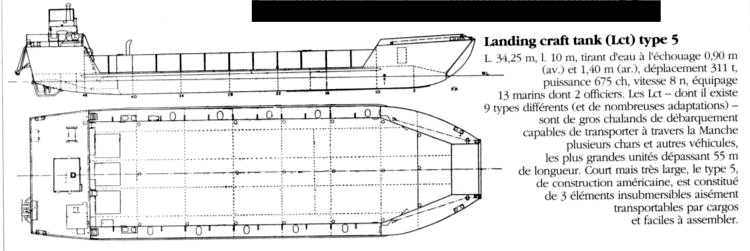
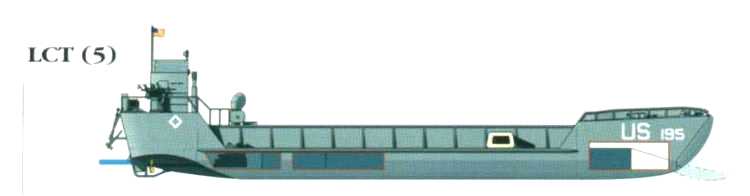
plan of the LCT mark 5




352
The 147th Beach Engineers Battalion
(of the 6th Special Engineer Brigade)
in Vierville on 6 June
The 147th Beach Engineers Battalion was part of the 6th Special Engineers Brigade, which was responsible for the ground-based operation of the bridgehead "Omaha Beach". This battalion was specifically assigned to the beaches of Vierville "Dog Green" and "Dog White".
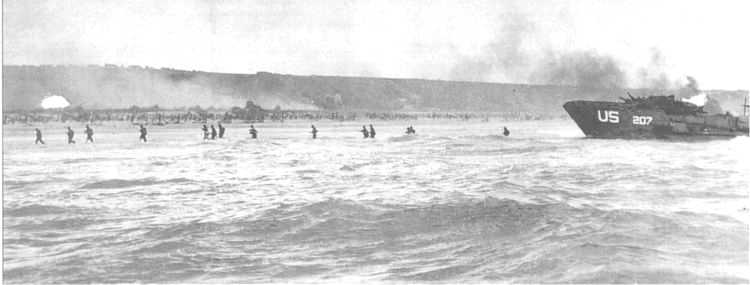
The bulk of its sappers landed on Dog White with LCI 91 and 92 and suffered heavy losses during the fire of these two large ships on the beach.
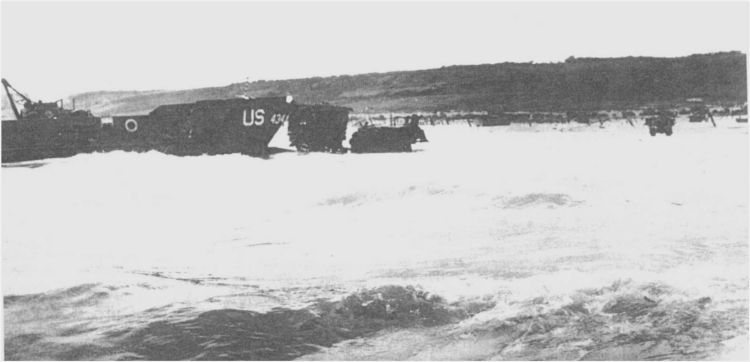
The vehicles and equipment were to arrive at around 9.30 am on several LCTs, but they were delayed and drifted to Le Ruquet, except for 1 or 2 LCTs that approached Dog White or Dog Red at approximately 11:00 am.
The battalion was therefore dispersed and before the groups, some elements followed the infantry towards Vierville by the cliff.
Here are some testimonies about Cie B/147:
(Excerpts from the Testimonials of Captain Roy Gordon and Lieutenant George Itzel):
"Because of the initial losses on the beach, B/147 was reduced by 50%. An officer and 19 sappers were killed on landing. 35 sappers were burned, injured or found floating half drowned in water near the ship in perdition (an LCI in front of Dog White at about 8:00 a.m.). The rest of it came out and came to the shore.
Later, those seriously injured had to be evacuated to Weymouth. The most seriously affected were even returned to the United States.
The company's PC was to be installed in the middle of the Dog White sector (up to the Raymond Marchal villa). The location was known to everyone in the Company, in case he needed something during the operations. I had to crawl to that location through the obstacles. There was machine gun fire everywhere. And also, shortly after my arrival, mortar and artillery fire.
Operations have therefore started slowly. The staff responsible for specific tasks were to be consolidated and new assignments ordered. We weren't many enough to complete all the missions in a row. Specialized equipment had often been lost and dispatches were on the agenda.
The problem of firing was solved when we were able to install a light machine gun aimed at the flank of the German trenches and thus drive the enemy out of the nearby cliffs.
The company was embarrassed in its work by the troops disembarked from the barges (Cie C/116 and the Rangers) and who did not leave quickly inward (around 7:30 a.m./ 8:30 a.m.).
A moment their advance was blocked in the cliff and congestion occurred. I was so concerned that I radioed the command ship about this situation. The space available was sufficiently limited, without a pile of troops turning it into an easy target for the enemy. Shortly after, an infantry colonel arrived and incited his units to leave.
All the engineers troops (at least those of the Special Brigades, but not the 121st Engineer Battalion) were recognizable by their 1/2 white circle painted on the front of their helmet. Troops not wearing this mark were invited to leave.
When enough troops left the area between the road and the cliff (around 9 a.m.), our sappers started cleaning it from its traps and mines. It was necessary to have the area ready for a first supply depot, for evacuations of wounded and for the PC to be enlarged. Later a temporary cemetery for D-Day deaths was installed there (a monument currently commemorates it).
Mine detectors were used to detect any metal objects, to dig up carefully, and to blow up with TNT.
All troops and equipment disembarking have been confined to safe and marked areas. These provisions had to be implemented for 2 days.
The beach itself had to be cleaned and demarcated exactly.
The three types of obstacles on the beach were all mined or trapped in one way or another. The stakes were exploded by their base. It was found that there was usually a mine hidden at the foot. A block of TNT cut the stake at the base and at the same time blew up the mine. Metal hedgehogs were broken into pieces by placing a block of TNT in the centre of the crumbs. All obstacles were removed at the end of D-Day.
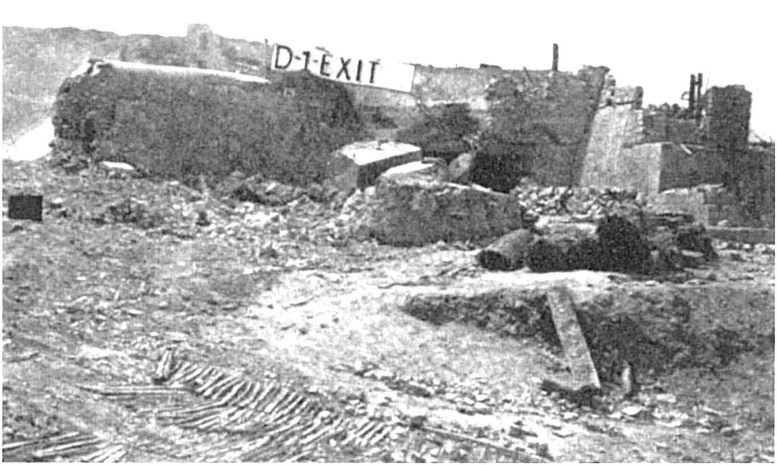
A difficulty arose very early when tanks and other vehicles were unable to leave the beach, with exits D1 (Vierville) and D3 (St-Laurent) closed. A concrete wall across D1 closed the exit (at D3, St-Laurent, the Germans kept the passage until the next day). Lieutenant Turpin, one of my officers, informed me of this problem and also warned me that there was a shortage of TNT on site to destroy the wall.
See the account of Sergeant Dube (121st Genie) of the destruction of the wall
This is the corresponding account made by the sappers of the 147th Genie., which participated in the destruction of the wall, gathering sappers, explosives and bulldozers.