




331
The progression of the company C/116 from the beach to Vierville
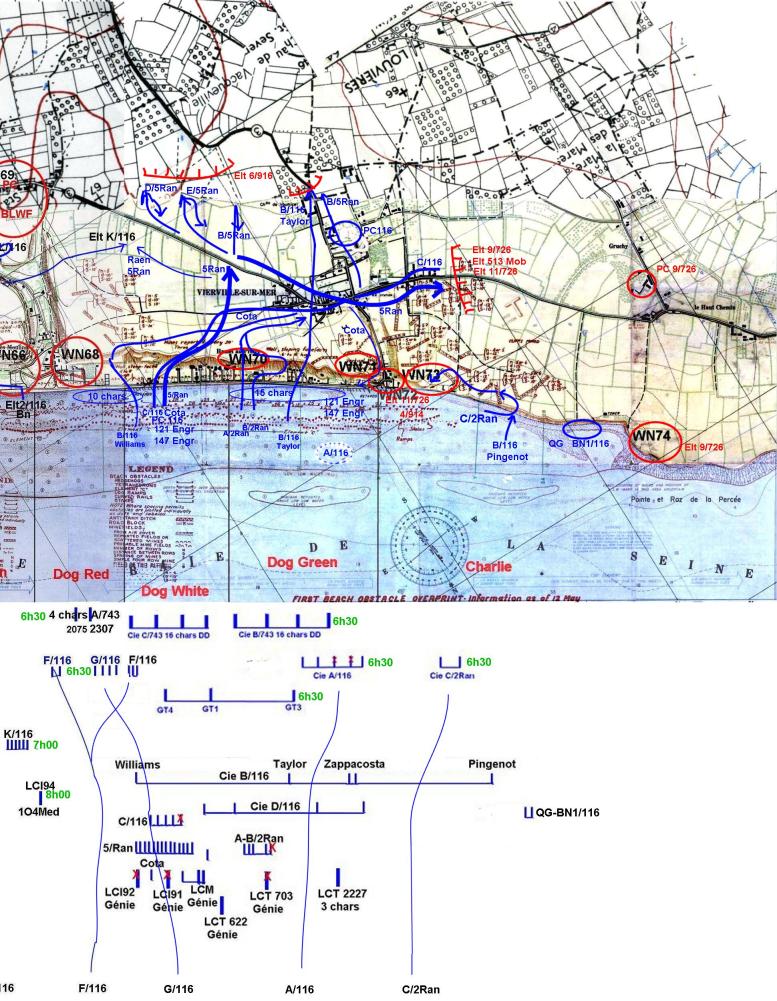
On the Dog White area between the 1st cemetery and the Richard villa, Company C of 116° Reg. of Infantry landed at about 0710 hours in relatively good conditions and suffered only very slight losses, but the men had piled themselves along the pebble slope, at the foot of a wall of tree trunks on the seafront.
A few sections of these troops came from other units of the 116th Reg. and some elements of the engineers (121st and 147th Battalions of the Engineers). Immediately behind, the 5th Rangers Battalion landed in turn.
The ensemble represented about 700 infantrymen, Rangers and a few sappers.
The start-up of all these troops was stimulated by the presence of General Cota and the 116th Regiment Command Group, which had landed at the same location at about 0730 hours. Exposed to the enemy fire, which injured Colonel Canham on the wrist, these officers walked along and down the slope, urging officers and non-commissioned officers to advance their men.
See testimony of C/116 Company soldiers collected by Lieutenant Shea
The area (old villas completely demolished) was favourable to a progression on the flat area behind the road, and to climbing the cliffs. The closest German strong points were several hundred meters on each side and there was no concentrated fire on this area, yet full of troops.
A thick smoke produced by burning grasses on the slopes of the cliffs stretched eastward. From the pebbly slope to the foot of the cliff, there were only 150 meters, but this flat terrain, with some marshy places, was practically empty of all covered except a few ruins.
Company C/116's progress began at about 7:50 a.m. Along the road bordering the seafront, there was a double network of intertwined barbed wires.
Private Ingram E. Lambert jumped over the wall, crossed the road and prepared a Bangalore pole. When he fired the friction fire, it didn't work and Lambert was killed by a bullet. The platoon leader, Sub-Lieutenant Stanley M. Schwartz, jumped in turn and repaired the firing. The explosion opened a large breach; the first man who tried to pass there was killed, but others followed and were able to shelter in a few empty trenches close to the road, where they were joined by another group who had crossed the network by cutting the barbed wires. After 5 to 10 minutes, while other troops crossed the road to the trenches, they headed towards the cliff.
The cliff was bare, not very steep, the climbing men found small folds of land and depressions providing shelter against the shooting of small arms. The German defences on this part of Dog White had few shooter positions, sometimes empty of defenders, and connected between them by deep trenches, located just on the ridge of the cliff.
The slope and smoke provided good protection, but the advance was slowed down by fear of the mines. The men climbed into a narrow column, groping the land in front of them and oblivating to the west to enjoy a narrow path.
No enemy was encountered in the trenches on the ridge. The column moved about two hundred metres into flat, bare fields, and stopped by encountering sporadic machine gun fire at some distance on its flanks. It was the only sign of enemy resistance and Company C/116 had lost only half a dozen soldiers since it left the pebbly slope.
Captain Berthier B. Hawks, who had made a sprain while disembarking, came to the top with his men. At about 8:00 a.m., they were all on the cliff, but still had to shelter on the ground in open ground.
General Cota also reached the ridge above the central part of Vierville Beach. Cota and the 116th Regiment Command Group (Colonel Canham) spent a lot of time separating the units intertwined with the Rangers. The progression did not resume until around 10:00. It was necessary to organize themselves into fire support groups and manoeuvring groups. One of the groups ensured a continuous shot at German positions as the others jumped into the bare terrain. Finally, the Germans disappeared.
Company C/116, with General Cota behind the leading group, arrived on the road that entered Vierville by the Hamel-au-Prêtre. They headed to Vierville where they entered a little after 10:00. There was very little shooting in the suburbs, and besides, the village had been crossed by Rangers and Taylor section an hour or two before.
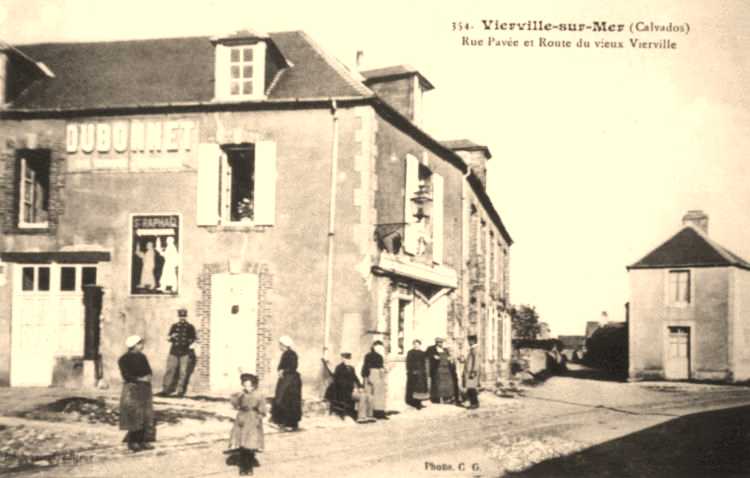
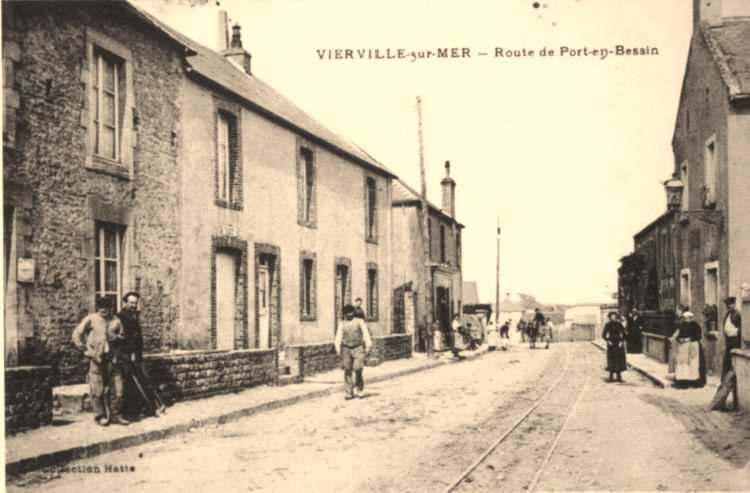
In Vierville the Americans met their first French civilians. There were no demonstrations, barely an exchange of greetings, the French were usually in summary shelters to shelter themselves from shells and bullets, some wanted to flee in the countryside. In general, the Americans and the French simply looked at each other as the Americans crossed the village. (See also the testimony of Mrs. Dubois)
The men of Company C remember Cota walking in the narrow main street, spinning his Colt in his index, like an old Far West pistolero.
To the west of Vierville, Cota sent some Rangers (of the Cies A and B/2Rgr) who were there, towards the point of the Hoc. They encountered strong resistance at the exit from the village. When their advance was blocked, Cota rushed to the front of the column and assisted the section head in organizing his forces.
Company C/116 crossed Vierville without opposition, and was also sent west on the Grancamp road, towards the point of the Hoc. About 500m from Vierville, it was stopped by machine gun fire from the hedges. For two hours, the Americans tried to overflow them, but they were still blocked by other shots. All attempts to cross an open field were stopped by rifles and machine guns at a distance of 200 or 300 m.
It seems that Germans of the 9th Cie of the 726th Regiment, those of Gruchy installed a defense screen west of Vierville in the morning. They may have been supported by some elements of the 513th Battalion of the 30th Mobile Brigade who came on the night of Coutances to the peak of the Hoc and the WN74 at the Percée. It was during these fighting that Captain Gründschloss, Cdr 9th Company was killed.