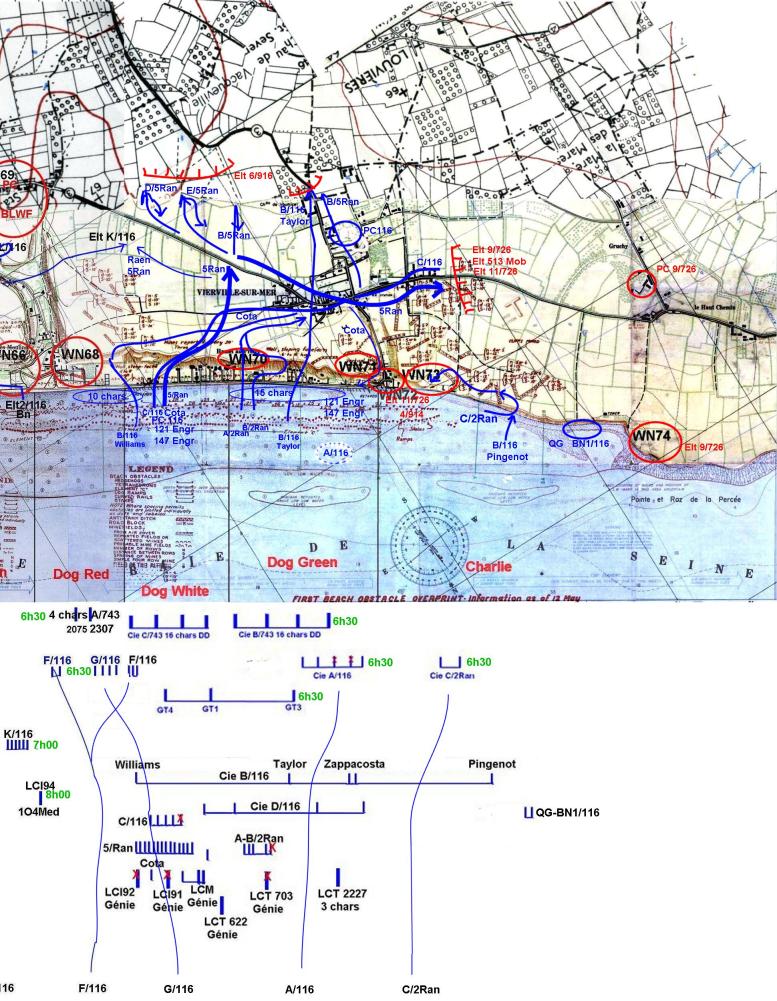

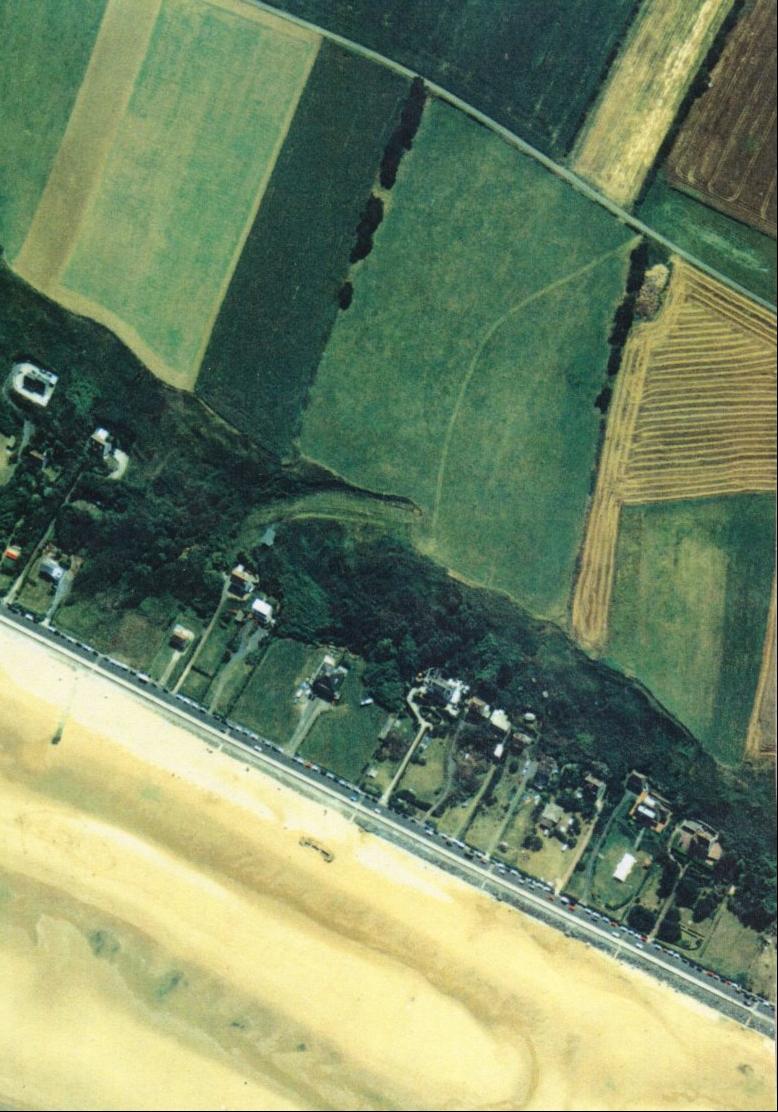
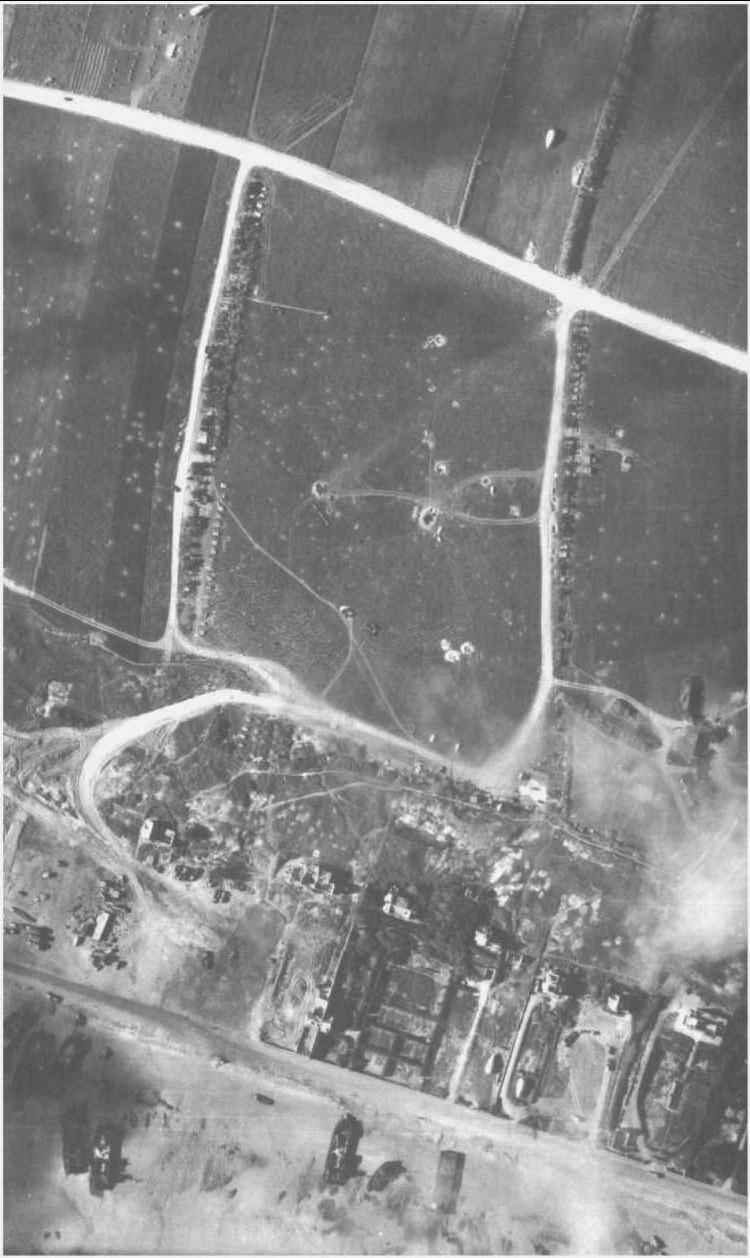
(details)
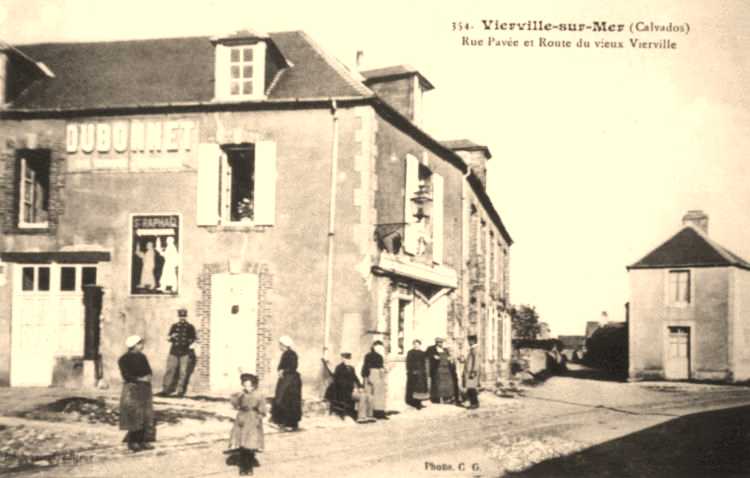
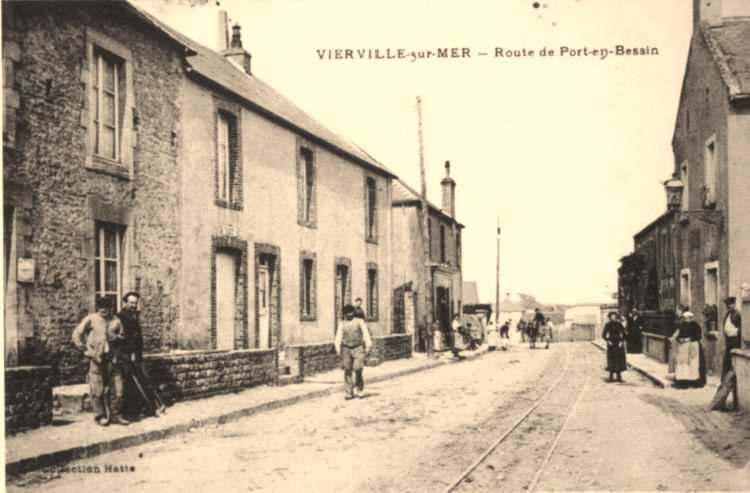
GIs entered Vierville by the Hamel at the Priest

(details)
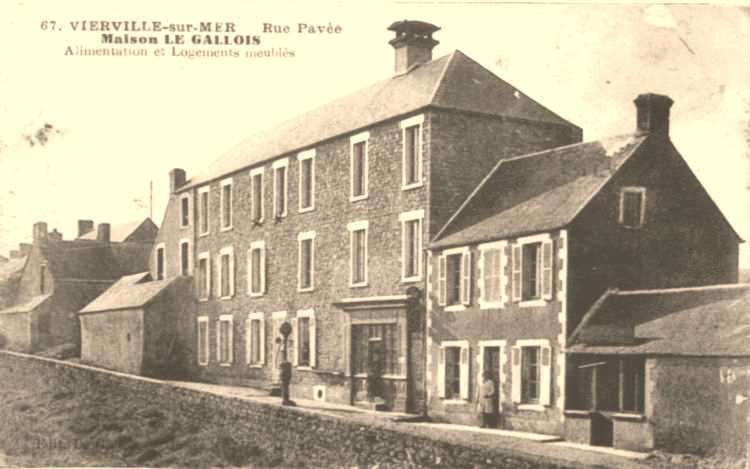
Dumont grocery store at the beginning of Rue du Hamel-au-Prêtre




C/116 Operations Report
(from the beach to Vierville)
(continued from the interview of the CieC/116 men by Lieutenant Shea)
Lieutenant Bedell (Cdr Assaut Section No. 1), looking at how many men he had in his section, saw General Cota:
"He was shaking his Colt 45 gun calmly, and he said like this to him, Lieutenant, we have to get the men out of this beach. We have to get them out," said Bedell, speaking about his first meeting with Cota. Bedell began to set up a team to cut the double barbed wire belt that extended along the narrow road along the seafront beyond the wall. At this moment no one remembers seeing Colonel Canham.
Bedell and two of his men (soldiers Lambert and Pat Keefes) slipped over the wall and crossed the barbed wire. They were so busy at this job that they didn't hear that a second passage had taken place a few minutes later with a "Bangalore" torpedo.
Sergeant Frances E. Huesset was with Lieutenant Schwartz' "Support" section. He described what preceded the opening of the barbed wire by a Bangalore, and he also spoke of Cota:
"He (Cota) arrived, waving his gun, and told us to run off the beach, that we had to cross the barbed wires. We all thought if he could go and come like this, we could do it too."
Sections of Bangalore poles were slipped under the barbed wire by 3 infantrymen from the Schwartz section. Huesset remembers that a soldier, whose name he no longer remembers, placed the last section and shot the friction light. Everyone waited a few minutes but nothing happened. So Lieutenant Schwartz went himself on the wall and did something. In any case, he came back soon after, each of them sat in the shelter and the barbed wires were torn apart by the explosion.
Huesset said the breach was 30-40 m to the left of the bow of LCI 91 on fire.
(it was about 08:00, the sea was at midmarried and the LCI was stranded at least 100 or 150 m from the seafront, in the middle of the obstacles)
None of the witnesses remember the name of the first one who crossed the breach, but all remember what happened to him while he was running through the still smoking corridor. Many saw him hit by several machine guns. He collapsed on the left side of the barbed wire and was heard calling the nurses and then his mother. After that, no one else was touched by crossing the barbed wires or in the flat space and discovered beyond.
The movements of the Scharwtz and Bedell groups had to be simultaneous, as they slipped through the barbed wires, down a small slope and in a series of shallow communications trenches that stretched right diagonally between the road and the foot of the cliff.
The separate lines of the two groups joined as the men advanced through the trenches, and then gained shelter from a few bushes near the foot of the cliffs.
The single column resulting from the 2 breaches first ran westward before starting to climb from the right.
The head element that arrived on the plateau extending towards Vierville was Bedell's with the section "Assaut" N°1.
During the confused period that immediately preceded and followed the barbed wires, the men noticed that soldiers from many other units were mixed with the Cie C/116 column heading from the barbed wires to the top of the cliff. Witnesses remember members of Cies A and B/116, and some Rangers. They are not sure about the Rangers units involved, but many remember Rangers saying about Charley Company (probably the CieC/5Rgr).
While Cie C/116 managed to cross the barbed wire and leave the beach in the area of LCI 91, another group did the same thing further west.
The column of Bedell, followed a vague path going up to the right, across the cliff. There were few shots directed towards the column, it was protected from direct fire and the Germans who did not see this area could not adjust mortar fire there. The main difficulty came from the fear of anti-personnel mines. The men moved forward slowly, searching the terrain before placing one foot in front of the other.
Men remember a small abandoned foundation, concrete or stone, near the ridge. The head of the column climbed slowly to this place when the men saw several German prisoners, taken back to the beach by a single American, killed by German fire. The witnesses remember that a soldier had noticed one of the Germans hit on their legs, kneeling in a supplication position and yet completed with a second shot of machine guns coming from high positions, east of the column.
All men remember a group of stunted pine trees that were where the first column reached the top and began to move on the plateau.
(these pine trees still exist, less numerous, in 2 hedges facing North-South, above the villas Raymond Marchal and Voisin)
Bedell and his men are sure that their element is the first to reach the top in this sector. They didn't see any other troops. They were mixed with other units, mostly Rangers, and they were happy to be on the set.
The leading men on the plateau were targeted by machine gun fire from the right and left. Some soldiers remember several shells in the vicinity at that time. The machine guns nailed the column to the ground. Then again the men noticed the action of General Cota arriving to move them forward. Several of these men on the ground remember Cota saying: "Now we'll see what you're made of. This is where men are distinguished from children."
But everything was disorganized, and even the general could not easily reorganize everything.
At least two men were injured there by machine guns, one had a piece of the right hip carried away. Finally Cota asked for "volunteers" to "get this guy on the left". 3 Rangers said they were going there and started moving along a low hedge and a ditch running south. By this way they could overflow the machine gun through its right flank. Witnesses remember to notice 2 of the 3 Rangers on the Vierville road later. The Rangers told them that one of the three had been killed as they approached the machine gun. As evidence of the success of their mission, one of 2 came up with an MG42. Around his neck, several German machine guns were hanging.
When the 3 Rangers left for their overrun manoeuvre, the rest of the column stopped. The only other shootings were isolated gusts from the right, some houses in Vierville.
Bedell sent his column away as soon as the fire from the left stopped. The men headed straight south because Bedell wanted to reach the St-Laurent-Vierville road and then turned west to enter Vierville.
Shots from the right continued to block the elements from the rear, and it was this group that General Cota tried to send to Vierville across fields. Finally, he stopped his exhortations, came forward alone, and the men followed him by seeing him.
It is not the St-Laurent-Vierville road that Bedell and his men reached, but rather the secondary road (the Hamel-au-Prêtre road) which runs from Vierville to the Moulins, 2/300m east of the fork that separates the two roads.
It was about 9:10 a.m. when the first elements reached this road and turned west. The advance to Vierville was slowed down - at least the witnesses had the impression.
Gunfires at the edge of the cliff disorganized the long line behind them. As they moved slowly towards Vierville, the tail of the column that had followed Cota through fields arrived on the road near an old gate. A reorganization was made and Bedell was sent with his section at the top of the column to serve as a vanguard in Vierville.
To the question "how long did the witnesses have to cross the plateau and enter Vierville?" the witnesses answered at least 1 hour to enter the village.
The first elements arrived at the main junction (the fork from the Hamel to the Priest and Saint-Laurent roads), the section of the Lt, at about 10:00 a.m. Bedell in mind. However, the column of troops behind had stretched from the cliff and plateau.
The first elements of Cie C/116 to enter Vierville were the "Assaut" N°1 section led by Lt. Bedell. Quickly they travelled the narrow streets of the village where debris was complicating the passage, following the preliminary bombings. A horse cart was lying on the side, the dead animal between the stretchers. A handful of villagers looked at the broken windows, looking at fearful and perplexed, with troops invading the village. They did not seem particularly shocked by the bombardment that had preceded the arrival of the troops.
(this bombardment had taken place around 0600 in the morning, consisting of 127mm lost shells of the "Texas" or destroyers that targeted coastal fortifications; perhaps a dozen shells had fallen on the center, not counting the 3 or 4 that had reached the castle; finally Cie C/116 was not the first US unit to cross Vierville, at least a small group of Rangers of the 2nd Bat (cies A or B/2Rgr) and the section of Lieutenant Taylor of the B/116 Cie. 09:00 and 10:00, the Rangers heading west and Taylor going to the Ormel after driving some Germans out of the village).
Bedell and his men did not see any other troops near the crossroads or around the village and continued west towards Grandcamp. At this moment General Cota was about 50m behind the column head.
No shooting slowed down the crossing of Vierville. Cota remained near the main junction, hoping to meet Colonel Canham, while Bedell continued westward.
Bedell's elements crossed the last buildings of Vierville (Crespigny Farm) before being blocked by fire. A first automatic burst and several isolated and adjusted shots killed three men, the column found itself in the ditches, wondering what to do.
Morse, the Rangers and his heavy weapons had meanwhile passed the crossroads and were on the tail of the Bedell column. Morse saw the column stopped, came forward to see what was happening. On returning to his men, he saw Cota for the first time. It was about 11:00 a.m., Cota had seen the stopped column and went to see what was blocking it.
Morse says: "Some killed in the ditch had been hit by snipers. But Cota remained standing, the Colt 45 gun in his hand. He told us to get out of the road so we could manoeuvre against those shooters."
Lt. Bedell and Captain Hawks, CO. Company C/116, then had the head of the column turned back. The General returned to the crossing (where he saw Colonel Canham) and began his descent towards the sea by the road- JT Shea (around 12:30 pm).
Bedell returned his column to Vierville, crossed farmyards (Crespigny Farm, Dubois Farm, Normanville Farm) and passed through fields bordered by hedges to the south. He wanted to overflow the Germans by their right flank.
This is where the typically Norman hare problem came up to him for the first time.
Bedell and Lieutenant Schwartz had their men glued to the hedges running south from the farms (Normanville and Crespigny), but any movement to cross them and continue eastward was stopped by light and automatic weapons fire at a distance of 2/300m.
The Germans were obviously well camouflaged and the infantrymen were unable to detect their locations. The Germans used smokeless powders (unlike the Americans).
An attempt was made to cross a field westward. Two scouts went over the hedge without getting shot. They began to cross the field, but despite the cover shots of the troops aligned along the hedge, one of the scouts was killed and the other fatally wounded. The injured man stayed there all day. Nobody could have picked him up before night. This is where Lieutenant Schwartz was killed, too.
At the same time the Cie C/116 (plus a few men of the Cies B and D) organized themselves in the fields south of these farms, the Rangers settling on the other side (north) of the road. Lt. Bedell noticed, crossing the farms to the south of the road, a Ranger sending in indirect firing bazooka shells on a house on the north side. He suspected the presence of a sniper and his warning cry sent a hail of bullets and bazookas to this house.
Witnesses agree with the Rangers: "Individually, they were the best, the bravest fighters we met. But we couldn't get them to work in teams."
Finding that this harsh opposition blocked all their attempts to move westward, Captain Hawks and Lt. Bedell decided to put himself on the defensive, and to look for the rest of the regiment and the battalion headquarters.
At that time Hawks had no connection, radio, wire, or physical to these elements of which he did not know the position.
(the 2nd and 3rd battalions were beyond Saint-Laurent and the 1st Battalion HQ was still blocked under the cliffs between the Percée and Vierville)
So these first elements of the battalion buried themselves and stayed there for the rest of the day. The "main line of resistance" was established and extended north side of the road by the Rangers in similar circumstances. Several men had been killed by repeated German fire.