

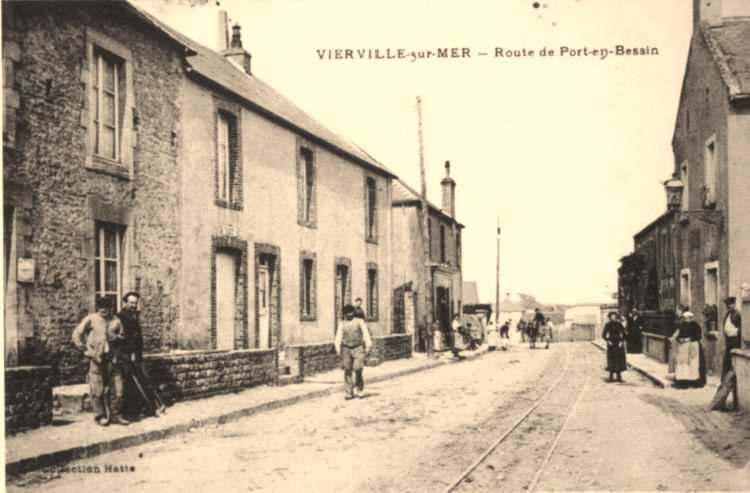
A patrol from 5/Rgr got lost and left an inscription in an old house inland: “5th Ranger Lost Patrol - USA” (“The lost patrol of the 5th…”; caption incomplete in the source).


332 see also the history of the 2nd Ranger Bn D E F Cies

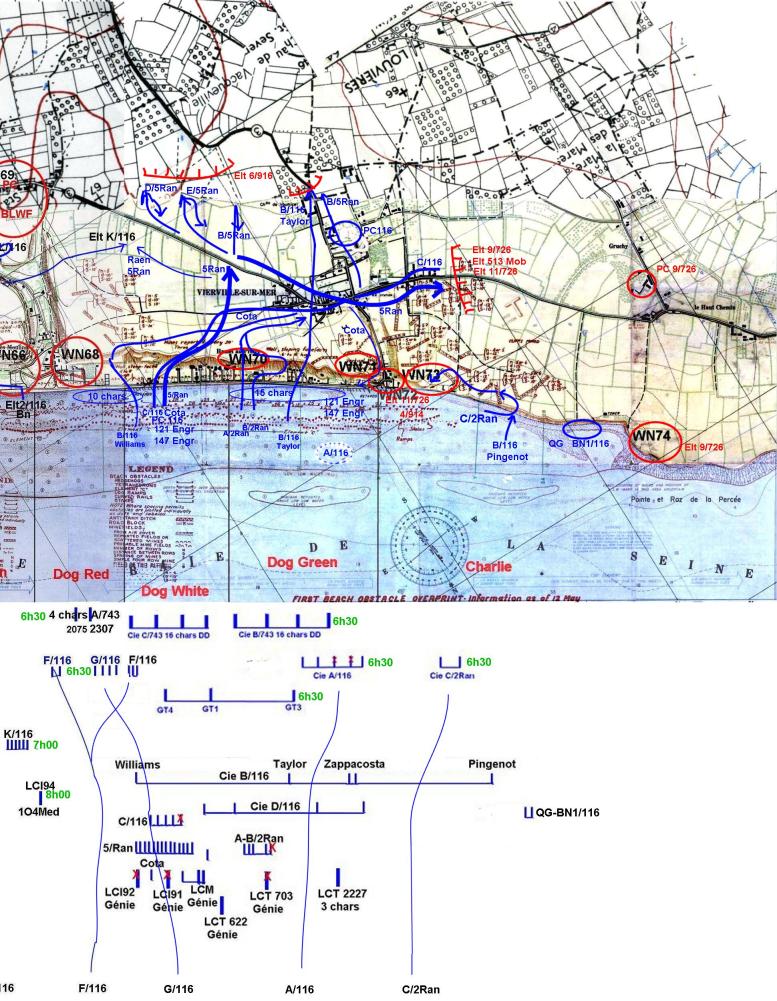
The 5th Rangers Battalion tries to bypass Vierville,
abandons, then crosses the village at around 5 pm, heading west
The 5°Bataillon de Rangers left the beach at about 8:10 a.m., behind Cie C/116 (between Villa Richard and the 1st cemetery). Some Rangers had involved themselves with the men of C/116.
The battalion had reached the pebbly slope just before 8:00 a.m., divided into ship sections. Rapid preparations were made for the attack and Colonel Schneider passed the slogan "Tallyhoo" to his officers, that is, the order for each section to make a way beyond the cliffs to the assembly area south of Vierville.
The Rangers started crossing the road. In the confusion on the beach and the smoke, few men realized that Company C/116 preceded them.
Four breaches were opened to explosives in barbed wires and men crossed flat terrain quickly and slowed down to climb on steep slopes. A thick smoke masked them in their escalation, forcing even some men to put on their gas masks. The time to reach the ridge, platoon formations disorganized and contacts were lost. After the top of the cliff of the signs "ACHTUNG MINEN!" have perms to the Rangers to avoid a minefield from which the engineer later removed 150 mines.
The first group that got to the top, A/5Ran Company Platoon (Lieutenant Parker) with a few E/5Rgr Company men, went inside and lost all contact with the battalion.
The other platoons arrived at the top at about 8:30 a.m. and stopped to reorganize. See other testimony on the Rangers' attack.
On the left flank of the battalion, the Platoons of Lt Dawson Company D/5Ran had to clean a few Germans in a network of trenches along the top of the cliff and destroy a machine gun nest located just below the ridge and firing along the beach.
The battalion had lost only eight men, with a small arms fire becoming increasingly ineffective as the Rangers progressed towards the cliff.
Colonel Schneider's headquarters reached the top, along with his other Rangers to the right and left. They were in front of open fields with many hedges beyond. German machine guns sheltered and distant were firing at them.
The reorganization on the plateau took a lot of time, the Rangers had mixed up with the infantrymen of the 116th Regiment.
The progression finally resumed between 10 and 11 a.m., with General Cota intervening to press the movement. The 5th Rangers Battalion intended to push beyond the coastal road and bypass Vierville through the south, while the elements of 116°Reg. I'd go to the village. The objective of the 5th Rangers Battalion was Pointe du Hoc.
But Colonel Schneider, still ready to decide on the circumstances, even if it was contrary to the plans, dispatched a patrol from his command company (Captain Raaen) to the east, to seek an liaison with the Americans who would normally go up through Saint-Laurent.
Raaen himself went there by the ditches and hollow paths between the hedges, and "we came upon a patrol of the K/116 Company, coming from the Ruquet. A lost paratrooper from the 101st Airborne Division, fallen in the water off Omaha Beach, recovered by the company K/116, was now fighting with them."
(This patrol had come from the area north of Saint-Laurent and had infiltrated through the Saint-Laurent Valley at approximately the current post. This affair did not have a sequel)
The Rangers' advance stopped when the first elements (the B/5Ran Cie) reached the road from Vierville to Saint-Laurent and when a German machine gun opened fire from a hedge, located in a field to the south. The column stopped, the Cies E and D trying to bypass the machine gun and Cie using its 81mm mortars. A platoon advanced behind a hedge towards the machine gun. In doing so, another machine gun also opened fire on the left of the first machine gun. Another Rangers platoon attacked him with fire once again new enemy positions along the hedges even further east. A third flank attack was launched, she encountered further machine gun fire and was recalled pending an artillery support trial.
(It is likely that the Rangers encountered a defensive screen coming from Formigny in the morning and composed of experienced elements of the 6th Regiment 916 Cie of the 352nd Div., company stationed in Formigny and sent to support the defense of St-Laurent and Vierville on the morning of June 6. Parker Platoon as well as the Taylor section of B/116 probably passed before the implementation of this defence line)
We were at the beginning of the afternoon, the 58° Army Battalion of Campaign Artillery had just landed a few cannons at the Ruquet, but the forward observer accompanying Schneider and Canham stated that shooting at this range was impossible because of the screen presented by the cliff.
Approximately four hours had been devoted to all these efforts. The Rangers then abandoned the attempt to move south from the coastal road and followed this route to Pointe du Hoc by crossing Vierville where they had been preceded a few hours earlier by C/116 Company and the Rangers of Cies A and B/2Ran.
a section of Cie B/5Ran went south in the direction of L'Ormel where they contacted section B/116 of Lt Taylor. Some other Rangers were required to ensure the safety of Colonel Canham's PC, who had moved to the Isles, quite isolated.
At 1700 hours, the Rangers main force was in Vierville and plans for a westward attack were drawn up and cancelled later that evening. Colonel Canham decided not to continue his efforts on the coastal road to Pointe du Hoc, as the 5°Rangers was his main force in defending Vierville against a counter-attack from the south, and he still had no tanks or artillery at his actual disposal.
As dusk and darkness arose, the battalion formed a perimeter of defence for the night, with the companies A, B, C of the 2ème Ranger, part of 1/116 and 743ème tank battalion (23 tanks mounted from the beach around 21:00).
For its part, the section of the company "F/5Ran" which had landed under Saint-Laurent, encountered artillery and machine guns. Numerous patrols were sent to contact the battalion, but without success. The unit then proceeded to advance along the beach towards Vierville, but after 600m it lost 8 rangers, killed or injured, finding itself immobilized for the night in this position, on the side of the Moulins.
The D-Day was over, the Rangers had made: dozens of prisoners, killed 150 enemies They had had about 60 Rangers killed or injured.