Preliminary bombardments
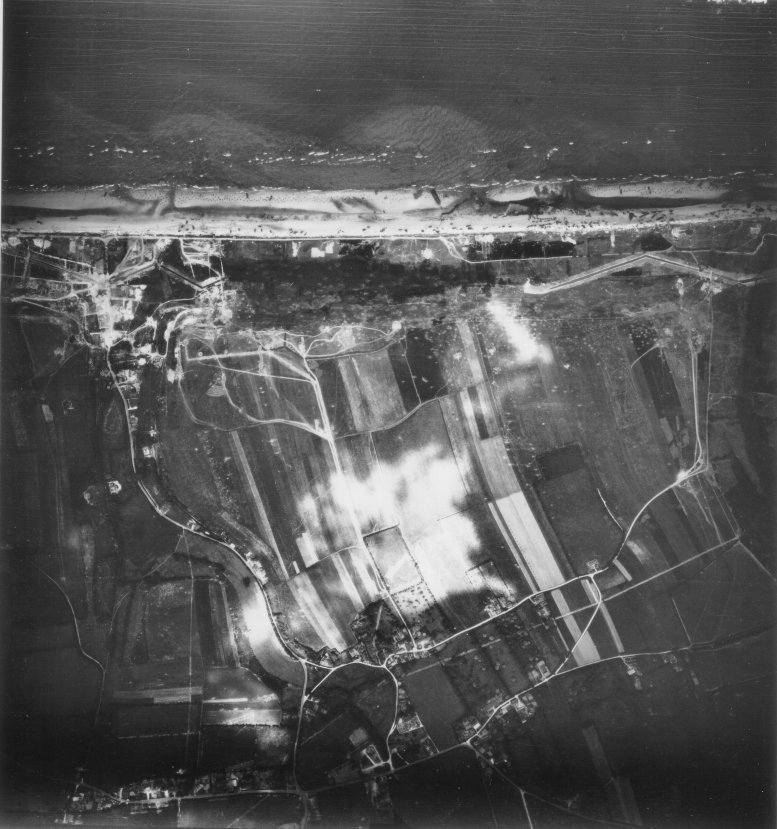
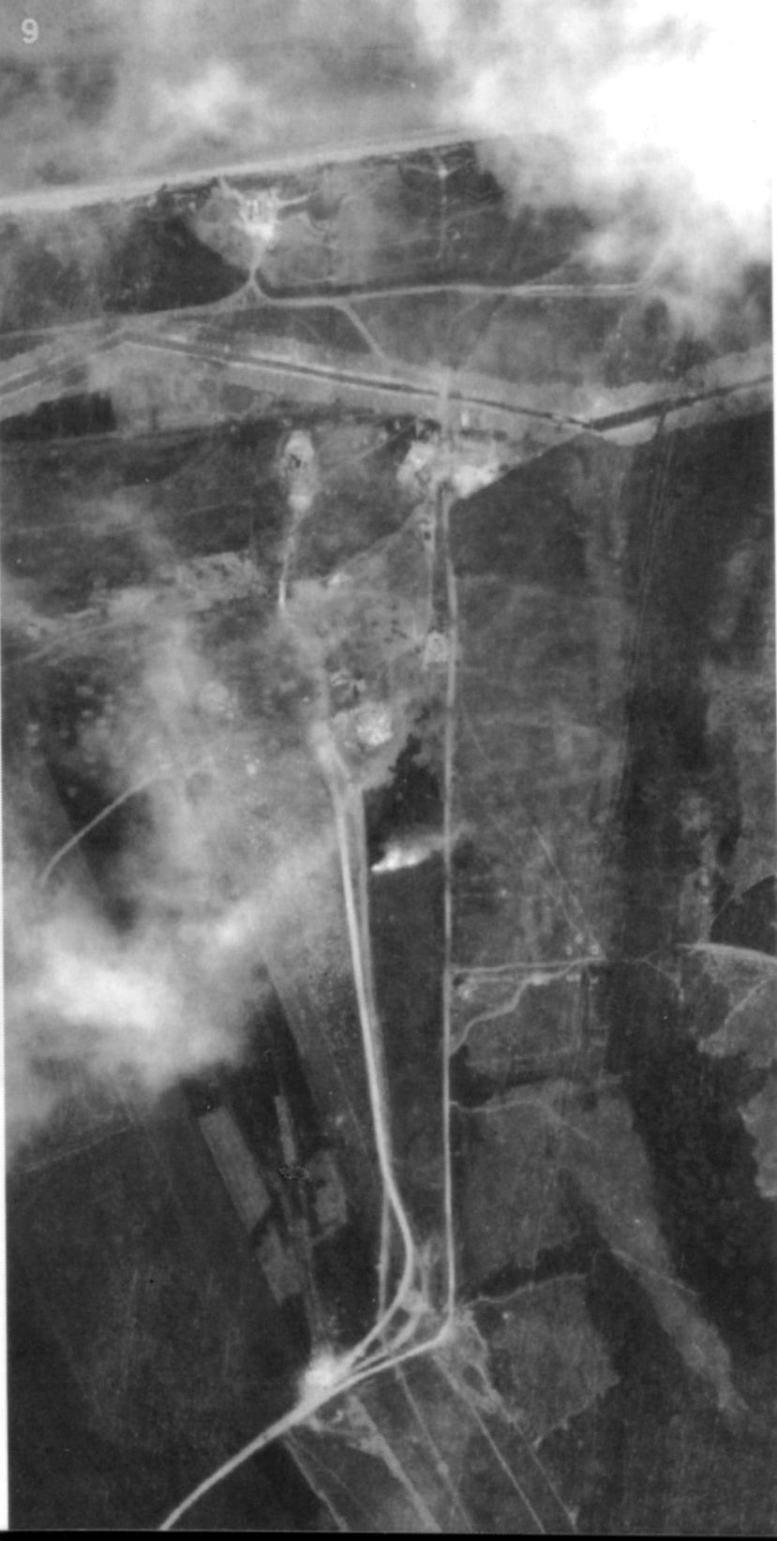
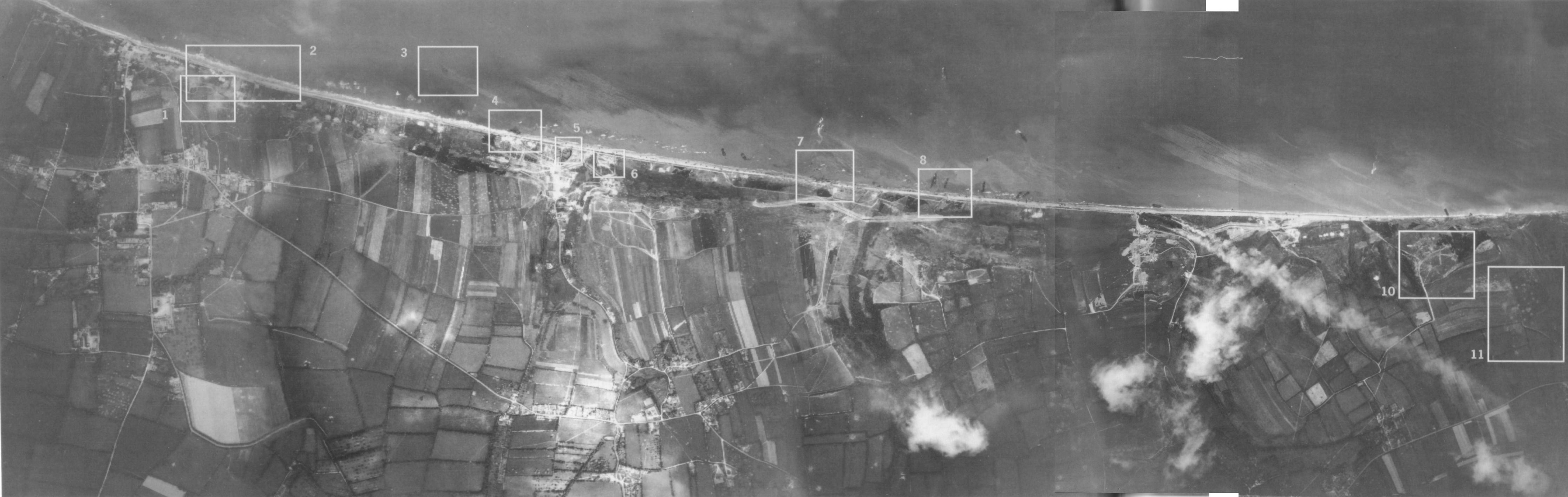
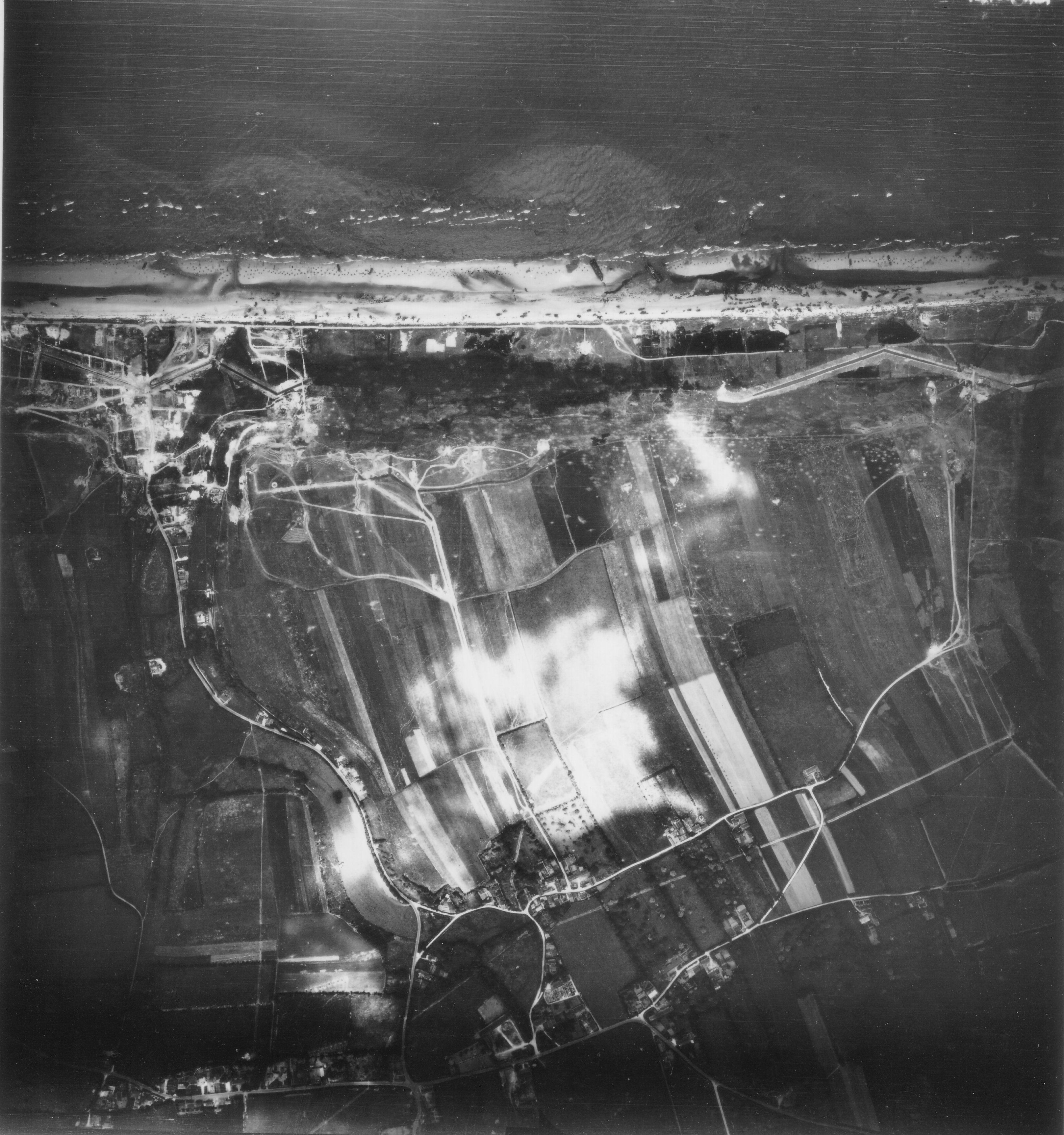
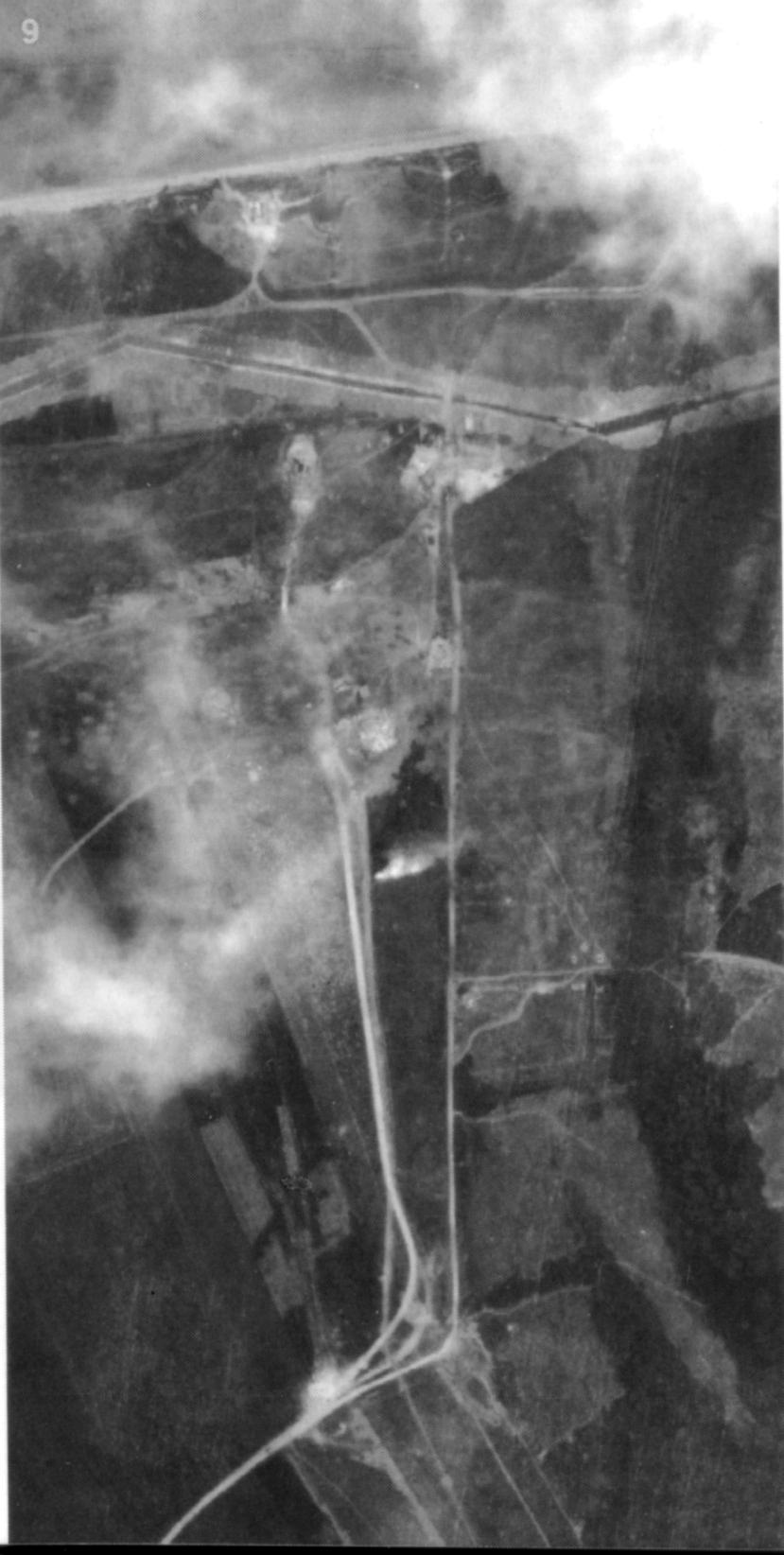
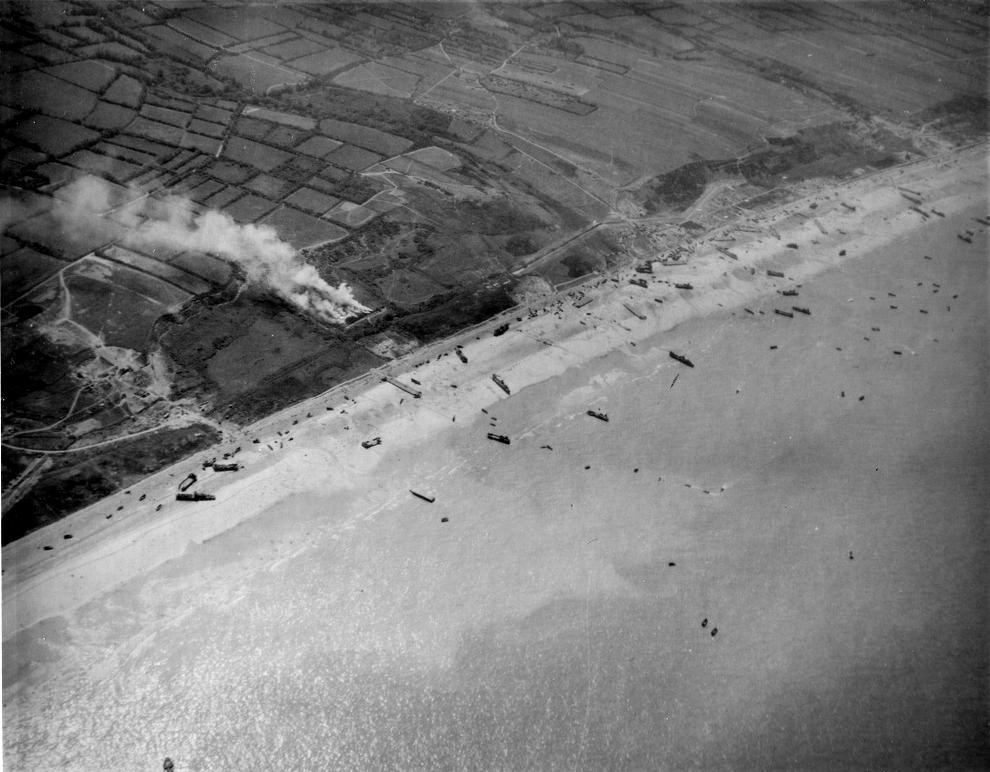
The aerial bombardment was a complete failure. Liberator quadrimotors had been planned, but they were flying at high altitude and above the clouds. As the accuracy was already poor in clear weather, the Allied Major States had to resolve to prescribe an additional margin of safety for the target, which led the centre of gravity of the impacts to several hundred meters and sometimes several km south of the target. It was then certain that the bombs could not reach the landing craft flotillas that approached the shore at full speed at the same time.
As a result, the bombs dispersed in the countryside, without any effect on German defences.
Naval bombardments have been more effective, especially for conventional warships, battleships, cruisers and destroyers. On the other hand, evidence indicates that rockets launched by LCT(R) have generally fallen into the sea. It was indeed impossible to aim and adjust the firing of this kind of gear. The duration of the bombardment by the other ships was too short for the German defences to be disrupted.
All in all, these bombardments had a very limited effectiveness.
Tanks
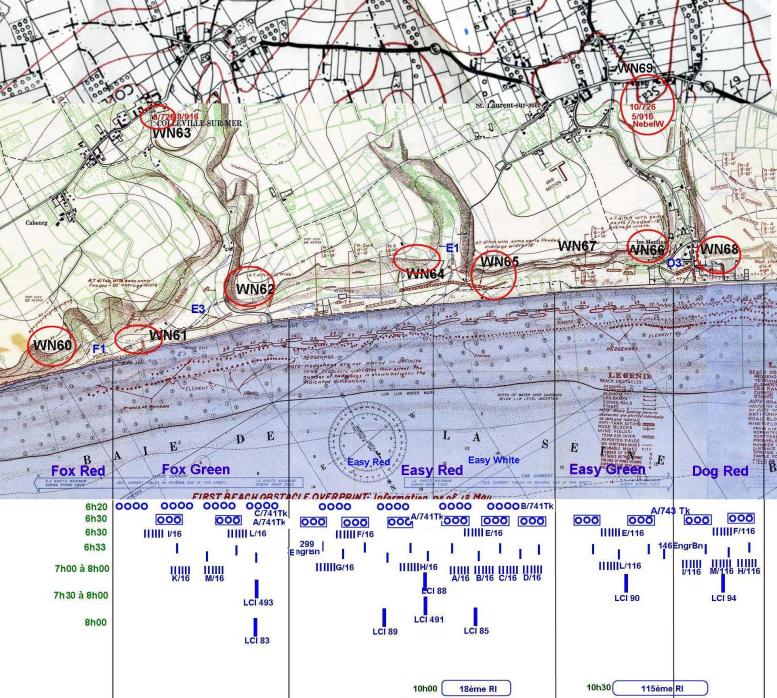
On this half sector, 2 LCT were to launch at sea at 5500m from the coast, 8 amphibious tanks of company B/741. Of these 8 tanks, 5 were actually launched, 3 sank immediately and 2 tanks arrived in good port on Easy Red. The remaining 3 were driven to the beach by the LCT 600, whose first tank launched sank by damaging the launching ramp at sea.
In addition, 3 LCTs were required to land 6 A741 standard tanks and 3 tankdozers to support the SETF teams. All arrived late in the day, in front of the Ruquet (LCT 2008, 2043 and 2228)
In total, only 5 DD amphibious tanks landed at about 6:30 a.m. on Easy Red, while the others arrived only later. These 5 tanks were not directly confronted with anti-tank guns close to 88mm and 75mm, and they were able to participate in the fight against German fortifications between Le Ruquet and Colleville.
Assault infantry, first wave
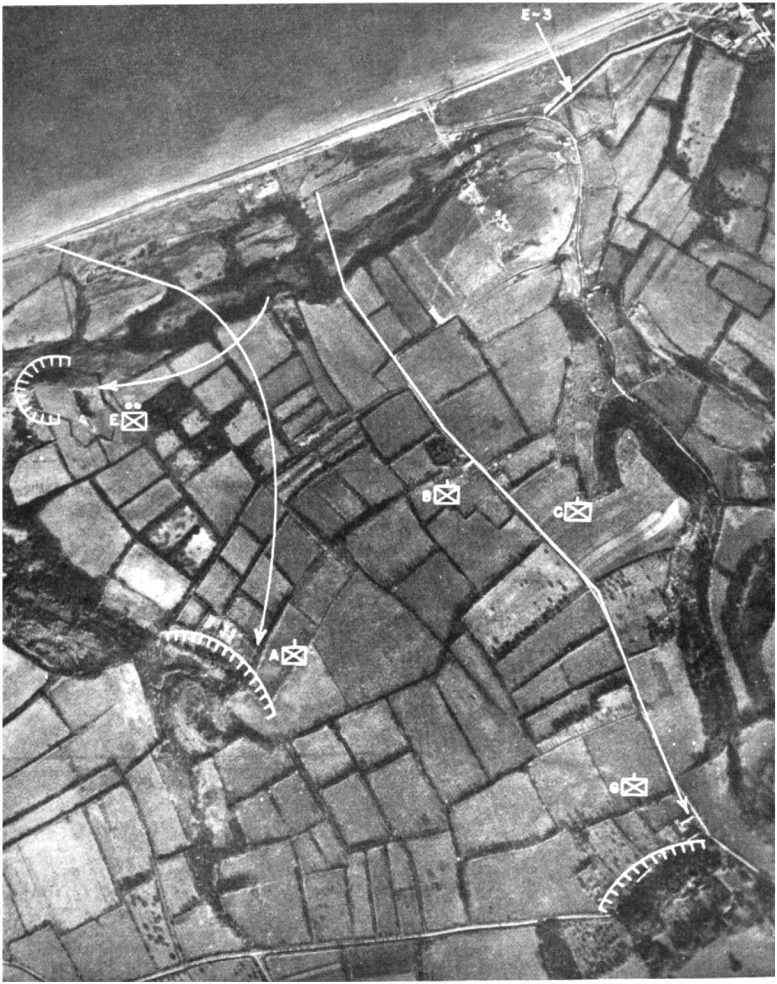
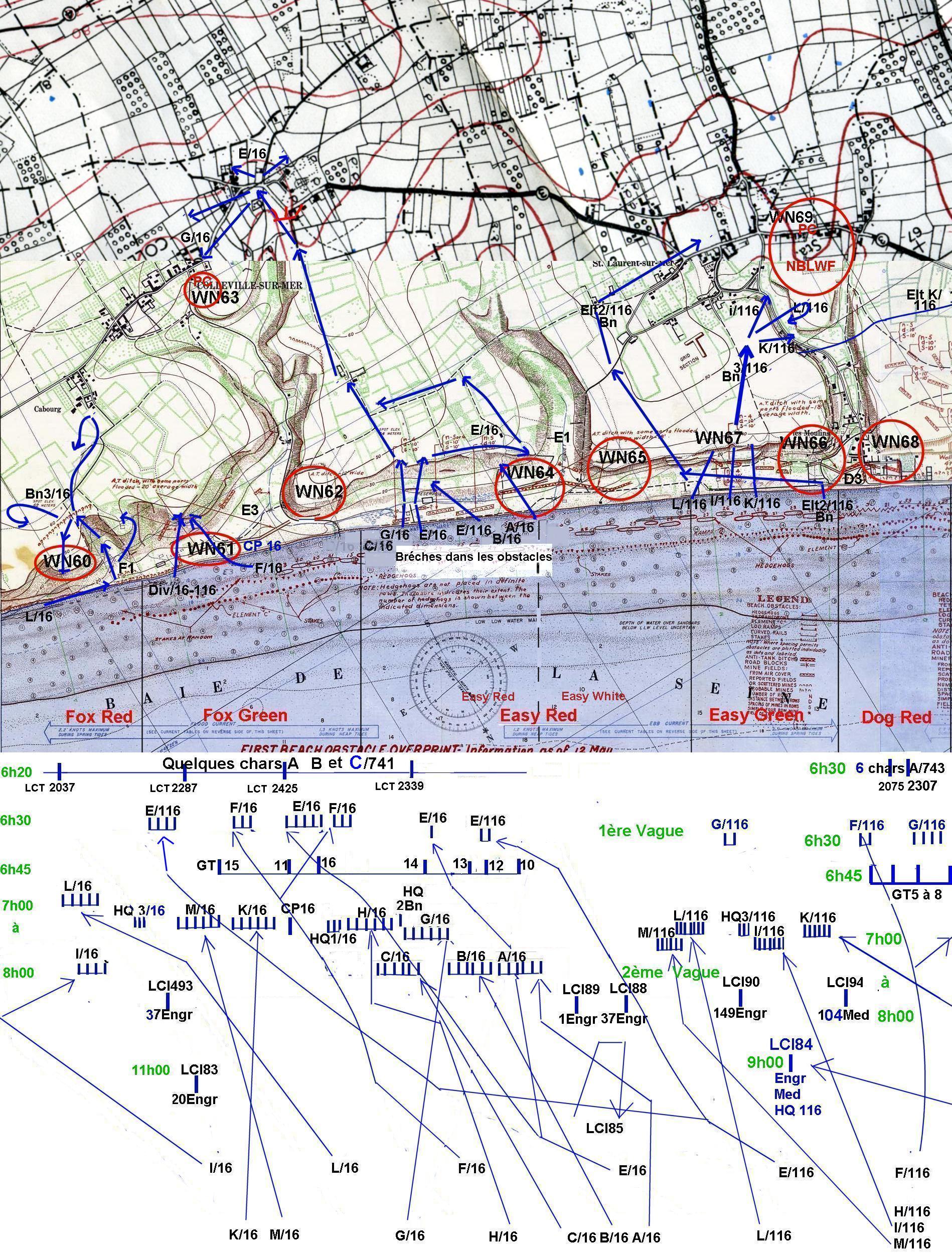
This half area was reserved for company E/16, which was disoriented by smoke and tidal currents. She finally approached far east on Fox Green.
However, an E/16 LCVP and 2 isolated from the E/116 arrived between the WN 62 and 64, in an area relatively far from the German firing stations, and they reached the pebble slope with losses (of the 32 men of the E/16 LCVP, 20 were valid at the top of the beach).
This slope was not surmounted by barbed wire and ruins provided a suitable shelter. No close German defences overhanged them.
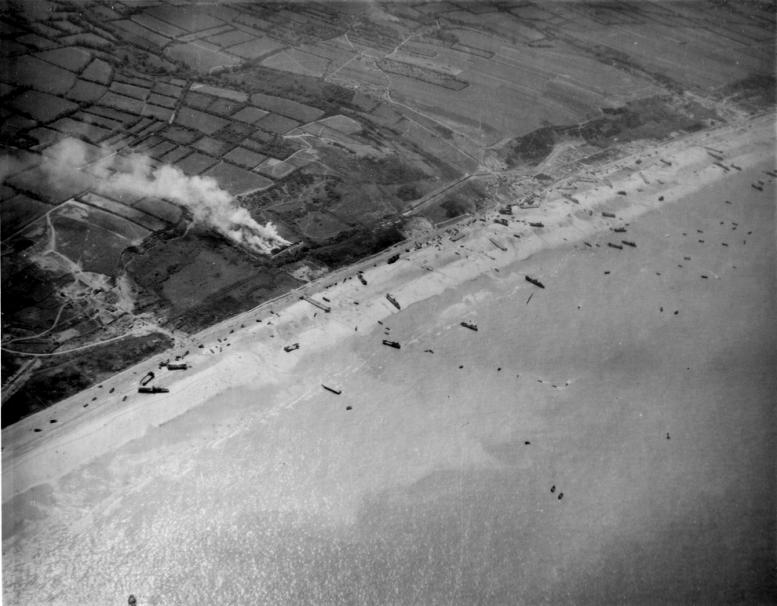
Further east, no assault troops landed in front of the Ruquet defences (WN64 and 65)
The "Gapteams" of the SETF
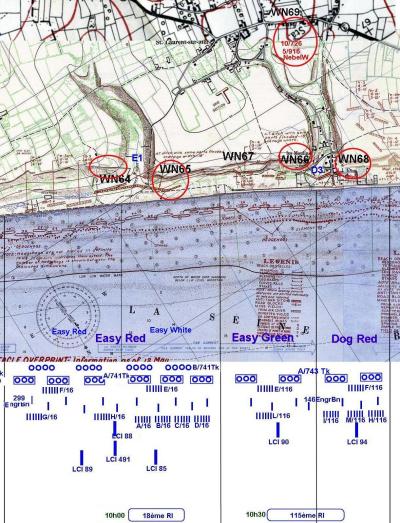
It was planned, on this 1/2 sector, 3 gapteams: the Gapteams 9, 10 and 11, arriving at 6:33 am
In fact, it appears that 4 gapteams arrived in this area, Nos. 10, 12, 13 and 14, and an average 1/4 hour delay, around 6:45 a.m. As they had to work before the rise of the sea, so before 7:00 a.m., they could not complete their work. Their losses were comparatively limited, as they were between active WN 62 and 64 and relatively far from them.
The 2 support gapteams (Gapteam E and F), which were to support them at 6:41 a.m., arrived too late to act effectively.
The work carried out was nevertheless quite significant, a fairly large area having been well removed from obstacles, between Le Ruquet and Colleville, area which will be used for the landing of reinforcements in the morning (115th and 18th regiment)
None of these teams could be supported as planned by a tankdozer.
Assault infantry, second wave
On this half-sector Easy Red West (the future sector to be known as Easy White) was to address companies A and B/16. Disoriented like the others, they arrived on the east of Easy Red, but did not suffer significant losses, being distant from WN 62 and 64.
On the other hand, the half sector saw the arrival of half of L/116 and M/116 (heavy weapons company of the 3rd battalion). They were not very far from WN 65, but not directly under his fire.
The WN 65 and 64 were still without many assault troops under their fire, as at the time of the arrival of the first wave.
The arrival of the Combat Engineers, the Beach Engineers and the first medical elements, aboard LCI and LCT, between 07:00 and 09:00
In addition to some LCT, arrived on Easy Red, 2 LCI out of the 3 planned:
LCI 88 with elements of 37 Eng Bn and 6 Beach Bn
LCI 89 with elements of 1st Engr Bn
They were able to cross the line of mined obstacles and leave, probably because these mines - anti-tank telrminen - had not resisted the submersion of the tide twice a day.
A 3rd LCI, LCI 85 with elements of 37 Engr Bn, 6 Beach Bn and 1st Med Bn, could not land, being seriously hit by shells and mines on obstacles. He left, unloaded his wounded on LSI Samuel Chase and finally had to be abandoned and sank offshore in the afternoon. (its wreckage marked on the charts, by 49 23,627N and 00 50 143W)
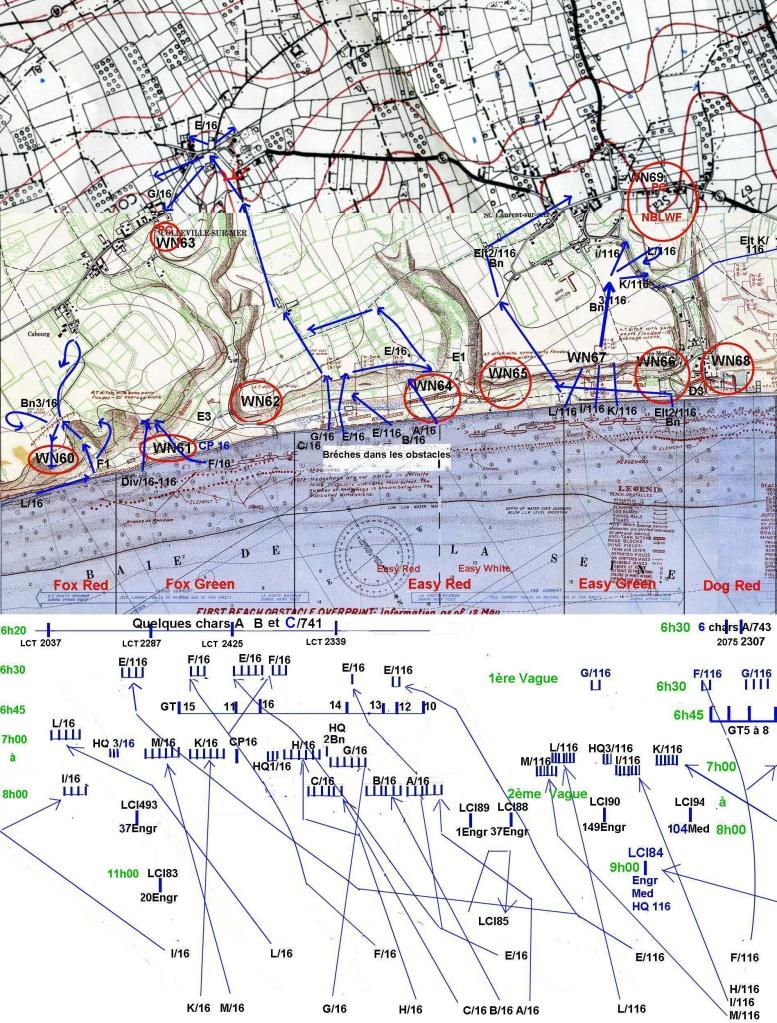
In the Easy Red East sector, between the WN 62 and 64, Lieutenant Spalding trained around 7:15 a.m. about 20 surviving men from an isolated LCVP section of Cie E/16 (1st wave). They blew up with "Bangalore" a section of the barbed wire and infiltrated beyond, passing through the ruins of a villa, breaking a path through anti-personnel and anti-tank minefields. They were lucky, the mines were often very visible, and the passages were protected from sight by brushing, especially at 400m on their left the 2 WN62 bunkers with 2 75mm guns.
At the top, they were arrested by a machine gun, but they were able to make prisoner his only servant. He said he spoke in Polish with a Polish GI, and he said that only 16 Germans were defending the WN64 at 500m on their right.
They were now reduced to 20, still isolated, but they were followed by Captain Dawson's G/16, who, at about 8:00 a.m., asked Spalding to attack WN64, while he himself would go with his company directly to the town of Colleville.
Spalding thus followed to the west an empty trench on cliff ridge, he arrived directly on the WN 64, he found there a tobrouck with 81mm mortar, a 75mm battery gun to the west, a bunker under construction, and a concrete shelter. A few shots in the stairs of the shelter brought out a group of Germans who went without difficulty with their wounded. At around 10:00 a.m., the WN 64 was neutralized, its defenders descended their hands on the head towards the beach, from where company A/16 went up.
Indeed, under WN 64, A/16 company had landed, and it had been able to cross the anti-tank ditch filled with water before climbing towards WN64 attacked from the rear by the Spalding section. They also crossed minefields, losing a few men. They then set out eastward to regroup with the B/16 and C/16 companies that had climbed following Dawson G/16 Cie. In the middle of the morning, the entire 1st Battalion I/16 was on the cliff to regroup and advance towards Colleville.
The arrival of the division's advanced PC, with General Wyman
Wyman, General Huebner's second, had been on a LSI Samuel Chase LCVP since 6:00 a.m., ahead of Omaha Beach. His intentions were not to land too soon. If the operations were to proceed normally, he thought Colonel Taylor could handle everything; but when at 8:00 a.m. Wyman's LCVP docked the wet PC 553 escort in front of Easy Red, who had closely followed the operations, he immediately realized that nothing was working as planned:
1 - The tanks of the 741 TkBn were not at the meeting, lost at sea or late
2 - The waves of assault did not capture the 4 main exits in the first hour.
3 - The SETF engineering teams had not created marked breaches in the belt of the beach obstacles
4 - The large LCT and LCI were round and dared not approach at high tide on a beach filled with underwater mined obstacles.
And from his LCVP at 8:00 a.m., Wyman was not aware of the significant successful infiltrations into the cliffs by several assault groups the size of a small section or a company.
Wyman's advanced group was taken to the ground at about 840, between WN62 and 64, where several isolated groups of Battalion II/16 climbed the cliff and headed towards Colleville, along with the Spalding section attacking the WN64 from the rear. Battalion III/16 had just landed in 2nd wave
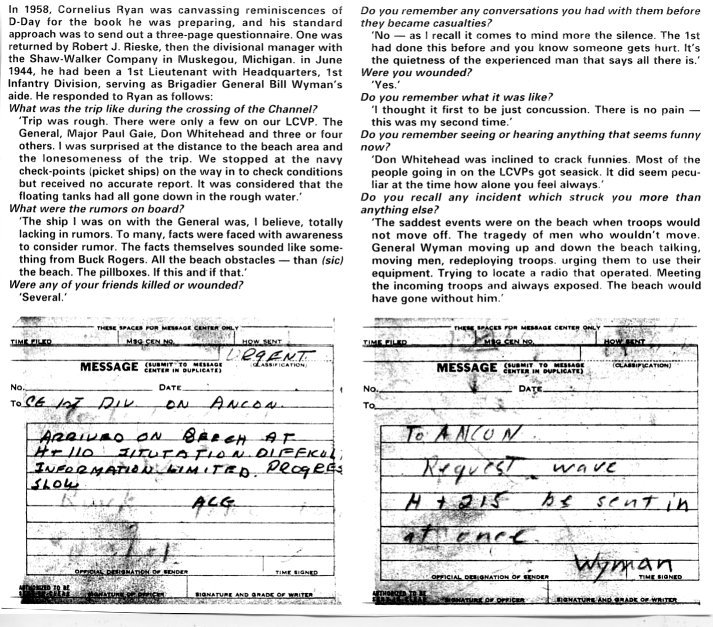
At 9:00 a.m., Wyman could send Huebner (on board the LSH Ancon) a first not too pessimistic message.
But for Wyman, these infiltrations by the cliffs were not enough, it was absolutely necessary to open the beach exits and especially the exit E1 of the Ruquet immediately to his right.
At 9:50 a.m., he requested that vehicles be stopped and combat troops sent.
At 1010, he asked to strengthen Battalion II/16, the one in charge of the Ruquet, which had been disembarked too far east.
Where was that second battalion, Wyman wondered. He knew that the G-Cie had gone to Colleville with 1st Battalion I/16, but the mission was the Ruquet, and Wyman did not yet know that Spalding with 20 men was taking over the WN64. When he finally learned it, there remained the WN65, which still held and prohibited access to the beach exit of the Ruquet. He needed backup.
Reinforcement regiments arrive on Easy Red West
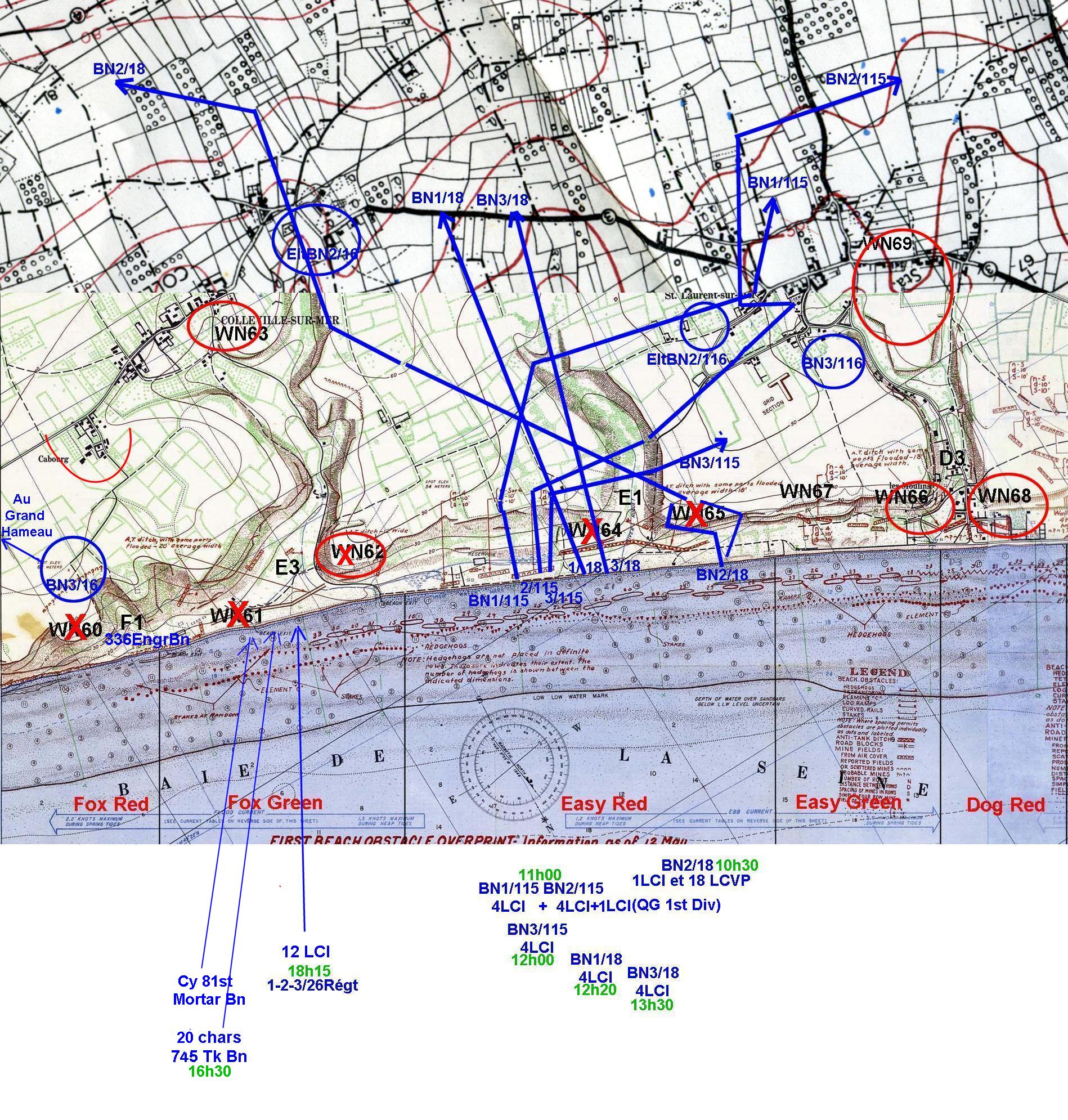
The initial plan provided for the landing of the 18th regiment: Battalion II/18 at H+195 (9:45) on 18 LCPV of LSI Anne Arundel and LCI 489 (taking the HQ Cy) of the battalion, and Battalions I/18 and III/18 at H+ 210 (10:00) on 8 LCI.
In fact the I/18 arrived at 10.30 am, immediately west of the WN65, the other 2 battalions arrived east of the Ruquet at 12.20 pm (Bat I/18) and 13.30 pm (Bat III/18).
The sea was high, and only a narrow strip of sand was available in front of the pebble bench and a small dune. Obstacles were not visible at half-immersed, and the LCVP hesitated before launching over them.
Fortunately, the entire Easy Red area was completely devoid of the almost continuous barrier of Elements C that existed elsewhere, and the SETF groups had been able to start their work. Many LCVPs encountered obstacles, but without damage, indicating that mines were generally to be deactivated by tide-induced immersion alternations.
The WN65 attack was carried out with the help of the USS destroyer Frankford (who fired at about 10.30 a.m. on a mortar spotted on the plateau), a few tanks of the CIeA/741 (who fired at cliff ridge positions west of the Ruquet) and 37mm guns on halftrack of the 467th DCA Battalion (a half track fired at the main bunker - that of the PAK gun 50mm - until a shell entered the bunker).
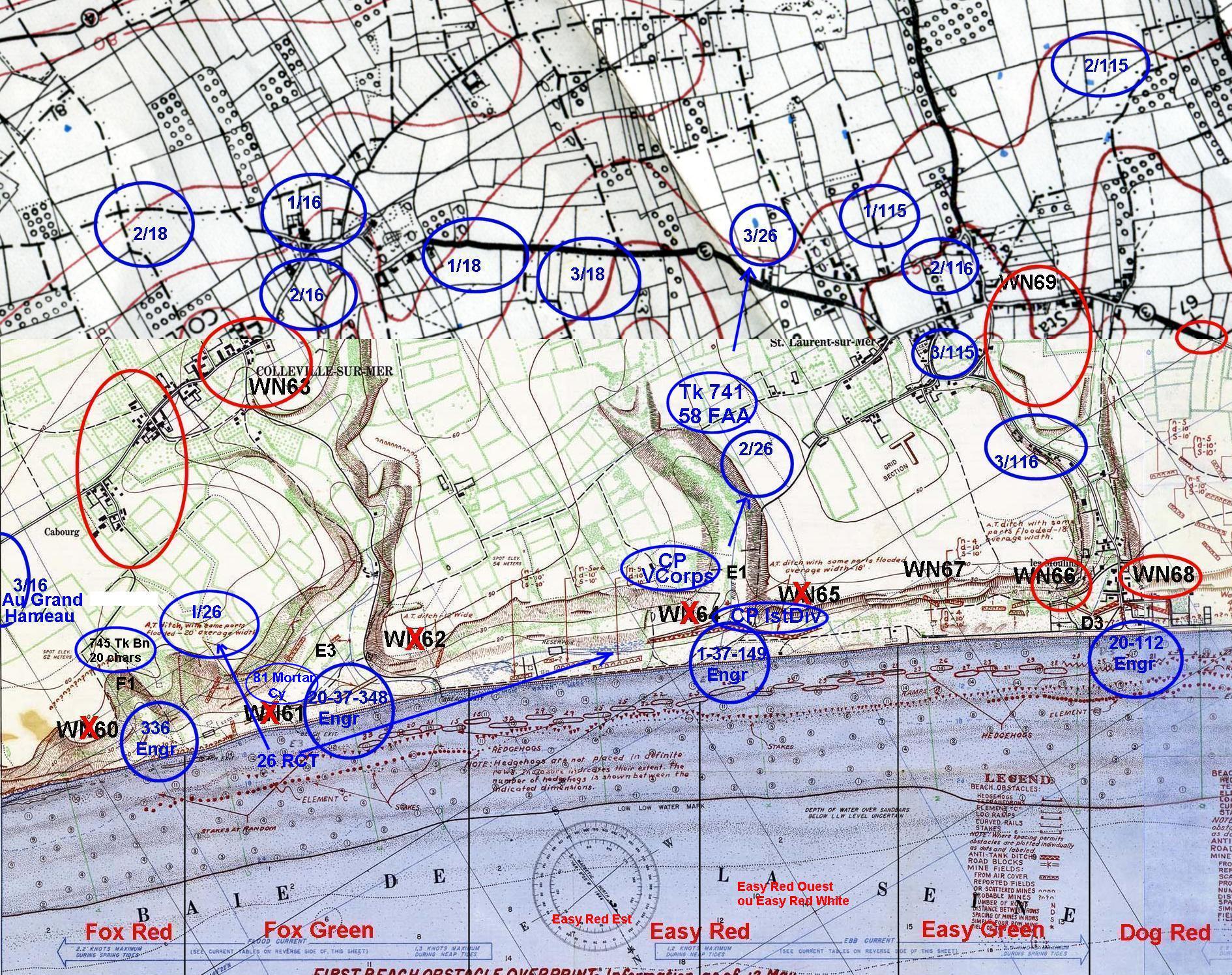
During these shots, E/18 was sent to the ridge between the Ruquet and St-Laurent, and F, G and H/18 took over the WN64 facilities, taking back its lower part. Shortly before noon, the WN was neutralized and some 20 Germans were taken prisoner. Colonel Gibbs Cdt the 7th Field Artillery Battalion participated in this operation as an infantry officer while his guns were not yet available (half - boarded on DUKW - were lost at sea).
After this success, the II/18 was sent by the shore to climb on the cliff east of the Ruquet and push towards Colleville and then south.
Meanwhile, from 12.00 pm, the vehicles of the 1st Engineer Battalion (1st Engr Bn) and those of the 37th Engr Bn (of the 5th Special Engineer Brigade) that followed, activated themselves to open a road through the Ruquet Valley, creating a runway in the dune, filling the anti-tank ditch, then opening the first road rising on the plateau and a transit area east of the village of Saint-Laurent, which was done by 3.00 pm. At 5:00 p.m., the new road was in full swing. But it would remain an ass as long as the village of Saint-Laurent was held by the Germans.

These operations were complicated by the unexpected arrival at around 11:00am and 12:00pm east of the Ruquet of the entire 115th Regiment (out of 12 LCI), resulting in a lot of confusion and congestion with battalions I and III of the 18th Regiment arriving at the same place immediately after (12:20pm at 1:30pm, on 8 LCI).
These troops from the 115th were not in their area and their colonel (Colonel Slappey) was not there, because his LCI had hit an obstacle and found himself the last to present himself. Without their leader the first 2 battalions immediately advanced towards the cliff, followed by the 3rd battalion. Of course, it was the only thing to do to the point where they were. There was little German opposition, dispersed and not intense. The 2500 men of the 115th climbed the hill in 2 Indian lines, the I/115 on the left, the II/115 on the right, followed himself of the III/115, objective the village of Saint-Laurent. To the right and left of each trail there were anti-personnel mines and some lost a leg or foot.
Battalion II/18, after having caused the WN65 to fall, followed 115th in the hill east of the Ruquet and headed towards Colleville. It was followed by the other 2 battalions of the 18th regiment disembarked around 12:20 and 13:30.
Thus in the middle of the afternoon, 5000 men of these 2 regiments had engulfed in the Ruquet valley, a gaping hole in the Atlantic wall, a little in confusion at the beginning, but completely unseen by the Germans. Nothing could now reject them to the sea, except a Panzerdivision and none was available for this in Normandy.
The surviving tanks of the 741 TkBn were sent to regroup 500m east of Saint-Laurent. (17:00). They were accompanied by 11 of the 16 caterpillar howitzers of the 58th FAA Bn who ended up landing in the afternoon in front of E1 after having failed with heavy losses in front of D3 in the morning. These howitzers were then put on battery and participated in the battles against the town of St-Laurent.
The 5th Corps envoy, Colonel Talley.
Talley, with four DUKW ducks well equipped with radios, was instructed by General Gerow (Cdt the 5th Corps) to inform his head directly of the operation. In fact, he could not get too close to the beach without risking the destruction of the DUKW and the failure of his mission, and as a result the information collected was very insufficient. It was only around 1 p.m. that he was able to lay down at the Ruquet and immediately meet General Wyman, in the midst of dangerous but sportadic mortars. At 4:20 p.m., he was able to inform Gerow of the improvement, but noting that several hours would still be needed before the 4 exits were operational
Arrival of General Huebner Cdt the 1st division
Huebner left the LCH USS "Ancon" at about 5:15 p.m. to join General Wyman at the advanced PC in the WN65 bunker, at the foot of the Ruquet (Wyman had settled there around 3:00 p.m.). Wyman was in radio liaison with the divisional artillery and the 18th Inf Regiment. On the other hand, connections with the 116th Inf Regiment were limited to the part of the regiment that was on St-Laurent. No liaison with Vierville and Colonel Canham or General Cota was available. Wyman didn't know what was actually going on there, and vice versa.
Huebner and Wyman immediately decided to land the division's reserve regiment, the 26th RCT, which approached 12 LCI from 6:15 p.m. at the foot of E3, on Fox Green. His previous orders were to push southeast towards Bayeux after leaving the beach. But it was too late and the orders were changed and the II/26 Bn and III/26 Bn were sent by the beach to the Ruquet to serve as a corps reserve (II/26) and to place between the 18th and 115th (III/26), while the I/26 Bn had the mission to push towards Cabourg and Port in Bessin.
Then Huebner estimated that the beach remained a target for the Germans, with sporadic artillery fire, so he ordered the displacement of his advanced PC at the top of the Ruquet valley, 400m east of Saint-Laurent. At 8:00 p.m., it was hardly more calm, very close to the ongoing attack on the village of St-Laurent. Nevertheless, it was clearly visible from his fighters, and it was good for their morale, to see that the "Coach" was among them, with its radio transmitters, its telephone exchanges etc....Often the staff had to shelter themselves and soon holes of men were dug for everyone. D-Day was a special day for both soldiers and generals.

(details) Evening positions, sector Le Ruquet - Saint-Laurent
Arrival of General Gerow and the 5th Corps Advanced PC
With a LCVP, General Gerow left the LCH "Ancon" at 7 pm (he had to go down by a net along the hull, the ladder having been broken by a LCVP shock against the Ancon hull). The arrival at the beach took place at high tide, at the midpoint of the obstacles more or less destroyed. The General was transported dry with the dumpster of a bulldozer led by Colonel Talley himself, but his main condition had to wet his legs to his knees.
The PC of the Corps settled at around 21:00 on the cliff, in an abandoned trench of the WN64. The great chiefs settled in a German wooden shelter, the others sharing nearby trenches. The mapboard was out of the trench and was quickly pierced by a sniper's bullet. This one, hidden in a hole on the cliff opposite (WN65), was finally dislodged by a team of engineers deminers and the agitation calmed down. The sniper stated that his orders were to fire until his ammunition was exhausted and to kill as many people as possible.