Preliminary bombardments
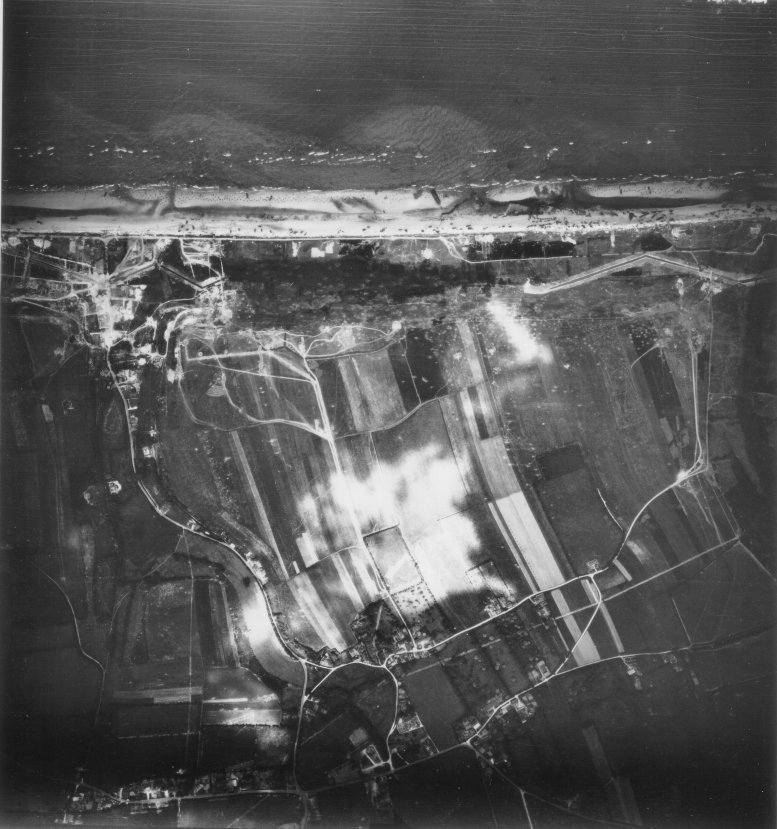
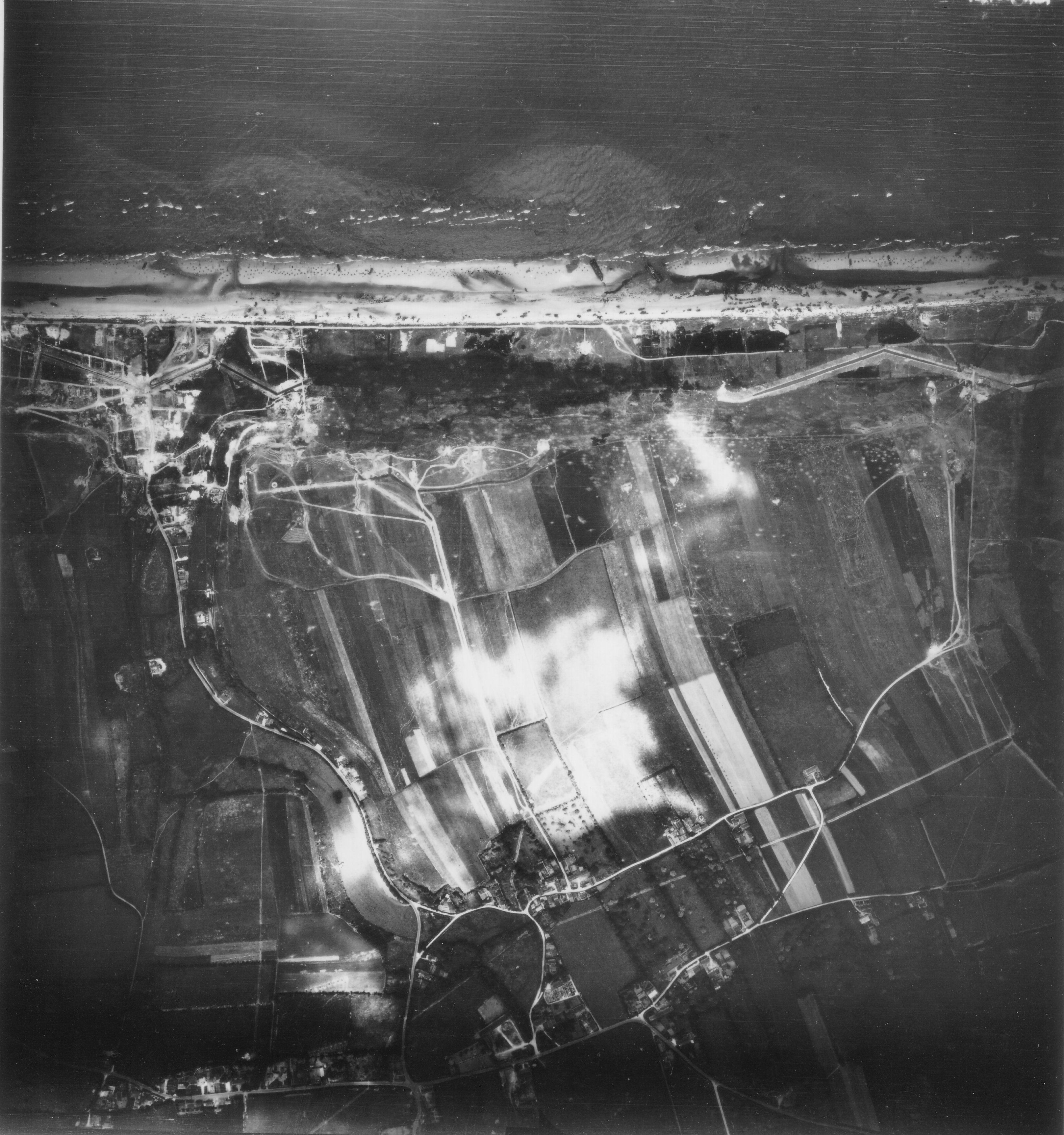
The aerial bombardment was a complete failure. Liberator quadrimotors had been planned, but they were flying at high altitude and above the clouds. As the accuracy was already poor in clear weather, the Allied Major States had to resolve to prescribe an additional margin of safety for the target, which led the centre of gravity of the impacts to several hundred meters and sometimes several km south of the target. It was then certain that the bombs could not reach the landing craft flotillas that approached the shore at full speed at the same time.
As a result, the bombs dispersed in the countryside, without any effect on German defences.
Naval bombardments have been more effective, especially for conventional warships, battleships, cruisers and destroyers. On the other hand, evidence indicates that rockets launched by LCT(R) have often fallen into the sea. It was indeed impossible to aim and adjust the firing of this kind of gear. The duration of the bombardment by the other ships was too short for the German defences to be disrupted.
All in all, these bombardments had a very limited effectiveness.
Tanks
There were no amphibious tanks planned on these areas, only standard tanks and tanks on LCT(A).
Of the 4 LCT(A) carrying 8 standard tanks of 743/Tk Bn and 4 tankdozers, 2 LCT(A) (LCT 2075 and 2307) only arrived on Dog Red, and the LCT 2050 arrived on Dog White. These arrivals were usually late. The LCT 2275 sank with its loading
So there were about 4 standard tanks + 2 tanks on Dog Red and probably no tanks on Easy Green.
Assault infantry, first wave
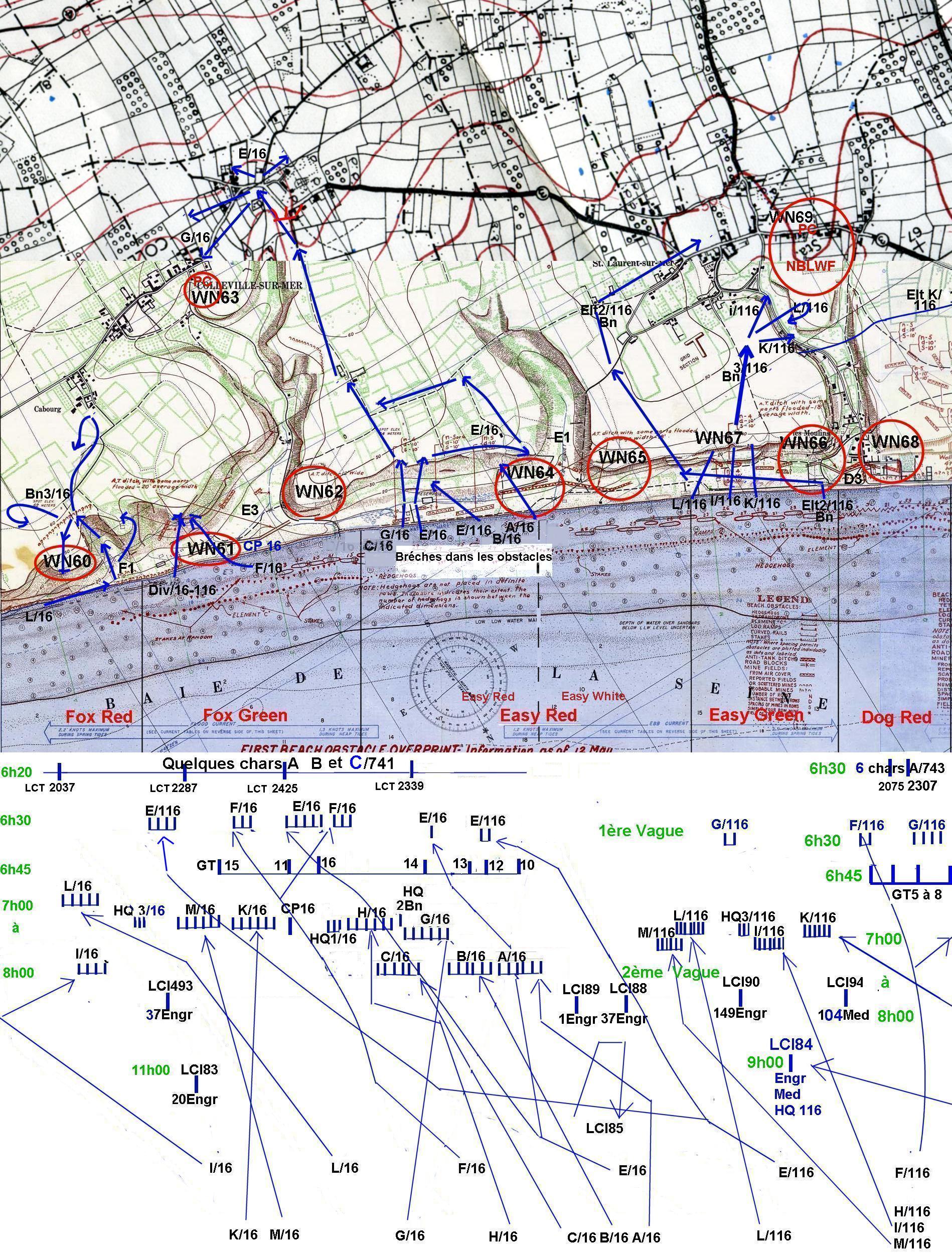
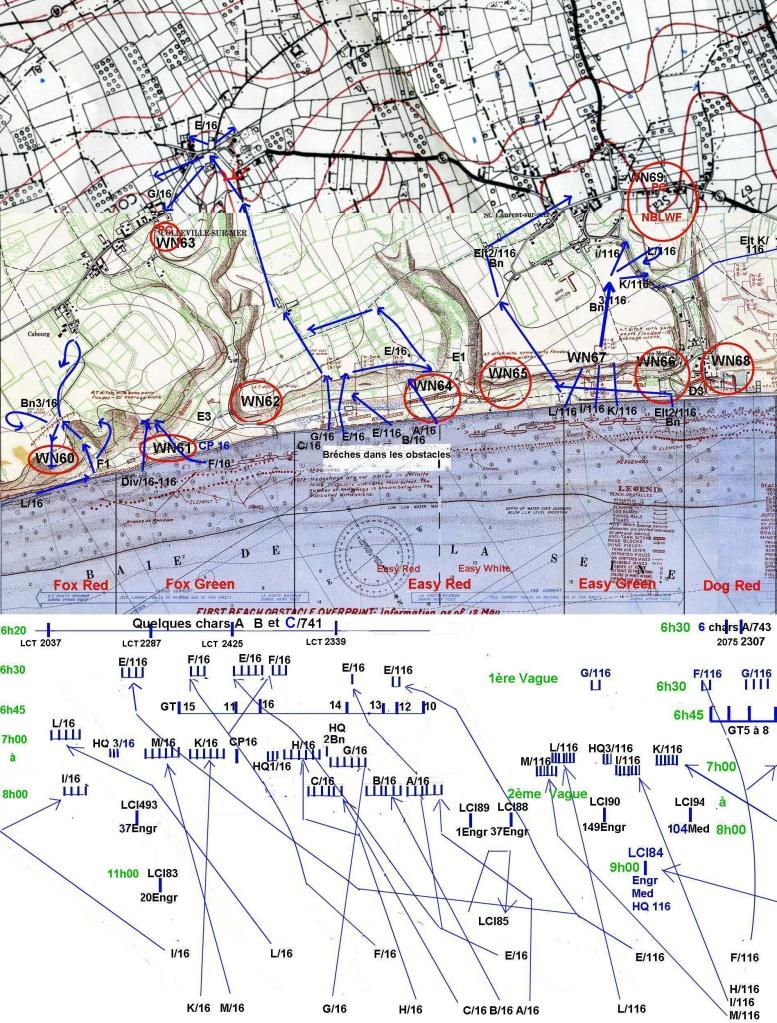
The 12 LCVP barges of the 2 assault infantry companies were widely dispersed by poor visibility (fires on grass slopes) and east-facing current.
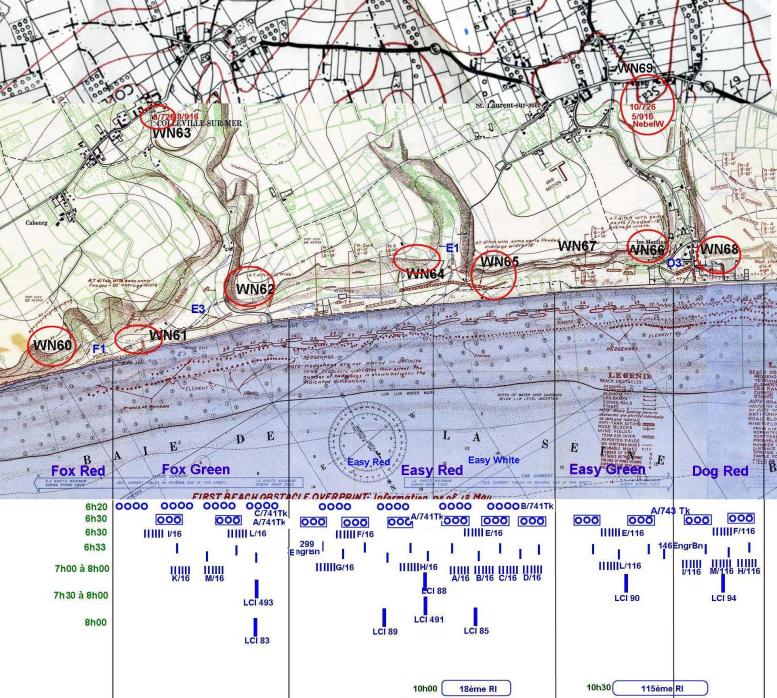
The F/116, intended for Dog Red, landed with 4 barges on the east of Dog White and only 2 barges on Dog Red.
The E/116, intended for Easy Green, was found with 2 LCVP on Easy Red and 4 on Fox Green, so widely dispersed eastward towards Colleville, in the sectors of the 16th regiment.
On the other hand, they arrived on Dog Red, 5 of the 6 LCVP of the G/116 Cie, intended in principle for Dog White.
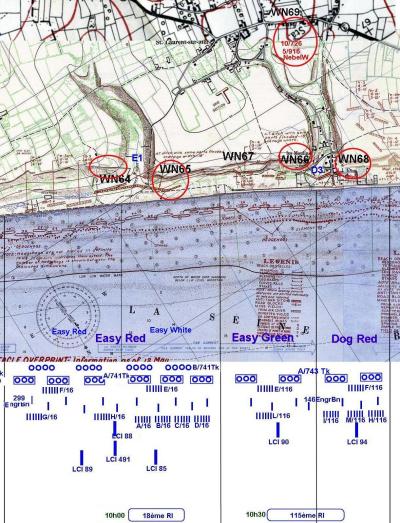
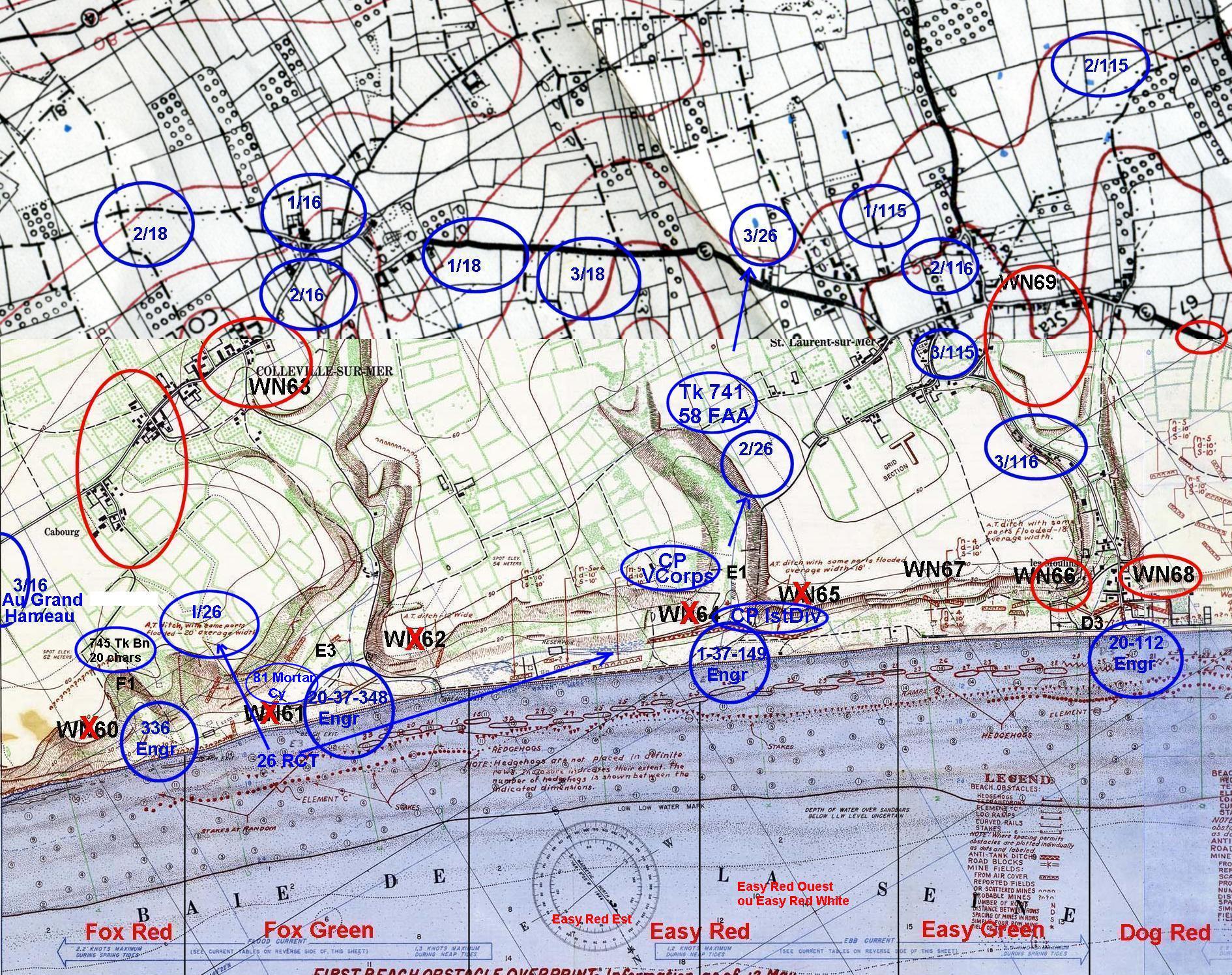
So there was very little infantry in first wave on Easy Green and in all about 6 or 7 LCVP of Cies F and G/116 on Dog Red. Arriving directly below the WN 66 and 68 of the Moulins, these troops suffered heavy losses crossing the beach due to the firing of machine guns and mortars. The smoke from the fires had little protection.
The survivors, scattered over 1 km, flattened on the pebble bench that offered protection against bullets, but any movement was impossible. A few tanks could provide fire support, but not effective against well camouflaged German shelters.
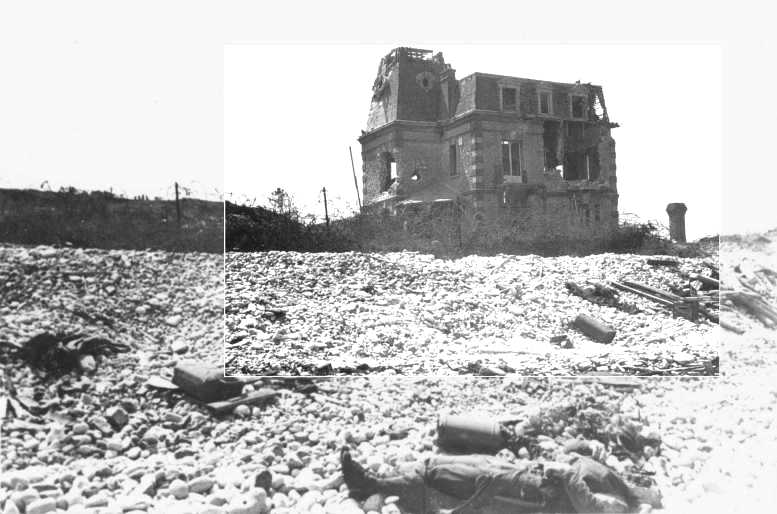
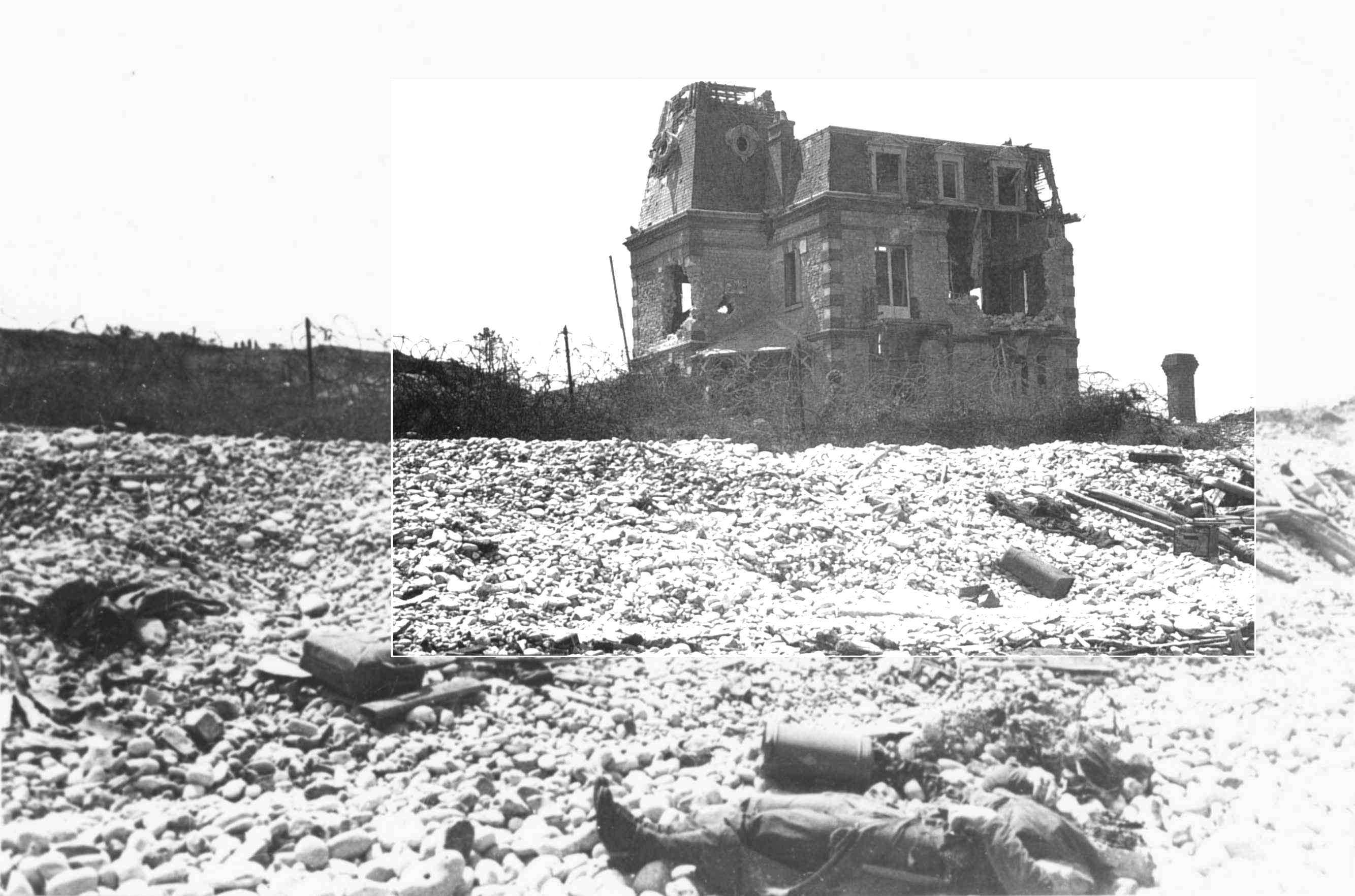
The GIs were in front of barbed wires separating them from a small dirt road, behind which was the Villa Les Sables d'Or, in the middle of a German fortified area, targeted by tanks.
At F/116, Captain Callahan, without radio, was seriously injured in attempting to designate targets to a tank. Any attempt to cross the barbed wire would have ended in an annihilation. The company's survivors were therefore immobilized on the pebbly slope.
When G/116 survivors realized that they were far east of their assigned area, they tried a difficult and dangerous lateral shift along the pebble bank. They quickly lost all cohesion and had to resolve to hide behind the many transversal ears they found on their way.
The "Gapteams" of the SETF
It was planned for 2 gapteams per sector, the Gapteams 5 and 6 on Dog Red, and 7 and 8 on Easy Green, arriving in principle at 6:33 am.
It seems that they all arrived in front of Dog Red, an average 1/4 hour late, about 6:45 a.m. As they had to work before the rise of the sea, so before 7:00 a.m., and as they were in front of Les Moulins, exposed to the fire of the WN 66 and 68, they were unable to complete their work, while losing a large part of their staff and equipment.
The 2 support gapteams (the Gapteam C and D), which were to support them at 6:41 a.m., arrived too late, and the Gapteam C even landed on Fox Green in Colleville.
None of these teams could be supported as planned by a tankdozer, all arrived too late.
.The assault infantry, 2nd wave
This second wave of LCVP experienced the effect of current and poor visibility as the previous wave.
Company I/116 was to approach Dog Red, its 6 LCVP arrived on the east of Esay Green.
The L/116 company was to approach Easy Green, it dispersed on the edge of the Easy Green and Easy Red sectors.
The M/116 (81mm mortars and heavy machine guns, planned on Dog Red arrived on the west of Easy Red.
On the other hand, the K/116 Cie, planned on Dog White, landed on the east of Easy Green, meled at I/116.
The bulk of the 3rd Battalion of the 116th was thus found, at about 7.30 a.m., between Le Ruquet and Les Moulins, but often far from the WN 65 and 66 who kept these exits. Far from these WNs, the units suffered relatively little loss, which did not prevent them from advancing to the poorly defended hill above.
The arrival of Combat Engineers, Beach Engineers and the first medical elements on LCI and LCT
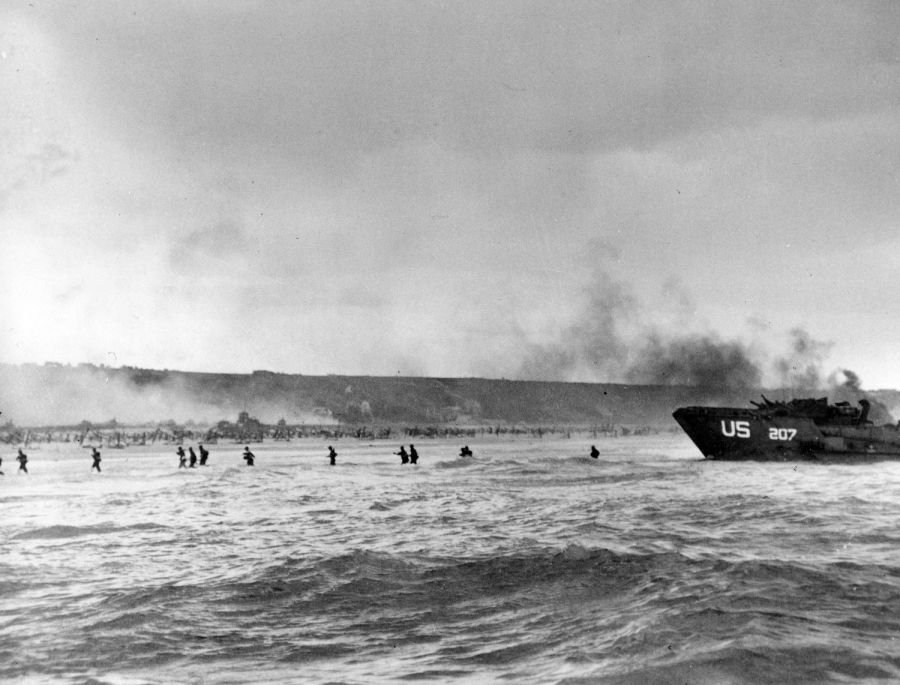
With many LCT, arrived on Dog Red, LCI 94 (with elements of 112 Engr Bn and 104 Med Bn, and LCI 84 - planned on Dog White but diverted - with elements of 149 Engr Bn, 7 Beach Bn, 104 Med Bn, HQ 116 (Advanced PC Communication Group).
Also arrived on Easy Green, the LCT 90 with elements of 149 Eng Bn and 7 Beach Bn.
These LCIs were able to leave despite having been hit by the German 3 fire. They were able to cross the line of mined obstacles, probably because these mines - anti-tank tellerminen - had not resisted the flood of the tide twice a day.
In front of the WN 66, Major Bingham, Cdr II/116, found himself with troops decimated by German fire, notably coming from the villa Les Sables d'Or, on 3 floors, damaged well by the naval bombardments, but still housing near the ground floor, a German post. With the help of other officers of his PC and a few soldiers of the F/116 Cie, he tried several times, but without success to move towards exit D3, too often the soldiers' weapons did not work, full of sand that had to be carefully cleaned. He assisted Colonel Thompson (Cdr. 6th Special Engineer Brigade) when he was seriously injured in the throat. According to some indications, Bingham would have climbed to the top floor of the villa, would have come out after finding that his men had no weapons in order to function, and would then have infiltrated the east of the house into the cliff and gone down, without being able to maintain itself. Major Bingham then led his small group eastward where he joined the 3rd Battalion (III/116), which climbed the cliff towards Saint-Laurent.
Further east, on Easy Green, Battalion III/116 landed without too much loss between the WN 66 and 65. The battalion was disoriented because it was not his area (he should have been on Dog Red) and he should have passed behind the 2nd battalion, but there was little infantry on this Easy Green area except part of the G/116.
They were able to cross the barbed wire and the clear and flat space, before climbing on the cliff, in Indian line avoiding the mines, crossing the WN 67 very little defended, it seems that it was only a decoy with a lot of earthwork, trenches and holes, but almost without fighters to garnish it. Only a bunker had to be neutralized by the L/116 cie with explosive charges.
At about 8:30 a.m., the battalion was on the plateau, but the PC remained at the foot of the cliff until the afternoon. The orders did not intend to enter St-Laurent but to regroup to the south west of the village. The battalion, still separated into sections of boats, went straight to its right, to cross the valley of the Moulins which was on its way. This made him pass under the WN69, which was well defended by a German company and which also housed a battery of 40 Nebelwerfer rocket launchers.
The 3 companies I, K, L were caught under fire from the machine guns and snipers of the WN69, and they could not move east of the valley separating them from the WN 69. Qiuelsections managed to cross the valley north of WN 69 and made contact with Rangers advancing towards Vierville, but the bulk of Battalion III/116 remained until evening north of Saint-Laurent.
The 115th regiment then intervened.
In the initial plans the 115th RCT was part of Force B, a support force, to arrive in the afternoon of June 6 in front of Omaha Beach, to be disembarked on demand the evening or the next day. He was supposed to land at the Moulins in principle without opposition since the D3 exit should have been opened by the 116th Regiment, and then cross the countryside south to the RN13.
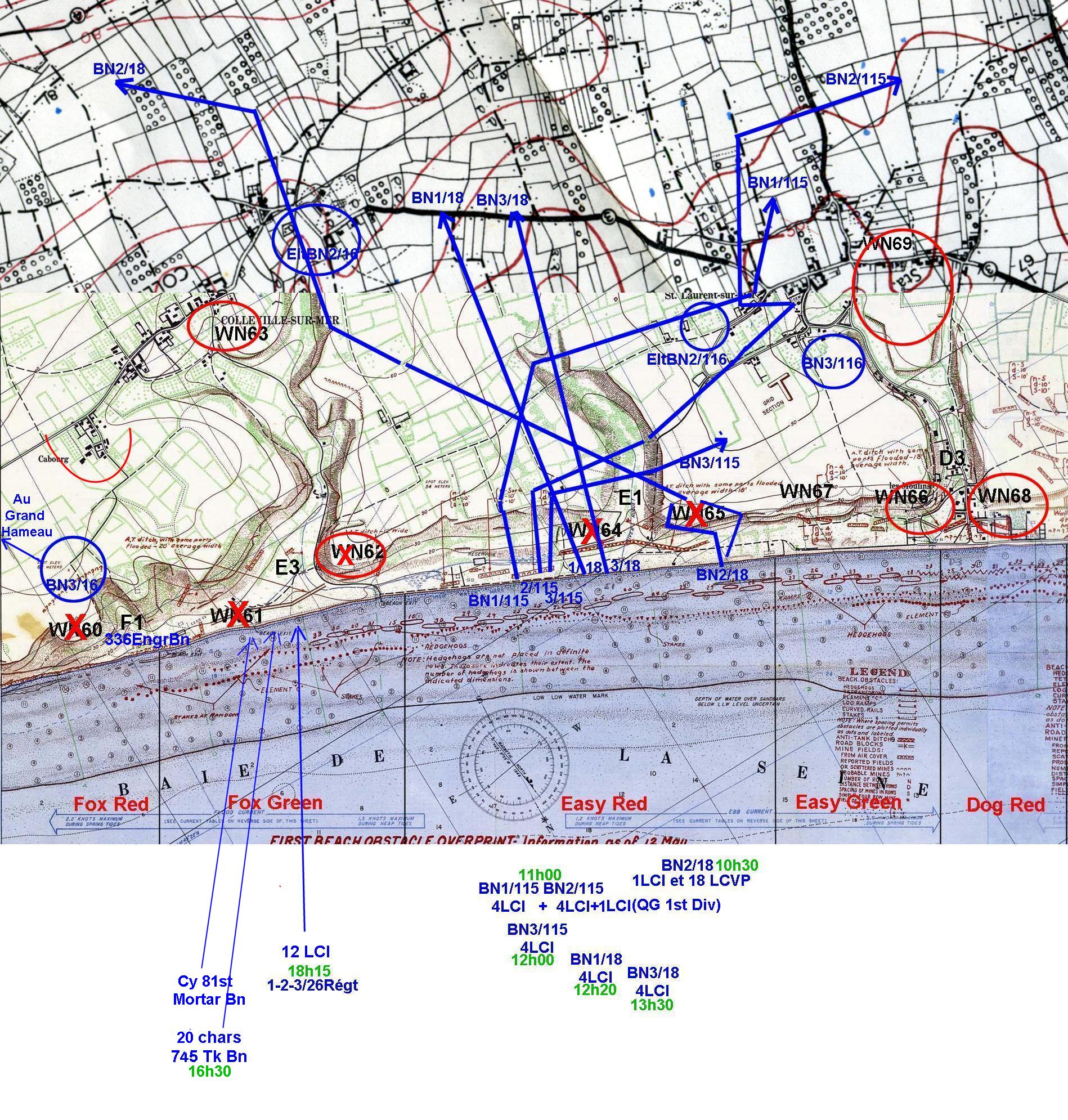
In fact, at the request of General Gerhardt, Commander of the 29th Division, the 12 LCI of the 3 battalions (2500 men) were amalgamated with the convoys of Force O, so that they could be disembarked earlier if necessary (the 700 men accompanying the vehicles and cannons assigned to the 115RCT, had remained with the convoys of Force B, but they would not be urgently needed on land). The landing of the 12 LCI of the 115 RCT was decided shortly after time H before evidence of the unexpected resistance of the Germans. The regiment was to land in front of Les Moulins, on Dog Red, from H+4, 10:30.
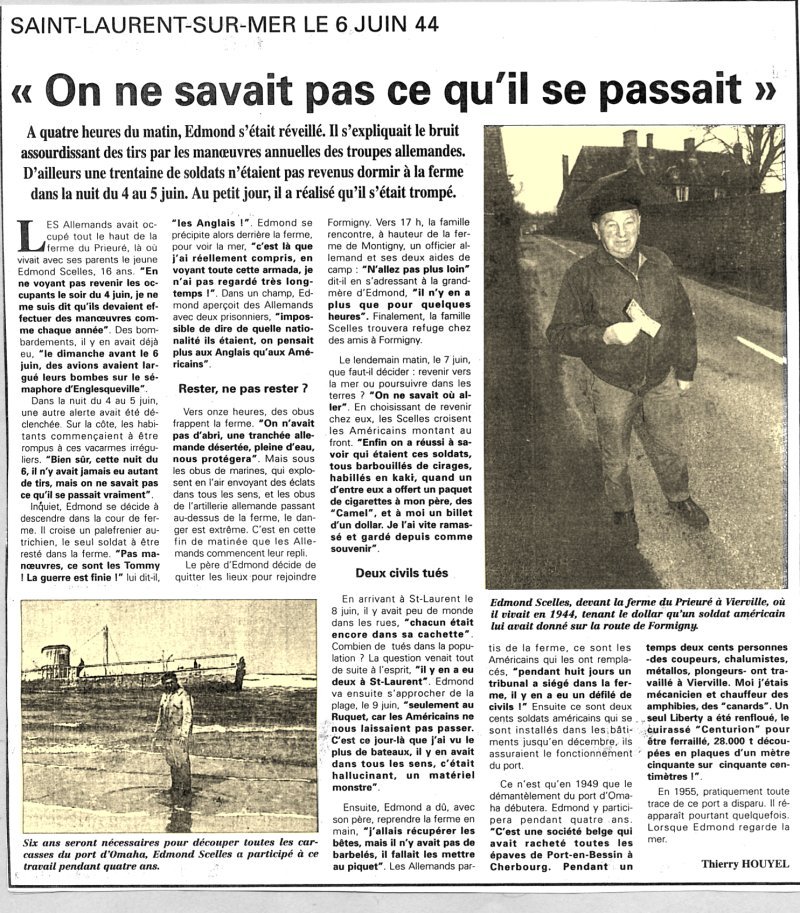
When the LCI came in front of Les Moulins, it appeared that the obstacles were not removed on the beach and that the D3 exit was completely controlled by the Germans. The LCI then looked for a more favourable location that they found east of the Ruquet. The time had passed, and the LCI disembarked before 11:00 for battalions I/115 and II/115, and at 12:00 for III/115. But this upset the arrival of the last battalions of the 18th Regt. (see fighting in the Ruquet)
The 115th crossed the Ruquet Valley westward in the afternoon. He then headed for the village of St-Laurent, well defended by Germans who barred them from the road.
The Saint-Laurent attack was carried out in the afternoon by Battalion II/115, towards the church and the Prieuré farm. After some time the bell tower could be destroyed by the USS Thompson, and a tank of the 741st TkBn entered the narrow streets of Saint-Laurent, neutralizing several German posts. As he approached the main junction, he was the target of an anti-tank gun or more likely a German bazooka that missed him. The tank then retreated outside the village.
As for the Nebelwerfer battery, it ended up being spotted by the Navy (destroyer USS Thompson) which was able to neutralize it around noon, but it had spit out to the Moulins beach most of its ammunition in the morning, probably headed by an observation post at the WN68.
Artillery fire was carried out by the 58th FAA Bn (armoured field arid battalion), who had landed in the Ruquet in the afternoon 11 armoured howitzers surviving an unsuccessful attempt to disembark in the morning on Dog Red. He had put himself in battery at the head of the Ruquet valley from 4:00 p.m.
Finally, at about 8:15 p.m., Battalion II/115 had to be removed from Saint-Laurent, after having lost, out of combat, about 100 men and 6 officers out of 11 Company E/115 and Company F/115. The fight had been savage, the Germans did not hesitate to shoot at the American nurses wearing their armbands and the German prisoners arriving rarely alive to the camps prepared for them at the Ruquet.
Battalion III/115, which was in reserve east of St-Laurent, took its place in front of St-Laurent at about 20:00.
For its part, Battalion I/115 bypassed the village as close as possible to the south.
La Cie A/115 put in place a stopper on the road to Formigny.
Colonel Blatt, Cd. I/115, was seriously injured by mortar fire while installing the D/115 mortar Cie and its command cie in grasses 500m south of Saint-Laurent. Blatt, struck by a shrapnel at the head, was swiped to the shore and then evacuated to a ship. He died before arriving in England.
Meanwhile, battalion II/115 moved in the evening even further south and then west across fields, well over St-Laurent, heading towards the road leading from Vierville to Formigny.
All these units buried themselves for the night while waiting to resume the fight on 7 June.
Meanwhile, Major Bingham, with the remains of his battalion II/116 very weakened, had not been able to open his way through the hamlet of the Moulins. So he moved on his left towards the Ruquet, and he also climbed up to St-Laurent, without being able to move forward in the village.
The units of the 116th RCT at St-Laurent were isolated and without communication with Colonel Canham's advanced PC, installed in a defensive position at Vierville. These units included the remains of II/116 (Major Bingham), III/116 (Lt-Colonel Meeks) and the Communication Group of the 116th (Captain Sink) headquarters, isolated from its leader Colonel Canham. The latter could only have had a radio link in the evening at around 10:00 p.m., and Canham decided to regroup his entire advanced PC in St-Laurent, which was done on June 7 at approximately 6:00 a.m. The 116th RCT was then again controlled almost entirely by its leader, after the dispersion due to the fighting of 6 June.



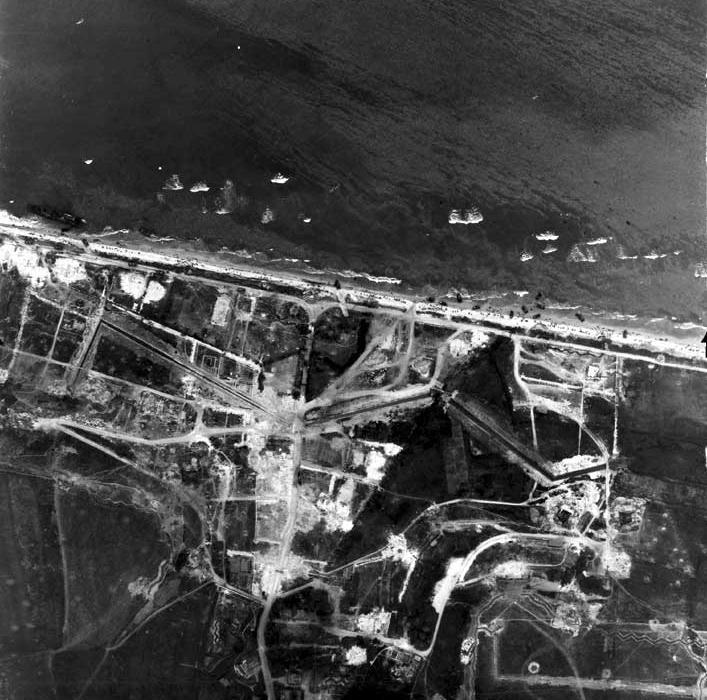
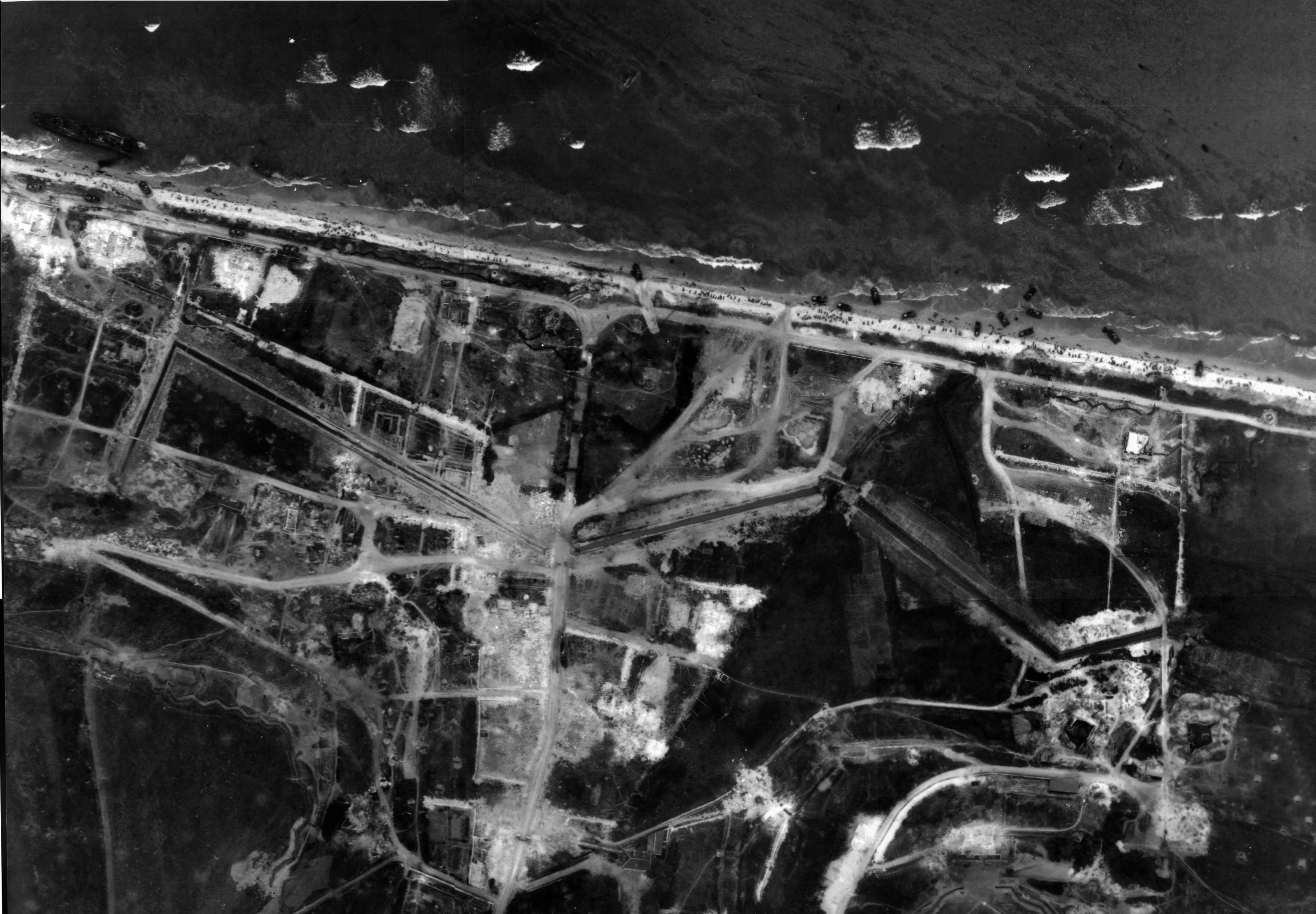
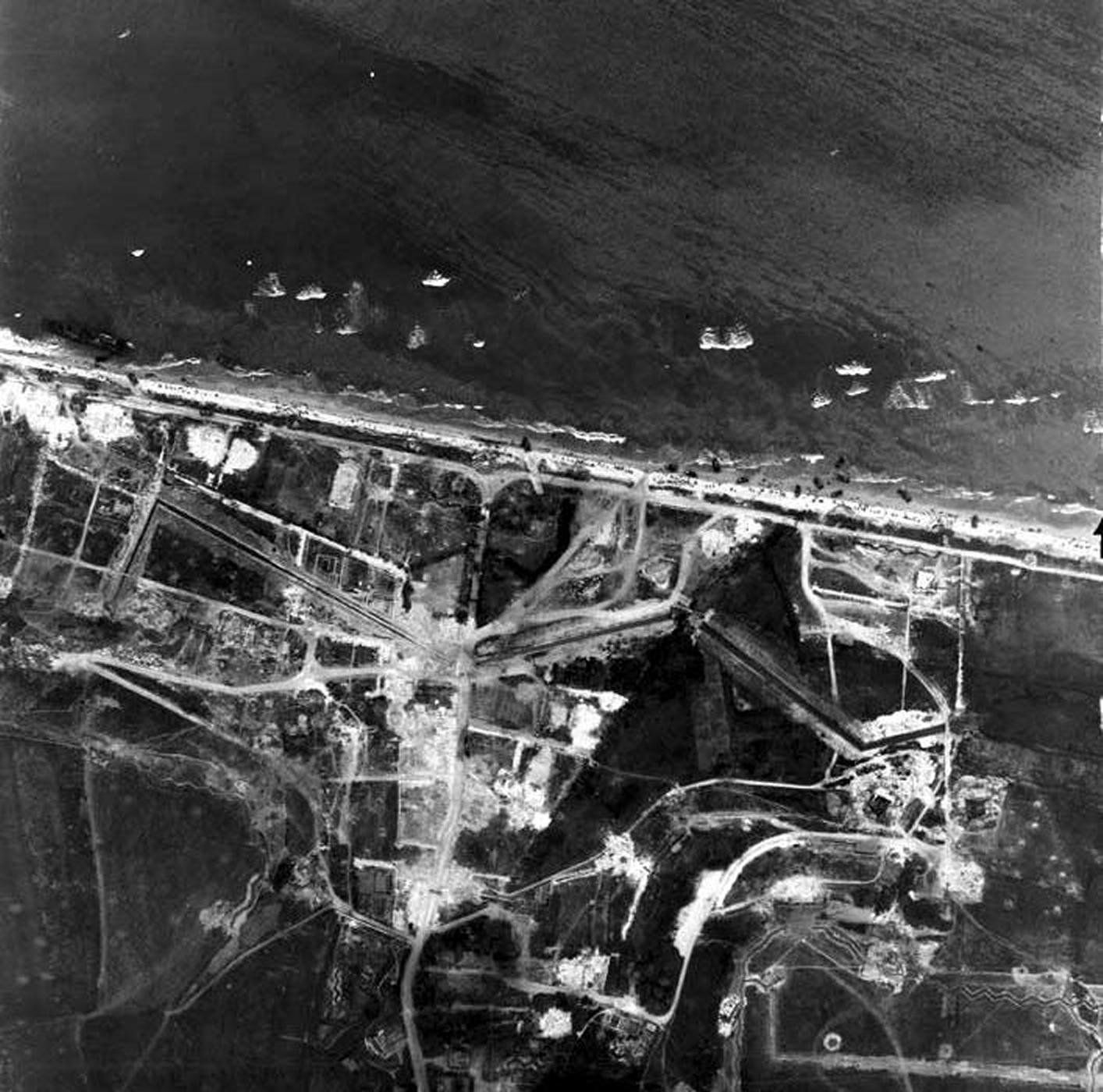
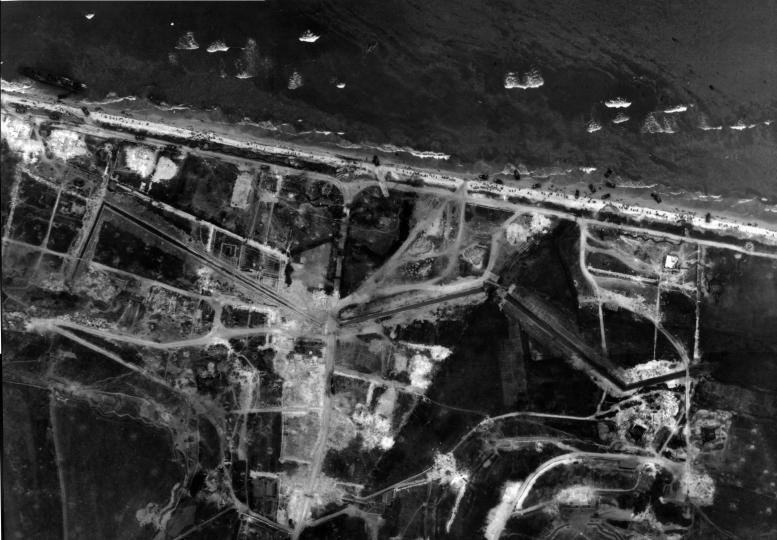
Les Moulins on June 6 around 12:30(details)
The LCI 92 is on the pebbles to the left, not visible.
(details)