

Company B of the 116th Infantry Regiment dispersed by disembarking
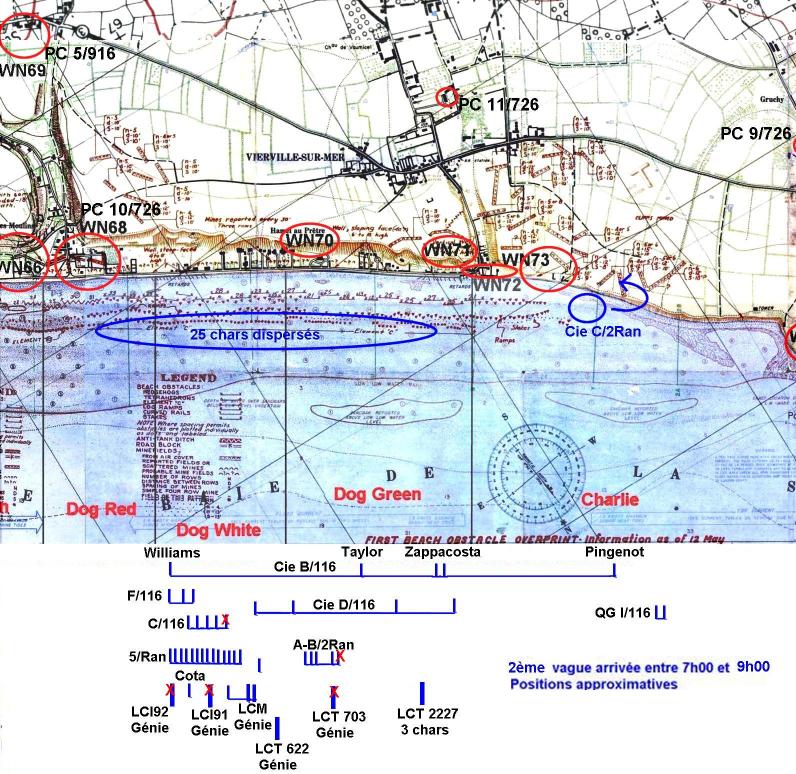
Company B/116 was scheduled to arrive at 0700 on Dog Green, following Cie A/116.
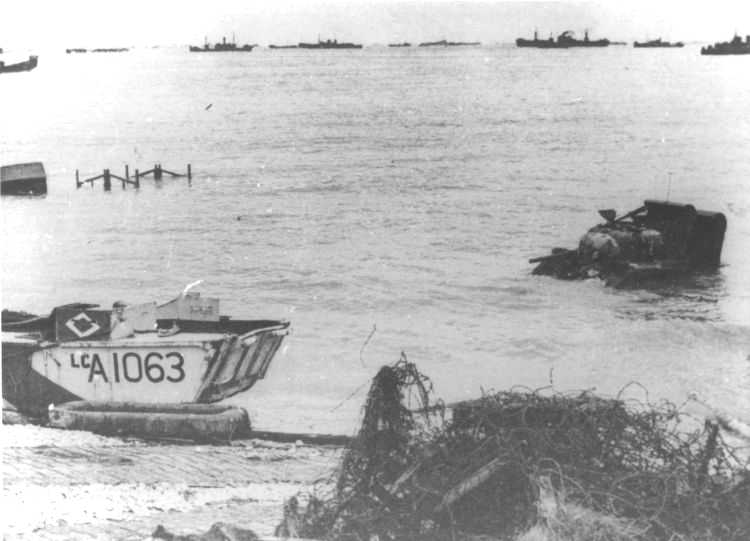
Its 7 ships, British LCAs, were in the right place, but finding catastrophic conditions on this area, they dispersed to the right and left and hit land on a front of almost 2 km around the planned Dog Green area.
The 3 barges that hit ground on Dog Green came under the same deadly fire that had destroyed Company A, and their remains were mixed with those of Company A, in a similar effort to survive.
Only three sections on both sides played an important role in subsequent fighting.
Company B/116 had already had a lot of difficulties during its approach.
(extracts "Battle at best" by SLA Marshall)
"The sea is so strong on the way that men have to go hard with their helmets to keep each of the 6 LCA floating. Thus concerned, they do not see the disaster that overwhelms Company A, until they have almost arrived. And what they see is so terrible that the whole flotilla gets scared and loses its cohesion. A large cloud of smoke and dust created by the firing of mortars and machine guns almost fired a curtain at the agony of Cie A. In front, you see nothing but a line of drifting corpses, a few heads on the water and the red sea of blood. That's enough for British pilots. They shout, "We don't have to talk here. No landmarks. We have to get out of here."
In the company commander's boat, Captain Ettore V. Zappacosta pulls out his Colt 45 gun and opposes: "Shit, you will continue to advance this boat!".
His courage forces obedience, but it is still a stupid order. The one to ship the boats of Cie B in the misfortunes of Cie A without helping him in any way. Three times. During the approach, mortar shells exploded next to the boat of Zappacosta without damaging it, thus giving the occupants a few moments of survival. At 70m from the sand, Zappacosta shouts "put down the ramp!". She falls and the bullet storm blows.
Zappacosta jumps outside the first, lets himself drag about ten meters in the water to the elbow, and shouts: "I am touched". He's still tripping a few steps. The nurse, Thomas Kenser, sees him bleeding from the shoulder and hip. Kenser shouts, "Try to hold, I'll be right there." But the captain fell face-to-face in the waves, and the weight of his equipment and his water-sip package kept him at the bottom. Kenser jumps to him, he's killed right now. Lieutenant Tom Dallas of Cie C, who accompanied them, is the 3rdème. He managed to get to the shore. There a burst of machine gun takes his head out before he can flatten.
Soldier of 1era class Robert L. Sales, which carries the radio SCR300 of Zappacosta, is the 4ème leaving the LCA, having waited enough time to see the others die. His heel clings to the edge of the ramp and spreads in the water, losing his radio, but saving his life. Anyone who tries to follow him is either killed or wounded before reaching the sand. Sales is the only one to reach the beach unharmed. Browse the 200 meters on this beach will take him 2 hours. First he squats in the water, and goes flat belly a few steps, bangs himself against a large floating and drifting log. At that time, a mortar shell exploded above his head, leaving him groggy. He clings to this floating wood so as not to faint, and this effort seems to shed a little light on his ideas. Then he realizes that an isolated Cie A lifts him on the log and using his knife, rids him of his pack, his boots and his assault vest.
Feeling stronger, Sales returns to the water and, from behind the log, using it as a shelter, grows towards the sand. Private Mack L. Smith, B.C., hit three times in the face, joins him there. A Cie A rifleman, hit three times in the right leg, comes next to him. Together they follow the log that finally arrives at the high tide leash (around 10:00). Then they flatten behind, remaining there hours after the flood has withdrawn. The dead of the two companies fall apart there, then go back with the juicer. When a body drifts near them, Sales and his companions, without paying attention to the shots, crawl from the log shelter to take a look. If one of them recognizes a comrade, they help each other to shoot him on the sand, out of reach of the water. Unknown deaths are left in the sea. As long as the sea is high, they attach themselves to this work. Later an unidentified nurse arriving walking along the beach heals Smith's wounds. Sales that takes over Kemper panse forces. All three stay behind the log until dark. There is nothing else to bring back members of the section of the boat of Zappacosta.
Only one of the other boats in Cie B is also trying to go straight on the lens. Soon the boat will be on the heels. Soon all are killed. One British pilot and 30 American infantrymen. Where they fall, there's no one to tell what happened.
Scared, the pilots of the other 4 boats cast a quick look, instinctively retreated, then saw to the right or left, away from the debris of Cie A. In doing so, they abandon their mission, while providing a respite to their passengers. The shock is such on the boat section heads, and this is their relief in the face of this backward movement, which none protest.
The third boat, Lieutenant Leo A. Pengenot headed towards the Percée, there, seeing a small quiet overhang under the cliff, the pilot went straight there. At 50m from the shore, Pengenot shouts "Down the ramp!" The pilot clings to the cable, refusing to let it go. Chief Sergeant Odell L. Pagett jumps on him, strangles him, throws him on the floor. Pagett's men drop the ramp and jump into the water. In 2 minutes they all have it up to their necks and struggle not to drown. Quick Pengenot is far ahead. Pagett ends up joining him and together they go to dry. The space in front of the overhang is dotted with huge blocks of stone. The bullets seem to be scaring them all.
Pengenot and Padgett dive behind the same rock. Then they look back, but, horrified, they don't see anyone anymore. Substantial smoke has half-hidden the landscape beyond the edge of the water. Pengenot groaned, "My God, the whole section is dead." Padgett shouts: "Hey, are you touched?". Many voices go up from behind the smoke: "Where are we going?" "Sweetly!" "We're going to get there" "Where does the fire come from?" "Who knows?". Men continue to move, using water as a shelter. Padgett's calls are their first indication that someone is in front. All go to shore, they're at the beginning. Pengenot and Padgett remain in front of them, encouraging them. Padgett keeps yelling, "Come, God, it's better over here." But they lose two killed and three wounded while crossing the beach.
Under the overhang, the section contacts a group of Rangers (Cie C/2Rgr) and then joins them at the top of the cliff, west of the Gambier house. They're still fighting with them.
A fourth ship of the CieB that veers to the right is much less fortunate, because it goes less far. Sergeant Robert M. Campbell, who leads the section is the first to jump out when the ramp drops.
It falls into deep water and its load of two explosive poles "Bangalore" drags it to the bottom. Then he throws his poles and on the surface abandons all his equipment for more safety. The firing of machine guns frames it, and it flows again briefly. Quite good swimmer, he returns to the sea and for 2 hours, he will swim about 200m from the shore. Although he did not hear and see anything about the battle, he did feel that the landing had failed and that all the other Americans had died, wounded or taken prisoner. His forces abandoning him, of despair, he prefers to go to the shore rather than drown. Beyond the smoke he quickly recovered the shots. Then he grabs a helmet on a dead man, crawls on his hands and knees to the seafront, and there finds five of his men, two of them uninjured.
Like Campbell, the 1stera Jan J class. Budziszewski is trained at the bottom by his load of 2 "bangalore" poles. He clings to it for half a minute before realizing that he had to let go or drown. Then he drops his helmet, his package and his rifle. Then it's surfaced. After swimming 200m, he sees that he is in exactly the wrong direction. Then he turns and goes to the beach, or he crawls to the shore "under a rain of bullets". On his way to a dead Ranger. Budziszewski takes his helmet, his rifle and his gourd and ramp towards the shore. A unique survivor of Campbell's boat to leave the beach, he spent the day walking along the cliff, searching for a known face. But he only meets strangers and none of them cares about him.
In the 5th boat (Lieutenant William B. Williams) the pilot veer frankly to the left and departs very far from the area of his chief Zappacosta.
Having not seen the captain die, Williams does not know that the command is his. Guided by his instincts, the pilot travels along the coast for a long time, then leads his boat to the beach. It is well seen; he found a small hole in the battle. The ramp is lowered even on dry sand and the boat section jumps to shore. (they're at Dog White - Dog Red)
Yet it was just right. He had been accompanied by mortar fire; and as the last rifleman cleared from the ramp, a shell fell in the middle of the boat, broke him in 2 and killed the pilot. At the moment the beach is not under fire, but the men in the section cannot cross it at once. Weakened by sea sickness and fear, they crawl, dragging behind them their equipment. After 20 minutes, Williams and 10 men rest at the foot of the pebble slope on the sand. 5 others are affected by the firing of machine guns sweeping the beach; 6 others, seen for the last time in a pond, never heard of again.
Sergeant Bill Presley might have been in this LCA. Here's his story.
When Cie B's assault boats dispersed just ahead of Vierville, the pilot of the 6th boat (Lieutenant Taylor's) turned to his left, heading on a point halfway between Zappacosta and Williams.
Until a few moments after opening the ramp, this beach end to the right of the Hamel at the Priest, is not hit by the fire. No mortar shells to crown the departure. Taylor quickly drove his section through the beach and under the pebbly slope, losing 4 men killed and 2 wounded (machine gunshots).
A few meters to his right, Taylor saw Lieutenant Harold Donaldson and Emil Winkler killed. But there is no stop-reflection; Taylor drives his section straight up the cliff. (he will be the first to enter Vierville shortly after)
