Memories of Michel Hardelay, about evenings, the beach and the port
"In the evening of this 8th June we learned what was to become the ritual of dusk: an anti-aircraft artillery piece fired a smoke shell at a point clear of the sky, if possible at ten thousand feet, then each battery settled on this high-flying shell that provided the direction and speed of the wind. That was the time when you had to have a roof over your head. Finally, the dam balloons were installed.
In the event of a night storm, the balloons, with a metalized canvas connected to the winch by a thin steel cable, acted as a lightning rod and it was strongly advised to move away from the winch.
If an enemy aircraft were detected by the search radars, an audible signal was heard and all the projectors, on land like those of the ships at sea, were extinguished at the same time. Indeed, landings continued at night and day under an artificial light that illuminated the sky and had to see itself from a distance, if I refer to that of the port of Arromanches, visible from home."
"On Friday, June 9, I decided, although it was forbidden, to go down to see what had happened to the remains of our villa.
I found two soldiers at the top of the cliff who, although surprised, let me pass. They had a jeep in a sink that had had to be dug in the bulldozer and appeared to be in charge of guiding the barges. A large panel, located in the cliff and on which a number of two digits were painted, was to give a mark to the ships and there were such signs every three hundred meters.
I took the downhill path; the barbed wire network that would bar him at mid-descent had been cut off and soon I arrived in what had been the summer salon; four men were making mine holes in the walls, under the orders of a non-commissioned officer, using a hammer-picker. I went to this one and told him that I intended to rebuild on the existing walls. He immediately stopped the work of his men, who put away their tools and went with him to blow up the neighbouring house.
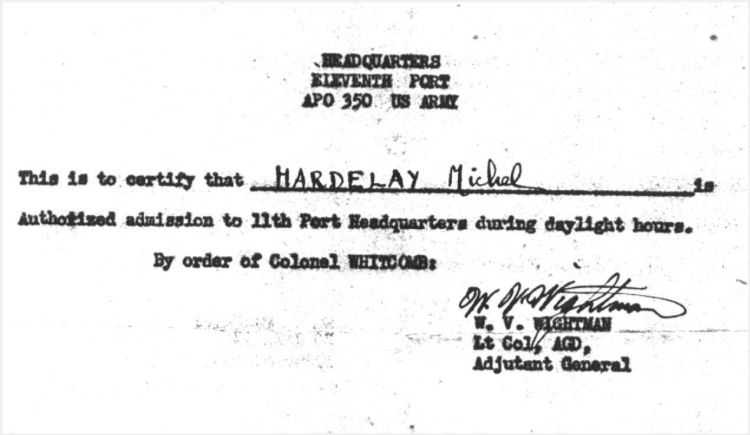
"At the beginning of the following week, on the occasion of some paperwork from the town hall of which I do not have the memory, I became acquainted with Colonel Witcomb who headed the services of the 11th Port at the Château de Vierville. He was a charming man, speaking French to perfection, and taking me in friendship.
permission given to Michel Hardelay to enter the PC of the 11th Port at the castle of Vierville
As it was the lunch break (probably around June 16) he proposed to me to go down with him to admire "his port". At the height of what had been the Casino hotel and where the monument of the 29th DI US is now located, an MP arrested the colonel and made him respectfully observe that access to the port was forbidden to civilians. So we stayed there, but we already saw a large part of our observation point: the pontoons "Phoenix" were in place and girdled the port to the west, the floating piers were rising and, quite curiously, were situated exactly on the old port of Vierville (the 16th century) which we can still see today.
A ramp had been established in front of the concrete house which the Germans had not been able to demolish but which had dislocated under U.S. plastic charges. A road for heavy vehicles was under construction in front of our small downhill road to the sea (i.e. in the field facing the castle) and bulldozers were trying to make a descent to Mont-Olive (she still sees herself, cutting the cliff); it will be intended only for the descent to the beach of the ducks led by black dockers whose camp went up behind our house.
In fact, at the very beginning of the landing, the "ducks" would directly carry supplies and ammunition to the combatant units, but the further away the front, the more this role was assigned to the GMC. (as soon as the front had moved away, all supplies passed through deposits in the fields of the interior. On the beach floor there were special transfer stations where the ducks were unloaded by caterpillar cranes in the GMCs)
I had to see the colonel two days later (probably on June 18th) that is, the day before the storm; he was radiant and greeted me by saying, "Yesterday we exceeded the average tonnage of the port of New York." The next day was desolation: most of the large sunken pontoons, the floating dike twisted like a corkscrew and the small barges and boats sunk against it.
Everything was to be done again, they did it again....