

The aerial bombardment on Vierville
Reporting to Bungay base
Ref.: journal extract "Le fana de l'aviation" N°T6994
Bungay, Suffolk, Monday, June 5, 1944, 11 p.m. Nothing seemed to move on the great American base. The dark and rough silhouettes of the 33 quadrimotors B24"Liberator" of the 446th Bombardment Group barely broke out on the almost black sky. Yet this calm was only apparent. Tendus, the crew leaders had been waiting for hours in front of their aircraft. They knew that the big day would start in a few hours, and that, from one moment to the next, they would enter the dance.
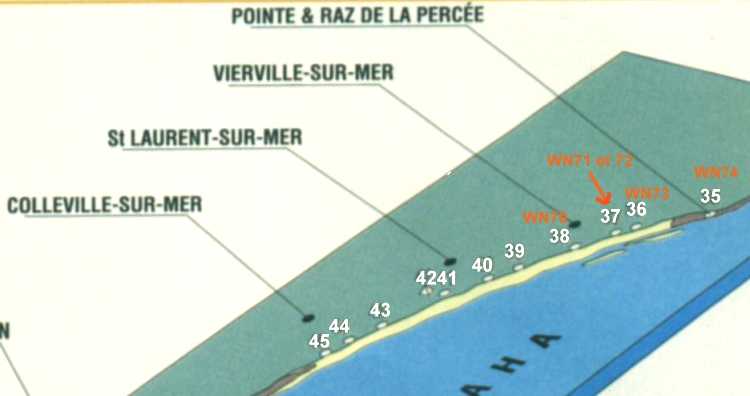
Finally, the speakers called all the crews for briefings, conferences that preceded each mission, for pilots, navigators, bombers. It was 11:30. Reading was made of Mission Order No. 328 which concerned the whole of the 2nd Air Division. And in particular the 20th Wing that was to provide 4 groups with 114 American quadrimotors to go pound the enemy positions just behind the beaches of Vierville to the Percaea.
At the head of this aerial armada would fly the 33 aircraft of the 446th Bomb Group that would attack the fortified points WN71 and 72 just below the valley of Vierville (Operating Order Goal 37).
Another group of 33 aircraft would take care of objective No.36, the fortified point WN73 (the Gambier house).
Two other groups of 24 aircraft each, would attack WN74, point of the Percaea (Objective No. 35) and WN70 above the Hardelay villa (Objective No. 38).
Each plane carried about 3 tons of bombs.
This first mission was important, as it was expected to precede the amphibious assault by little. It focused on the coastal objectives of Vierville. The main objective was to put the Germans in shock and cut off the lines behind the beaches, and that is why most of the aircraft were armed with 225 kg explosive bombs and 45 kg fragmentation bombs.
.
The instructions were very strict. The aircraft in difficulty could turn back until they crossed the English coast. Beyond that, they would be formally prohibited from doing so. The traffic would be one-way. Any aircraft flying in the opposite direction in the air corridors above the Channel, could be shot down.
Finally, in their message to the crews, the Generals Doolittle and Hodges strongly insisted on the need to crush the opposing defences with all the necessary power but precisely so as not to endanger the Allied troops whose landing would immediately follow.

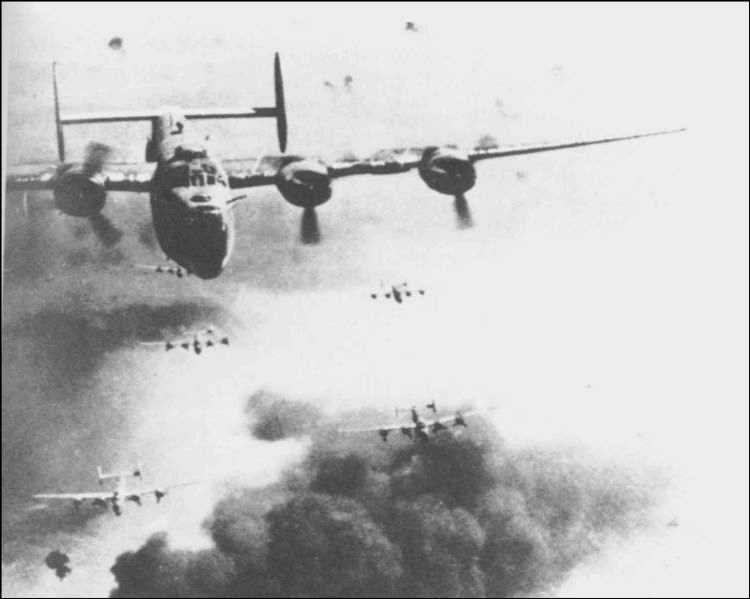


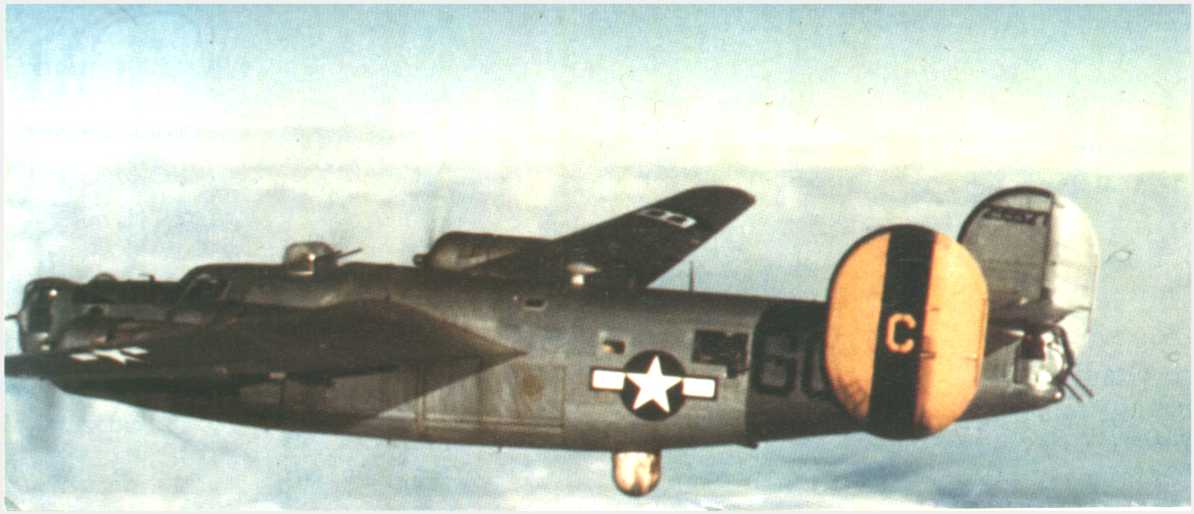




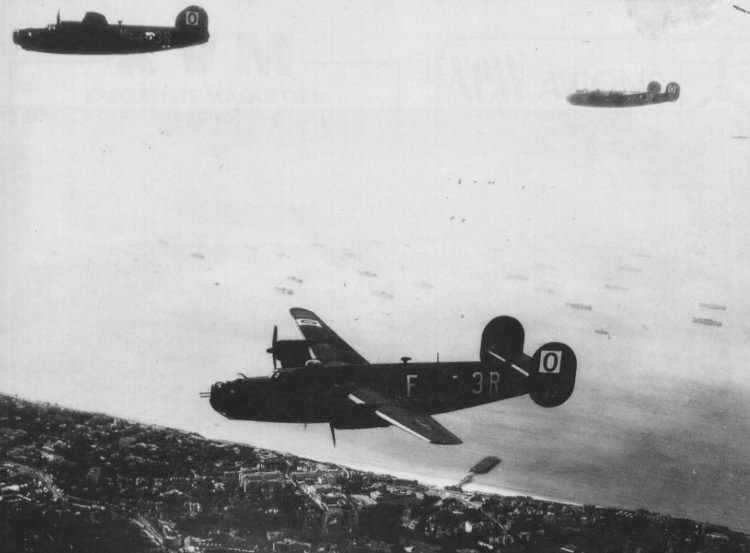


It was barely 2 hours in the morning when, in Bungay, the 33 "Liberator" with black and yellow drifts of the 446th Bomb Group started rolling. Opening the march, that of Captain Charles Ryan, nicknamed "Red Ass" (the red ass), because of the red cushion he had sewn at the bottom of his flight suit. On board also took place the group commander, Colonel Jacob I. Brogger.
The four 1200-hp Pratt & Whitney engines shouted their full power as if to hospel the plane that was starting too softly, and flew almost to regret as heavy as it was. Behind him, one by one, the aircraft of the Group's four squadrons rose. 33 drivers: Ryan, McConnell, Hornbuckle, Willis, Henderson, Beauregard, Crook and the others.
All the aircraft of the 446th Group headed north-west, moving away from France, in fact towards the assembly area of the 20th Wing, where they laboriously went to form their "box", a group of box-shaped bombers, before crossing the air corridor reserved for the 20th Wing of the 2nd Air Bomb Division.
Once again, the organization had been thorough. Each unit had been assigned a flight plan, schedules and a properly identified objective. The 2nd Bomb Division provides the 16 squadrons of 6 or 8 B-24 "Liberator" against Objectives 35 to 38 between 0600 and 0625.
Bad weather protected the Germans. Very soon it became clear that weather conditions were really not favourable to the Allies and that they would impose the bombing procedure without visibility, even less precise... Hence additional precautions to prevent bombs from falling on the infantrymen about to land.
In order to ensure that bombs would explode at least 1,000 m away from assault troops, it was decided to delay the drop after the moment determined by radar.
These shifts ranged from five seconds for the scheduled H-hour bombardments minus 15 minutes, up to 30 seconds for those scheduled at H minus 5. In addition, the flight plan provided for an approach perpendicular to the coast that simplified navigation and less exposed aircraft to Flak, while eliminating the risk of contempt by friendly gunners.
After their attack, all the aircraft made a right turn to return to England, west of the Cotentin.
In view of the flight incidents, about 100 of the 114 aircraft planned participated in these 4 missions on Vierville and Percaea. Take-offs followed from 1:55 a.m., and successive squadron gatherings took place almost as in training, except for some who failed to find their leader. There were also a few accidents and various breakdowns.
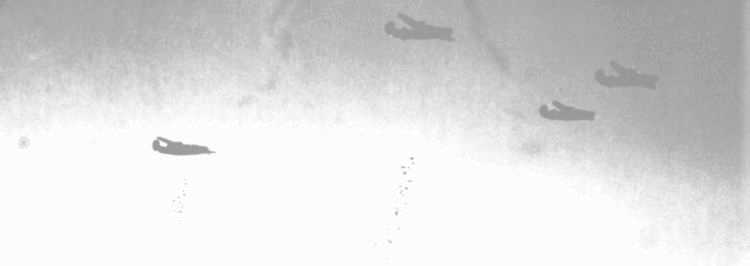
At the passage of the English coast, the aircraft lined up in six rows behind a guide bomber equipped with an H2X radar that gave an image of the ground masked under the clouds. Captain Charles Ryan's "Liberator" reached the area of objective 37 (down from Vierville), shortly before 6 a.m., half an hour before Hour H. It was exactly 5:56 a.m. when Lieutenant Jacobs, a Red Ass bomber, ordered the release of the 45- and 225-kg bombs at the German positions of Vierville-sur-Mer. The bombardment lasted 20 minutes, during which thirty pilots of the 446th Bomb Group dropped their bombs above the clouds, on the indications of the guide aircraft.
However, some could not attack because of cloud density, or, more simply, because they were unable to locate their pilot aircraft.
For the crews of the B24 "Liberator" quadrimotors, there was no visibility; they could see nothing but other "Liberator: those who were glued behind that of theirs equipped with special radar. When the bomber-guide dropped his bombs the others did the same. Such a system was completely unsuitable for the purpose sought, and this was also in case of good visibility.
At 6000m altitude, with thick clouds below, a sky that was beginning to lighten, knowing where we were could be a mystery. Many pilots were unable to locate themselves. The orders, if we didn't see the objective and if we weren't following a guide bomber, were to go back with the bombs to the airfield.
In his quadrimotor, Lieutenant John Meyer heard the co-pilot complaining about the clouds on the inside phone. He said, "It's a hell of a secret weapon Hitler found."
"It was a disappointing day," said Lieutenant Meyer, "We certainly didn't accomplish the mission." The only good thing was the lightness of the German Flak, and there was no Luftwaffe. "it was one of those risk-free ordinary missions," says Meyer. One percent of the planes were hit by Flak.
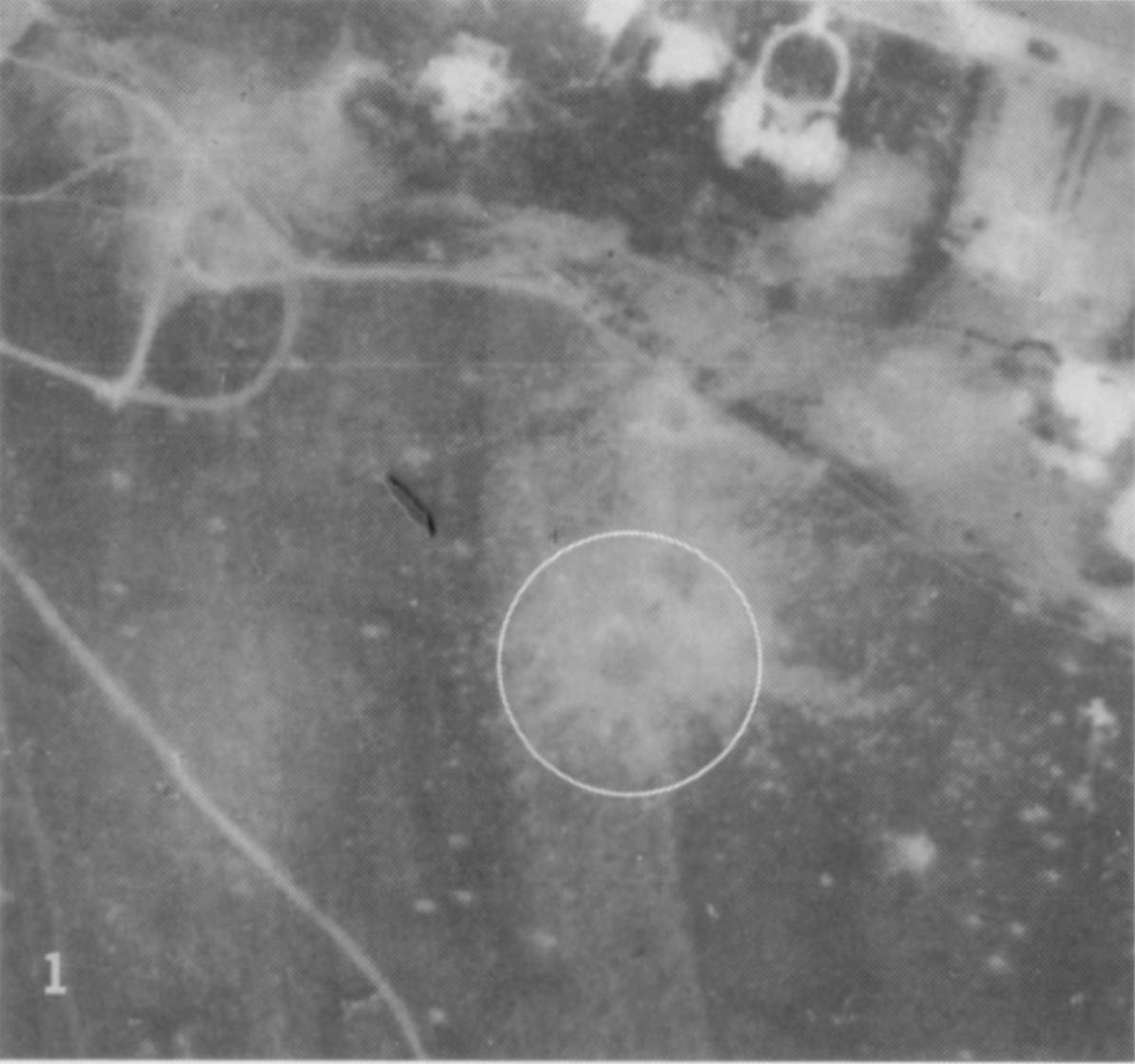
We do not know exactly where the bombs fell, probably in the countryside, scattered south of Vierville, on the side of Louvières and Formigny. It appears that a few 88mm batteries from Flak south of the RN13 were affected. Probably no bomb hit the strong points targeted on the coast.
There were civilian casualties, since in Louvières a milker and one of her young sons were killed at 6 a.m. by a lost bomb. She was the grandmother of a future mayor of Vierville.