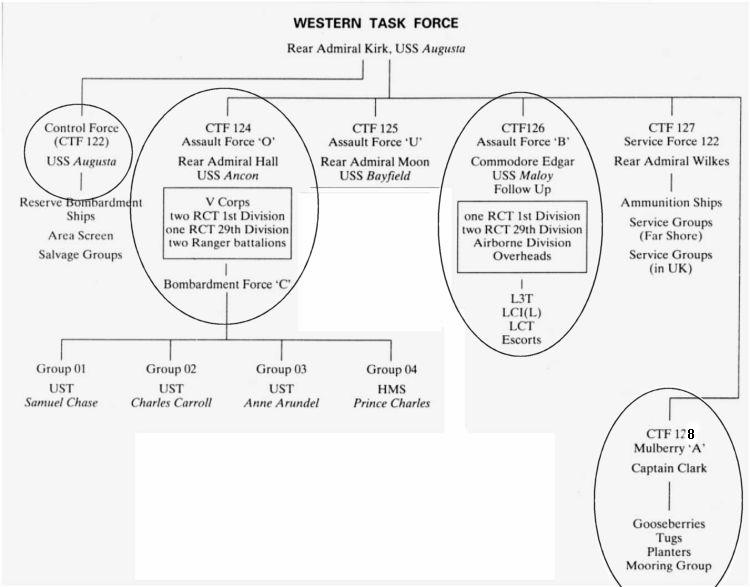
The Navy was organized as follows (Western Task Force):
-
‐ Task Force 122, under the orders of Admiral Alan G. Kirk, was responsible for the maritime aspect of the landing. It included forces O (Omaha Beach), U (Utah Beach), and B (support).
-
‐ Task Force 124 (Force O) to Omaha Beach, sailed from Portsmouth and Poole ports, and was commanded by the Real Admiral J.L. Hall, aboard its flagship, the USS Ancon.
-
‐ Task Force 126 (Force B), nicknamed Support Force, was commanded by Commodore C. D. Edgar. She was assigned to transport the units that came after the assault divisions, in order to enlarge the beach heads. These ships were loaded in the ports of Fowey and Falmouth and were to reach the approaches of Omaha in the late afternoon of D-Day.
-
Task Force 127 was serviced
- TaskForce 128 was responsible for artificial harbours on Utah and Omaha Beach
Composition of Force O or Task Force 124:
-
‐ The Task Force 124.1 (Landing Force) was under the command of Major General Huebner, and was composed of the 1st Infantry Division (less the 26th RCT, plus the 115th RCT and 116 th RCT of the 29th Infantry Division, plus the 2nd and 5th Ranger Battalion).
-
‐ The Task Force 124.2 (Shore Party) was under the direction of Brigadier General Hoge, consisting of the 5th and 6th Engineer Special Brigade, and the 6th and 7th U.S. Naval Beach Battalion,
-
‐ Task Force 124.3 (Assault Group 0-1) was under the command of Captain Fritzsche (USCG) and Captain Imlay (USCG Deputy), and represented a force of 94 vessels.
She was to land the 16th RCT units on Fox Green and Easy Red beaches (Omaha Beach East sector).
It was composed of:
2 APA (the Samuel Chase carrying the 1st Battalion of the 16th RCT,
and the Henrico carrying the 2nd Battalion of the 16 th RCT),
1 LCH (LCI-L 87),
1 LSI-L (LSI-L Anvil Empire carrying the 3rd Battalion of the 16th RCT),6 LST
5 LCL-L (LCL-L 83, 85, 88, 89, 493),
53 LCT (LCT 18, 20, 25, 195, 199, 200, 201, 206, 209, 213, 271, 276, 293, 3 ?5, 537, 538, 539, 540, 541, 542, 543, 544, 545, 546, 547, 548, 549, 550, 598, 599, 600, 601, 602, 603, 623, 624, 625, 626, 637, 638, 769, 814, 815, 856, 2008, 2037, 2043, 2049, 2228, 2287, 2339, 2425, 2487),
18 LCD-3,
2 PCs (PC 552, 553),
2 SC (SC 1291, 1307),
2 ML (ML 118, 187)
2 LCC (LCC 10, 20).
-
‐ Task Force 124.4 (Assault Group 0-2) was under the command of Captain Bailey (USN) and Captain Wright (USN Deputy), and thus represented a strength of 112 vessels.
She was to land the 115th and 116th RCT units on Easy Green, Dog Red, Dog White and Dog Green beach (west of Omaha Beach).
It was composed of:
2 APA (APA-28 Charles Carroll carrying the 3rd Battalion of the 116th RCT,
and APA-30 Jefferson carrying the 2nd Battalion of the 116th RCT),1 LCH (LCI-L 86),
1 LSI-L (the Javelin Empire carrying the 1st Battalion of the 116th RCT),
6 LST (LST 310, 315, 316, 317, 332, 372)
17 LCI‐L (LCI‐L 84, 90, 91, 92, 94, 408, 409, 410, 411, 412, 413, 540, 541.553,554.555, 557),
54 LCT (LCT 27, 29, 30, 80, 147, 149, 153, 197, 207, 214, 244, 294, 332, 364, 535, 536, 569, 570, 571, 572, 573,586, 587.588, 589, 590, 591, 612, 613, 614, 615, 616, 617, 622, 665.666, 703.704, 705, 713, 714, 767, 775, 776, 813, 2050, 2075, 2124, 2227, 2229, 2273, 2275, 2297, 2307),
18 LCD-3,
4 PCs (PCs 565, 568, 618, 1225),
4 SC (SC 1332, 1353, 1354, 1360),
2 ML (ML 153, 189),
3 LCC (LCC 30, 40, 50).
-
‐ The Task Force 124.5 (Assault Group 0-3) was under the command of Captain Schulten (USN) and Commander Unger (USCG Deputy), representing a 72-ship force.
She was to land the 18th RCT units on Fox Green and Easy Red beaches (Omaha Beach East sector).
It was composed of:
3 XAP (XAP Arundel, Ten, Thurston),
1 LCH (LCI-L 492)
12 LST (LST 6, 51, 75, 133, 134, 157, 285, 286, 347, 350, 375, 502)
11 LCI‐L (LCI‐L 93, 467, 488, 489, 490, 491, 494, 495, 496, 497, 498),
39 CTLs (CTLs 7, 22, 202, 415, 431, 434, 460, 562, 618, 619, 629, 6.39, 640, 641, 642, 643, 644, 645, 646, 647, 648, 649, 650, 651 052, 053, 654, 657, 658, 659, 667, 706, 707, 708, 711, 712, 715, 768 8.57), [LCT 7]
1 LSD (LSD Oceanway),
3 PCs (PCs 564, 565, 617), and
2 MI, (ML 193, 304). -
Task Force 124.6 (Assault Group 0-4) was under the command of Commander Dennis (RN) and represented a force of 9 vessels.
She was to land the units of the Provisional Ranger Group at Pointe du Hoc and on Charlie and Dog Green Beaches.
It was composed of:
3 LSI-S (LSI-S Prince Charles carrying the 2nd Ranger,
Prince Leopold carrying the 5th Ranger,
Prince Baudouin carrying the 5th Ranger,
3 LSI-H (LSI Ben My Chree, Amsterdam (carrying the 2nd Ranger), Princess Maud),
1 LCT‐Mk5 (LCT‐Mk5 413),
2 ML (ML 163, 194).
-
‐ Task Force 124.7 (Escorts) was under the command of Captain Sanders (USN), and represented a force of 67 vessels.
It was composed of:
12 destroyer US DD (the DD Frankfortd, McCook, Carmick, Doyle, Emmon, Endocott, Haldwin, Harding, Murphy, Satterlee, Thompson, Nelson),
3 destroyer class Hunt DD (the DD Tanatside, Talybont, Melbreak),
3 US DE escort destroyer (US DE Bortum, Amesbury, Blessman),
2 CSD (the Vesper and Vidette CSDs),
2 Frigates (the Frigates the Adventure and the FFL Escarmouche),
3 A/S Trawlers (the A/S Trawlers Bressay, Coll, and Skye),
9 PCs (PCs 552, 553, 564, 565, 567, 568, 617, 618, 1225),
6 SC (SC 1291, 1307, 1332, 1353, 1354, 1360),
5 ML-970 (ML-970 118, 153, 163, 304, 448),
7 ML (ML 187, 189, 193, 194, 214, 230, 907),
2 HDML (HDML 1383,1387),
6 SGB,
7 MTB
-
The 72-ship Gunfire Support Craft Task Force, under the command of Captain Sabine (USN), brought together the vessels, whose mission was to support the Landing Force by approaching the coast to the maximum.
It was to destroy or neutralize the German batteries, which could have threatened the ships of transport, disembarkation, and beaches.
This force was composed of
1 LCH (LCI-L 520),
7 CFLs (CFLs 3, 5, 6, 7, 9, 11, 12),
5 LCG‐L (LCG‐L 424, 426, 449, 687, 811),
9 CTL-R (CTL-R 366, 423, 447, 450, 452, 464, 473, 482, 485),
24 LCS-S,
16 LCT‐A (LCT‐A 2008, 2037, 2043, 2049, 2050, 2075, 2124, 2227, 2228, 2229, 2273, 2275, 2287, 2307, 2339, 2425),
10 LCT‐HE (LCT‐HE 2049, 2050, 2055, 2229, 2287, 2297, 2307, 2339, 2425, 2487).
It included Fire Support Group 4, 5 and 6, which included subgroups 41, 42, 43 and 44.
‐ FSG 41 provided guidance and command of all FSG4 vessels.
‐ FSG 42 included LCG‐L 424, 426, 449, 687, and 811. Each LCG, led by a British Royal Marines crew, was to attack the concrete positions.
The LCG‐L 424, 426 and 449 were assigned to the 29th Infantry Division, and
LCG-L 687 and 811 were assigned to the 1't Infantry Division area.
‐ FSG 43, which grouped LCT‐R 366, 423, 447, 450, 452, 464, 473, 482, and 485, was deployed on a single line facing the shore, and was to trigger their fire simultaneously, at a distance of 2700 m. After the first border, they had to be ready, to fire a second time at H + 210.
‐ FSG 44 controlled the 16 LCT-A 2008, 2037, 2043, 2049, 2050, 2075, 2124, 2227, 2228, 2229, 2273, 2275, 2287, 2307, 2339, 2425, in charge of Shermans non-amphibies of the 741st and 743 rd Tank Battalions.
The LCTs were designed so that 2 of the 3 tanks on board could fire on the beach.
FSG 45 provided coverage of the transportation anchoring area using LCF anti-aircraft barges. Then, it had to disperse a little further offshore, in order to protect the entire area from naval operations.
It included CFLs 3, 5, 6, 7, 9, 11, and 12.
‐ The Fire Support Group 5 carried the self-propelled M7 Priest of the 58th and 62nd Armored Field Artillery Battalions, aboard 10 LCT的HE. They were following the LCT‐R at 200 meters. The 105 mm howitzers were to start firing at H-30, at a distance of 8000 m from the beach, and finish firing at H-5, at a distance of 3700 m from the beach.
‐ The Fire Support Group 6 was composed of the FSG 61 and 62 subgroups. Each subgroup was composed of 12 SCL-S.
The LCS-S accompanied the LCT, who had boarded the Shermans D.D., guided them to the right beach, and then had to approach the coast, to provide fire support up to H+60.
‐ FSG 61 was engaged in support of the 1st Infantry Division, and had a USS Chase LCS-S, a USS Henrico LCS-S, four LST 374 LCS-S, three LST 376 LCS-S, and three LST 6 LCS-S.
‐ The FSG 62 was committed to support the 29th Infantry Division, and had a USS Caroll LCS-S, a USS Jefferson LCS-S, three LST 315 LCS-S, three LST 310 LCS-S, three LST 317 LCS-S, and a LST 375 LCS-S.
Task Force 124.9 (Bombardment Group),
Under the command of the Rear Admiral Bryant (USN), 17 warships were assembled to support the Landing Force.
It was to destroy or neutralize the German batteries, which could have threatened the ships of transport, disembarkation, and beaches. At H-40 or earlier, if visibility permitted, they had to support a counter-battery shot. At H time, their firing was directed by the adjustment teams, who accompanied the assault troops or by their own observation aircraft.
This force was composed of
2 BB (old battleships BB Texas and Arkansas),
3 CL (light cruisers CL Glasgow, Montcalm, George Leygues),
9 US DD (US DD destroyers Frankford, McCook, Carmick, Doyle, Endicott),
3 Hunt DD (the destroyer class Hunt DD Tanatside, Talysont, Melbreak).
The force was organized as follows, as part of the Fire Support Group:
‐ The Fire Support Group 1 had precise shot plans, to hit the coastal batteries. Each unit was charged with predetermined objectives, which could be modified as needed. Fire Support Group 1 was comprised of Texas, Glasgow, and destroyer group 1.
The Fire Support Group 1 was responsible for the 29th Infantry Division and the peak of the Hoc.
‐ The Fire Support Group 2 had, like Fire Support Group 1, precise plans to hit coastal batteries, and it was composed of Arkansas, Georges Leygues, and Montcalm, and destroyer group 2.
The Fire Support Group 2 was responsible for the Ist Infantry Division.
‐ The Fire Support Group 3 was composed of destroyers, and provided protection for larger vessels until land targets were designated by the adjustment teams. The Fire Support Group 3 was composed of destroyers Baldwin, Franklin, Thompson, Harding.
The Task Force 124. 10 (Sweeper Group, mine dredging) was under the command of Commander Cochrane (RN), and represented a force of 49 vessels. It was composed of:
4 th MS Flotilla, under the command of Commander Cochrane (RN), was composed of
9 MS (MS Kellett, Pangbourne, Albury, Sulton, Lydd, Selkirk, Ross, Saltash, Thunder),
3 DANLAYERS (Fuday, Righto, Neil Smith),
4 ML (ML 140, 142, 143, 255).
31stMS Flotilla, under the command of Commander Storrs (RCNR) was composed of
9 MS (MS Caraquet, Blairmore, Cowichan, Fort William, Mampeque, Vegreville, Minas, Wasaga, Mulgrove), of
3 DANLAYERS (Bayfield, Green Howard, Gunnar), and
4 ML (ML 345, 454, 465, 473).
‐167th BYMS Flotilla, under the command of Lieutenant Heath (RNR), was composed of
8 BYM (BYM 2155, 2069, 2156, 22101 2047, 2051, 2061, 2182).
‐104 th MS Flotilla, was composed of
9 MM (Ms 31, 37, 74, 75, 84,86, 279,305, 307).
-
Task Force 124.11 (Far Shore Service Group OMAHA) was under the command of Captain Camp (USN), representing a force of 555 vessels.
It was composed of:
1 Accommodation Ship (the SS Eleazar Wheellock),
ARL Adonis, 12 LCM, 4 LCI‐L (LCI‐L 89, 90, 91, 92),
4 LCI (LCI 86, 414, 492, 520),
72 LCT mark 5 and 6,
20 RHF,
139 LCD-3,
72 LBV-2,
172 LCVP,
9 Fuel Trawlers,
16 LBE,
26 LBO,
5 LBW,
2 LBK,
1 Pontoon Drydock.
-
‐ The Task Force 124.12 (Dispatch Boats) represented a force of 10 vessels.It consisted of
1 US PT (TP 72),
9 Disp. Boats (HM Seaplane Tenders 210, 269, 270, 271, 283, 1547, 1548, 1549, 1586).
-
Task Force 124.13 (Rescue Vessels) was composed of
15 USCG Cutters
.Composition of Task Force 126 (carrying the rest of the 1st and 29th Div and Vth Corps-specific units)
Convoy B1
DDRodman, DE Br Brissenden, DE Br Wensleydale,
Vessels A/S Gateshead, Olivina, and Lindisfarne
18 LST, 46 LCT br, 2 SC, 1 US Coast Guard Cutter
Convoy B2
AKA Achernar, DD Ellyson, PG br Azalea and Kitchener
1 LCH, 12 LCI, 2 PC, 1 USCG Cutter
Convoy B3
34 LST towing 26 barges
Convoy B4
DD Hambleton, PG br Boadicea, Bluebele,
DD br Vimy, Volunteer
Cradles A/S br Cornelian, Ellesmere and pearl
LST towing 9 barges
2 USCG Cutters